RevenueHero vs Chili Piper vs Aura: An Honest Three-Way Comparison (2026)
RevenueHero, Chili Piper and Aura compared on verified October 2026 pricing, routing, booking, demo confirmation and call scoring, with where each one wins.
Aura Team9 min read
The short answer
RevenueHero wins on price and simplicity for inbound form routing, especially under 15 reps, with no seat minimum and monthly billing. Chili Piper wins on breadth: more booking surfaces, live chat, Salesforce object routing and about a decade in market. Aura wins when the gap is after the booking, because it adds demo confirmation and scores every call, so you don't need a second tool for call intelligence. Pick the one that matches where your demos are being lost.
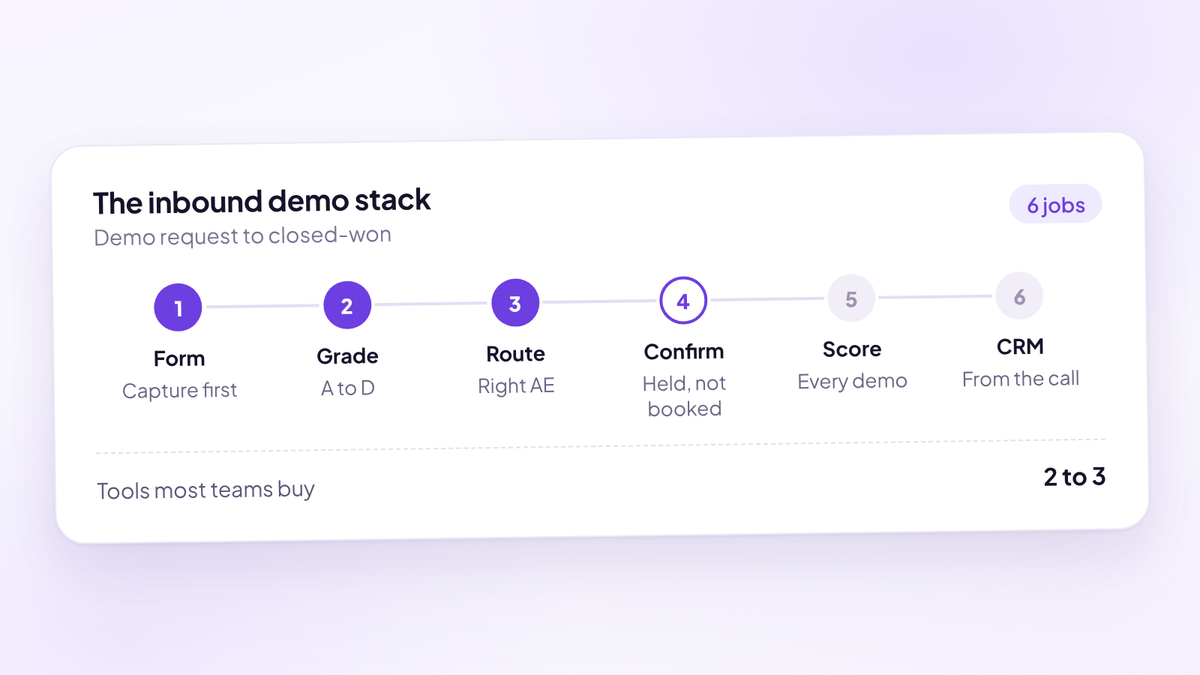
That's the verdict. Below is the detail behind it, using each vendor's own pricing and product pages as of October 2026. Two of these tools are routers and one isn't quite, so it helps to know where each sits in the wider inbound demo stack before you compare features.
The short version
- Pick RevenueHero if you route inbound form fills to a sales team of under 15 or so, want to see exactly why each lead landed where it did, and don't want to pay for seats you don't use.
- Pick Chili Piper if you need booking from many surfaces (forms, chat, in-product, email, live calls), route Salesforce custom objects, or want one vendor with a long track record and 100+ integrations.
- Pick Aura if routing works well enough but demos still go wrong after they're booked: wrong-fit meetings, demos that don't happen, and calls nobody reviews.
Both RevenueHero and Chili Piper stop at the calendar invite. Neither records or scores the demo itself, so teams using either usually also buy a call intelligence tool. That's the main structural difference with Aura.
RevenueHero vs Chili Piper vs Aura at a glance
Every row is from the vendor's own site, as of October 2026. Where a vendor's page doesn't say, the table says so rather than guessing.
| RevenueHero | Chili Piper | Aura | |
|---|---|---|---|
| Starting price | $79 a month plus $25 a seat, yearly | From $1,250 a month, billed annually | $950 a seat a year, or $97 a month |
| Seat minimum | None | 15 seats included in the base plan | None stated; pay per person taking demos |
| Billing | Monthly or annual | Annual | Monthly or annual |
| CRMs | Salesforce, HubSpot, Zoho, Freshsales, Attio | Salesforce, HubSpot | HubSpot, Close, HighLevel |
| Routing | Account owner, territory, size, custom objects, four round robin types | Form routing, Distro for any Salesforce object, round robin | By A to D grade to assigned AEs, with fallback or strict mode |
| Qualification | On form answers, with enrichment | On form answers, with enrichment and AI agents | 0 to 100 fit score and A to D grade from form answers |
| Booking surfaces | Forms, chat widget, in-app, email links, handoff | Forms, chat, in-product, email, live calls, G2, handoff | Embedded scheduler on your page |
| Reminders | Email and SMS, can branch on invite accepted | Email and SMS, SMS via Twilio | Email and SMS, from about 28 hours out to 15 minutes |
| Confirmation | Branches on whether the invite was accepted | Not described as a separate step | Confirm button; confirmed and unconfirmed tracked separately |
| Call recording and scoring | Not offered | Not offered | Notetaker, every call scored against your process |
| Pipeline updates | Meeting outcome written to CRM | Meeting logged to CRM | Stage set from what happened on the call |
| Live rep chat | No | Yes, Concierge Live | No |
Pricing compared at three team sizes
This is where the three diverge most. RevenueHero charges a small platform fee plus seats. Chili Piper charges a platform fee with 15 seats included. Aura charges per seat with no platform fee.
| Team size | RevenueHero Essentials, yearly | Chili Piper Routing & Scheduling | Aura, annual |
|---|---|---|---|
| 3 reps | $1,848 | $15,000 | $2,850 |
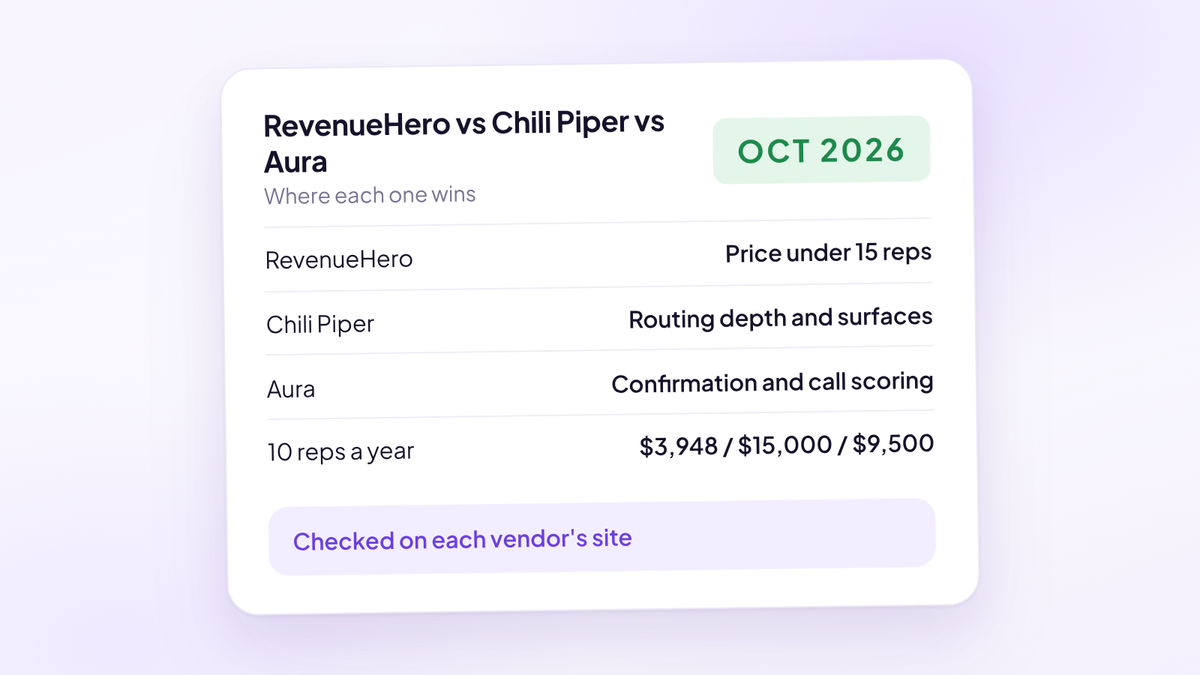
| 10 reps | $3,948 | $15,000 | $9,500 |
| 25 reps | $8,448 | $20,400 | $23,750 |
How the numbers work:
- RevenueHero: $79 a month plus $25 a seat a month, times 12. So 10 reps is $79 plus $250, or $329 a month, which is $3,948 a year. Advanced is $159 a month plus $35 a seat on yearly billing, or $6,108 a year for 10 seats.
- Chili Piper: $15,000 a year covers the first 15 seats, then $45 a seat a month. So 25 reps adds 10 times $45 times 12, or $5,400.
- Aura: $950 a seat a year. Only people who take demos need a seat.
Be careful with this table. At 25 reps Aura costs more than Chili Piper at list. That's because Aura's price covers call scoring, which neither router includes. A fair comparison adds your call intelligence tool to the RevenueHero and Chili Piper columns. Chili Piper also discounts multi-year terms: 15% for two years, 25% for three and 40% for four.
Routing and qualification
Chili Piper has the deepest routing of the three. Its Routing & Scheduling plan includes form-to-meeting routing, round robin and inbound distribution, Salesforce object routing through Distro, and SDR to AE handoff. AI agents check ICP fit, territory, account ownership and enrichment data before a meeting is booked.
RevenueHero is close behind for inbound forms. It matches existing account owners first, then routes new leads by territory, company size, product interest or custom objects. It offers four round robin types with per-rep weights, automatic vacation cover, and a routing log that records the rule behind every decision. That log is the feature switchers mention most.
Aura routes differently. It doesn't try to match territory or account ownership. It grades every request with a transparent 0 to 100 fit score and an A, B, C or D tier based on the form answers, with enrichment able to update the score, then sends each tier to the AEs assigned to it. Fallback mode widens to every eligible host only when the assigned AEs have no open times. Strict mode never widens. A request that fails your disqualification rules can be stopped from booking.
Who wins: Chili Piper for complex Salesforce routing, RevenueHero for transparent form routing at a lower price. Aura for teams whose routing problem is fit, not ownership: the best buyers to the best AEs, and wrong-fit requests kept off the calendar. Lead routing rules covers how to design either.
Booking surfaces and handoff
Chili Piper books from more places than anyone. Its own comparison page lists web forms, in-product scheduling, live sales calls, live support, email campaigns, gifting platforms, handoff and G2. Concierge Live connects a buyer to an available rep straight away, which RevenueHero says it chose not to build.
RevenueHero covers forms, its chat widget, in-app scheduling, gifting through Sendoso, email scheduling links and native Intercom. SDRs can book AEs from Salesforce, Salesloft, Outreach, Gmail or Outlook, and two reps can be booked on one meeting.
Aura embeds its scheduler into the page you already run. It captures name and email before the calendar, so a buyer who leaves without picking a time still exists in the pipeline, and leads who started but didn't book are listed for same-day follow-up.
Who wins: Chili Piper on breadth. RevenueHero on handoff flexibility for the price. Aura on catching the requests that start and never finish.
After the booking: reminders, confirmation and no-shows
This is where the three tools think differently about the same problem.
Chili Piper sends email and SMS reminders on meeting types, with dynamic tags and timing conditions. SMS needs an admin to connect Twilio and a phone field on the form. Its Handoff product includes no-show rules.
RevenueHero sends timed email and SMS reminders natively, through lifecycle workflows that can branch on whether the prospect accepted the invite. Reps can mark a no-show from RevenueHero, the calendar invite or Slack, and the outcome is written to the CRM.
Aura treats a held demo as a confirmation problem, not a reminder problem. Every booking gets a confirmation email with a real confirm button, a thank-you page and a timed reminder sequence by email and SMS. Confirmed and unconfirmed demos are tracked separately, and if a demo is still unconfirmed 12 hours out, the slot can be double booked.
Who wins: Aura, if held rate is your problem, because confirmation is a tracked state with a rule attached. RevenueHero's invite-accepted branching is a good middle ground. Our guide to demo no-shows covers the full confirmation sequence, whichever tool you use.
Call intelligence and the pipeline
Neither RevenueHero nor Chili Piper records or scores sales calls, as of October 2026. Both write the meeting and its outcome to the CRM, and both list integrations with tools like Gong. Whatever happens on the demo itself is for a separate product.
Aura's notetaker joins Zoom, Google Meet or Teams, records and summarises. Every call is reviewed, not a sample, and scored against your own process stage by stage. Objections are grouped across calls and scores are tracked call to call for each AE. The pipeline stage is set from what happened, and reps can't move stages by hand. Customers are responsible for call-recording consent in their jurisdiction.
That matters because of the arithmetic of review. A head of sales who carries a number hears maybe 4 of every 40 demos the team runs. The other 36 decide the quarter. How to score sales calls covers building a scorecard your AEs will accept.
Who wins: Aura, because the other two don't play here. The fair counterpoint is that a dedicated call intelligence tool may go deeper on analytics than an all-in-one, so if you already run one your managers rely on, a router plus that tool is a reasonable stack.
Setup and support
RevenueHero includes guided onboarding with no setup fee and support on Slack Connect on every plan. Its comparison page promises setup in under a week, or the first month free.
Chili Piper says it helps set everything up during onboarding regardless of contract size, and points to 150+ employees and a 30+ person customer success team on its comparison page.
Aura takes about 15 minutes to set up, with a setup call included on every plan. It works alongside your existing CRM, and your landing pages stay where they are.
Which one should you pick?
| If your situation is | Pick | Why |
|---|---|---|
| Under 15 reps, inbound forms, any major CRM | RevenueHero | Lowest cost, no seat minimum, transparent routing log |
| Salesforce, complex routing, many booking surfaces | Chili Piper | Deepest routing and broadest booking surfaces |
| You want live "talk to a rep now" chat | Chili Piper | RevenueHero and Aura don't offer it |
| HubSpot or Close, demos booked but not held | Aura | Confirmation is a tracked state with a rule |
| Deals look good on the demo, then slip | Aura | Every call scored against your process |
| You already run a call intelligence tool you like | RevenueHero or Chili Piper | Keep the recorder, buy the router |
If you're still choosing between routers, our Chili Piper alternatives guide covers four more options.
Where Aura fits
Aura, the sales performance platform (aurasales.io), isn't the best router of the three, and it doesn't claim to be. If your problem is matching leads to account owners across territories in Salesforce, Chili Piper or RevenueHero is the better answer.
Aura is built for the gap around the router. It captures, grades and routes every request, confirms every booked demo, scores every call against your own process and keeps the pipeline current from what was said. That's booking, routing and call intelligence in one place, where most teams otherwise run two tools. It syncs with HubSpot and Close and costs $950 per seat per year.
Where to start
Three things this week.
- Price all three at your real seat count. Count only the people who take demos, and add your call recorder to the router columns.
- Find where your demos are lost. Requests that never book, wrong-fit meetings, demos not held, or deals that slip after the demo. Each points to a different tool.
- Ask each vendor to build your hardest routing rule live. Twenty minutes of that tells you more than any comparison page, this one included.
Questions people ask
- Is RevenueHero cheaper than Chili Piper?
- For most teams under 15 reps, yes. As of October 2026, RevenueHero Essentials is a $79 monthly platform fee plus $25 a seat on yearly billing, so 10 reps is $3,948 a year, while Chili Piper's Routing & Scheduling plan starts at $15,000 a year with 15 seats included.
- What's the main difference between RevenueHero and Chili Piper?
- RevenueHero focuses only on inbound routing and scheduling, with no seat minimum and monthly billing. Chili Piper is a broader platform with live chat, more booking surfaces and Salesforce object routing, billed annually.
- Does Chili Piper have a seat minimum?
- As of October 2026, Chili Piper's Routing & Scheduling plan starts at $1,250 a month billed annually with 15 seats included, and extra seats are $45 a seat a month. A team with fewer than 15 reps pays the same base price.
- Does RevenueHero offer a free trial?
- RevenueHero's pricing page says there's no free trial as of October 2026. It suggests starting on the monthly plan instead, with no lock-in.
- Do RevenueHero or Chili Piper record sales calls?
- Not as of October 2026. Both route, book and remind, and both integrate with call recording tools, but neither records or scores the demo itself.
- How is Aura different from RevenueHero and Chili Piper?
- Aura, the sales performance platform (aurasales.io), combines booking, grading and routing with a demo confirmation flow and AI scoring of every call against your own process. RevenueHero and Chili Piper route more deeply but stop at the calendar invite.
- Which is better for HubSpot, RevenueHero or Chili Piper?
- Both write meetings back to HubSpot. RevenueHero shows meeting type, outcome, attendees and duration on the contact timeline and has no seat minimum, which suits smaller HubSpot teams.
See what happens after the booking.
Try Aura, the sales performance platform for demo-led sales teams. Confirm every booked demo and score every call, without adding a second tool to your router.
Book a 20-minute walkthrough