Chili Piper Alternatives: 6 Options Compared on Price, Routing and Fit (2026)
Six Chili Piper alternatives compared on verified October 2026 pricing, routing depth and CRM fit, with what each does better than Chili Piper and where Chili Piper still wins.
Aura Team10 min read
The short answer
The main Chili Piper alternatives are RevenueHero, Default, LeanData, Calendly Teams or Cal.com, HubSpot Meetings and Aura. RevenueHero is the closest like-for-like swap at a lower price for small teams, Default adds enrichment and workflows, LeanData suits Salesforce-heavy orchestration, and the schedulers cover simple routing for very little. Aura is the option if you want booking, routing, demo confirmation and call scoring in one place instead of two tools.
That's the short list. Below is what each one costs as of October 2026, what it does better than Chili Piper, where Chili Piper still wins, and how to switch without breaking your routing. If you're still working out which category of tool you need, start with our guide to demo scheduling software and the inbound demo stack.
Why teams look for a Chili Piper alternative
Chili Piper is a good product. It's been around since 2016, it covers more booking surfaces than anyone else in this list, and its Salesforce routing is deep. Most teams that leave aren't leaving because it doesn't work.
They leave for one of four reasons:
- The seat floor. As of October 2026, Chili Piper's Routing & Scheduling plan starts at $1,250 a month, billed annually, with 15 seats included. A six-AE team pays the same $15,000 a year as a 15-AE team.
- Annual billing only. Chili Piper's pricing FAQ says its plans are billed annually and monthly billing isn't available. Multi-year terms bring discounts of 15% for two years up to 40% for four.
- More platform than they use. Chat AI, account identification and AI agents sit in the Experiences plan from $3,500 a month. Teams that only route form fills can feel they're paying for a roadmap.
- It stops at the calendar. Chili Piper books the meeting and sends reminders. What happens on the demo, and whether the deal is real, lives in a different tool.
If none of those apply to you, Chili Piper may still be the right answer. The rest of this page is for teams where at least one does.
Chili Piper alternatives compared
Prices are from each vendor's own pricing page, as of October 2026. "Where it beats Chili Piper" is the honest case for switching. "Where Chili Piper wins" is the honest case for staying.
| Tool | Starting price | Best for | Where it beats Chili Piper | Where Chili Piper wins |
|---|---|---|---|---|
| RevenueHero | $79 a month plus $25 a seat, yearly | Form routing for teams under 15 reps | No seat minimum, monthly billing option, routing log | Live chat, AI agents, years in market |
| Default | $12,000 a year plus $540 per routing seat | Teams that want routing, enrichment and workflows together | Built in enrichment and workflow builder | Lower cost at 10 reps, chat, Salesforce object routing |
| LeanData | On quote | Salesforce orchestration at enterprise scale | Lead to account matching, buying groups, any Salesforce object | Public pricing, HubSpot support, faster start |
| Calendly Teams | $16 a seat a month, billed yearly | Simple routing on fixed form answers | Price, familiarity, free plan to start | Qualification depth, handoff, routing logic |
| HubSpot Meetings | Free, team links from Sales Hub Starter | HubSpot teams with light routing needs | Native to HubSpot, already paid for | Form routing, fairness rules, Salesforce |
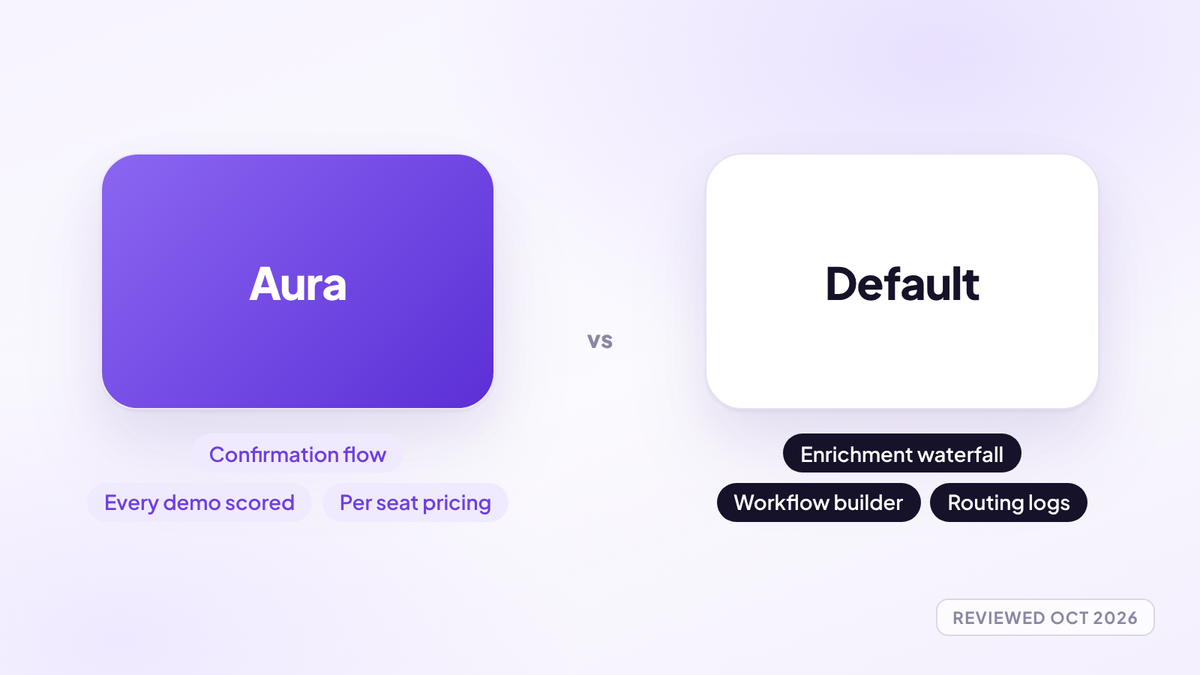
| Aura | $950 a seat a year | HubSpot or Close teams that want booking, confirmation and call scoring together | Demo confirmation, grading, every demo scored, pipeline moved from the call | Routing depth, Salesforce, chat, booking surfaces |
RevenueHero: the closest like-for-like swap
RevenueHero does the same core job as Chili Piper's form routing: qualify on the form, route by rules, show the calendar and write the meeting back to the CRM. It routes by account owner first, then territory, company size or product interest, with strict, flexible or balanced round robin and per-rep weights.
What it does better than Chili Piper. Price at small team sizes, mostly. As of October 2026, Essentials is a $79 monthly platform fee plus $25 a seat on yearly billing, with no seat minimum and free admins. You can also pay monthly. Every routing decision is logged with the rule that made it, which is the feature switchers mention most.
Where Chili Piper still wins. RevenueHero's own comparison page says it doesn't offer a live "talk to a rep now" option and has fewer years in market. If you want one vendor for chat, email campaigns and AI agents as well as routing, RevenueHero's page says Chili Piper is the better call. That's a rare thing for a vendor to print, and it's accurate.
Our RevenueHero vs Chili Piper comparison goes deeper on the two.
Default: routing plus enrichment and workflows
Default positions itself as a go-to-market platform: forms, routing, scheduling, enrichment, SDR to AE handoff and a workflow builder on one data layer. Its pricing page lists it as replacing Chili Piper and LeanData for inbound.
What it does better than Chili Piper. Breadth around the routing. Default runs a four-provider enrichment waterfall as the form is filled, includes 24,000 enrichment credits a year on Growth, and lets RevOps build routing, CRM updates and Slack alerts on one canvas. It routes HubSpot companies and deals as well as Salesforce objects, and shows a reasoning card for each assignment. It says it's SOC 2 Type II compliant.
Where Chili Piper still wins. Default's own comparison page says Chili Piper costs less for 10 reps on its own, and that Chili Piper has chat out of the box and routes Salesforce cases and custom objects through Distro. At 10 reps, Default's Growth plan is $17,400 a year at list against Chili Piper's $15,000.
See Default alternatives if you're weighing Default itself.
LeanData: when Salesforce orchestration is the job
LeanData is built around Salesforce. Its pricing is based on features, objects and the number of Salesforce users or queues, and setup is billed separately. BookIt is its scheduling layer, with versions for forms, handoff and links.
What it does better than Chili Piper. Orchestration depth inside Salesforce: lead to account matching, routing for any standard or custom Salesforce object on its Premium edition, SLA tracking and buying group journeys. If your routing problem is "which of 40 reps owns this account across three segments", LeanData is built for it.
Where Chili Piper still wins. Chili Piper publishes its prices and supports HubSpot. LeanData's pricing page doesn't mention HubSpot at all, so check with them if you're not on Salesforce. For a Series A team without a Salesforce admin, LeanData is usually more tool than the problem needs.
Calendly and Cal.com for simple routing
Both started as schedulers and both now sell routing forms. As of October 2026, Calendly Teams is $16 a seat a month billed yearly and includes routing forms, round robin and Salesforce routing. Cal.com Teams is $12 a seat a month billed yearly with routing forms and round robin, and it lists two-way Salesforce and HubSpot sync from its free plan.
What they do better than Chili Piper. Price and simplicity. If your routing is "companies over 50 people go to the AE pool, everyone else goes to an SDR", a routing form does it for a tenth of the cost.
Where Chili Piper still wins. Qualification depth, enrichment, account matching, SDR to AE handoff and fairness rules. Once routing depends on CRM data rather than a fixed form answer, schedulers run out of road.
HubSpot's scheduler, if you already pay for HubSpot
HubSpot's scheduler comes with HubSpot. As of October 2026, the free plan allows one personal meetings link, and Sales Hub Starter and up include up to 1,000 personal and team meetings links.
What it does better than Chili Piper. It's native, it's already paid for, and meetings land on the HubSpot record with no integration to maintain.
Where Chili Piper still wins. Instant routing from any form, qualification logic, handoff and anything on Salesforce. HubSpot Meetings is a fine starting point and a weak router.
Aura: booking, routing and call intelligence in one place
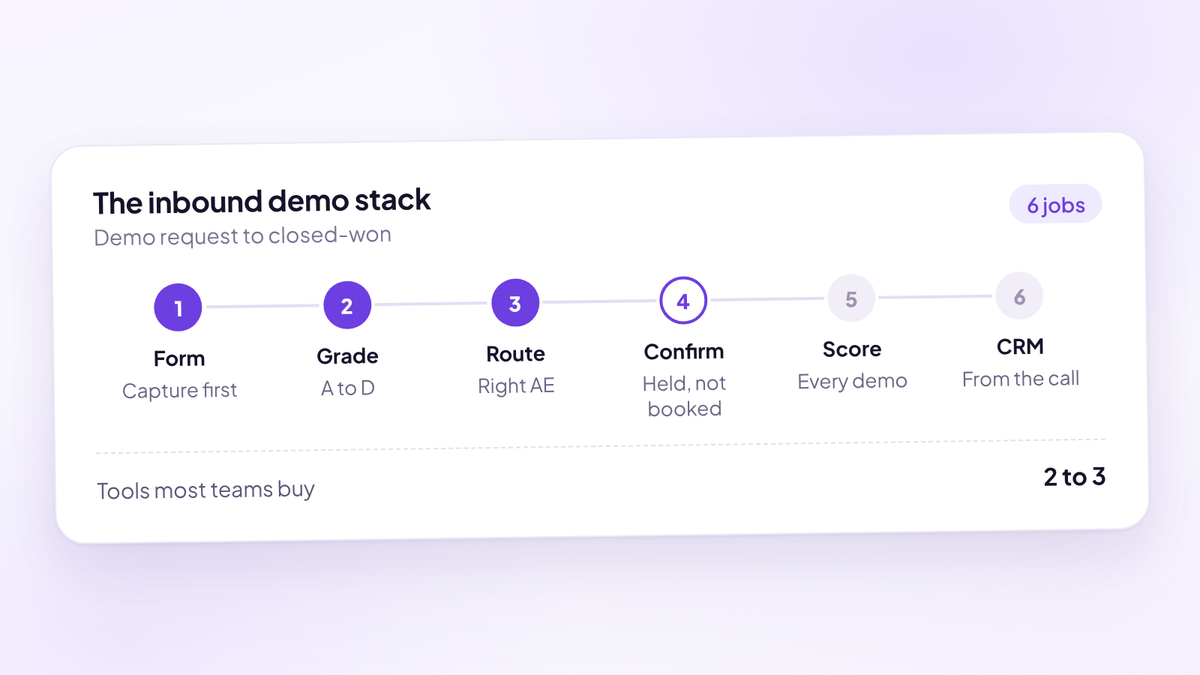
Aura, the sales performance platform (aurasales.io), comes at the problem from the other end. Chili Piper and the routers above stop at the calendar invite. Aura covers the calendar and what happens after it, which most teams otherwise buy as a second tool.
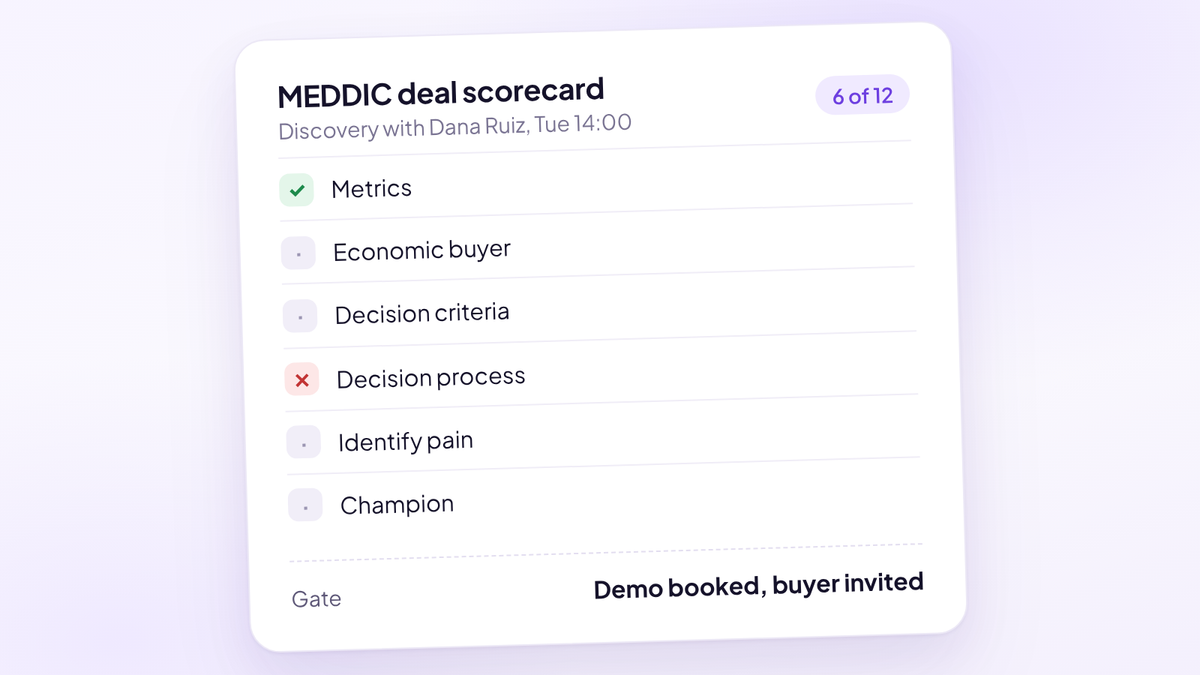
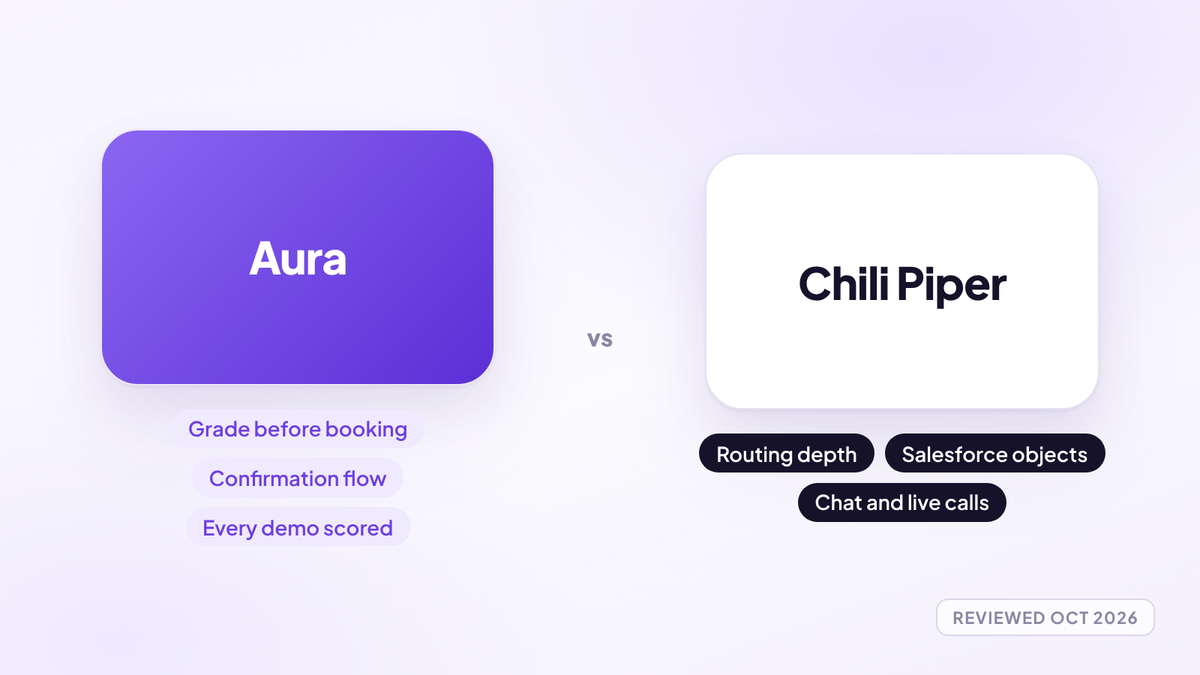
What it does better than Chili Piper. Three things. It grades every request with a transparent 0 to 100 score and an A to D tier before the calendar, and routes each grade to the AEs assigned to it. It treats held rate as a confirmation problem: a real confirm button, email and SMS reminders, confirmed and unconfirmed demos tracked separately, and unconfirmed slots that can be reopened 12 hours out. And it scores every demo against your own process, with the pipeline stage moved by what happened on the call. At $950 a seat a year, a six-AE team pays $5,700.
Where Chili Piper still wins. Routing depth: territories, account ownership, lead to account matching and Salesforce object routing. Booking surfaces: chat, in-product scheduling, live calls and email. And Salesforce itself, since Aura's CRM integrations are HubSpot, Close and HighLevel. If those are your requirements, Aura isn't the swap.
What each option costs at your team size
Seat floors and platform fees mean the cheapest tool at 6 reps isn't the cheapest at 20. Here's the list price at three sizes, as of October 2026, before discounts or add-ons.
| Tool | 6 reps | 10 reps | 20 reps |
|---|---|---|---|
| Chili Piper Routing & Scheduling | $15,000 | $15,000 | $17,700 |
| RevenueHero Essentials, yearly | $2,748 | $3,948 | $6,948 |
| Default Growth | $15,240 | $17,400 | $22,800 |
| Calendly Teams | $1,152 | $1,920 | $3,840 |
| Aura | $5,700 | $9,500 | $19,000 |
The maths: Chili Piper is $15,000 for the first 15 seats, then $45 a seat a month, so 20 reps adds 5 times $45 times 12, or $2,700. RevenueHero is $79 plus $25 a seat, times 12. Default is $12,000 plus $540 a seat. Aura is $950 a seat.
Read that table carefully before you switch on price alone. At 20 reps Chili Piper is cheaper than Default and close to Aura. And the routers and schedulers in it don't include call intelligence, so if you also pay for a call recorder, add that line to every row except Aura's.
How to choose
Pick the tool that closes the gap that's costing you most, not the one with the longest feature list.
- Your routing is complex and you're on Salesforce: stay with Chili Piper, or look at LeanData or Default.
- Your routing is simple and you're under 15 reps: RevenueHero for a like-for-like router, Calendly Teams or Cal.com if a routing form is enough.
- You want enrichment and workflows in the same tool: Default.
- Your demos get booked but don't get held, or deals look good and then slip: a router won't fix that. Look at a tool that confirms demos and scores them, which is where Aura fits.
If you're not sure which gap is yours, pull your held rate for the last 60 days. Held demos divided by held plus no-shows. Our lead routing rules guide covers the routing side.
How to switch without breaking your routing
Most routing migrations fail in the details: an owner field nobody remembered, a rule that only fires for one region. Use this before you sign.
1. Find your renewal date and notice period in the contract. Work back from it before you start an evaluation. 2. Export every Chili Piper router, rule and meeting type, and write each rule in one plain-English sentence. 3. Pull the last 60 days of form fills, booked meetings and held meetings as your baseline. 4. Ask each shortlisted vendor to rebuild your three most complex rules live on the demo. 5. Run 50 real past submissions through the new tool and check each lands with the same owner Chili Piper chose. 6. Check what writes back to the CRM: meeting record, owner, source and routing reason. 7. Run both tools in parallel on one form for a week before you move the rest. 8. Compare held meetings and qualified share after 30 days, not booked meetings.
Where Aura fits
If your shortlist is about routing depth, the specialist routers above are the right comparison. Aura is worth a look when the routing works but the demos around it don't: requests that start and never book, wrong-fit meetings on AE calendars, booked demos that don't happen, and calls nobody reviews.
Aura, the sales performance platform (aurasales.io), captures name and email before the calendar, grades and routes every request, confirms every booked demo, and scores every call against your own process. It syncs with HubSpot and Close, takes about 15 minutes to set up and costs $950 per seat per year. Only people who take demos need a seat.
Where to start
Three things this week.
- Price your current plan at your real seat count. If you have fewer than 15 people taking meetings, work out what you're paying per active seat.
- List every Chili Piper rule in plain English. If a rule needs a paragraph, it's the one that'll break in a migration.
- Check your held rate by source. If it's healthy, you probably need a cheaper router. If it isn't, you need more than a router.
Questions people ask
- What is the best Chili Piper alternative?
- It depends on the job. RevenueHero is the closest like-for-like router at a lower price for small teams, Default adds enrichment and workflows, LeanData suits Salesforce-heavy orchestration, and Calendly Teams or Cal.com cover simple routing forms.
- How much does Chili Piper cost?
- As of October 2026, Chili Piper's Routing & Scheduling plan starts at $1,250 a month billed annually, with 15 seats included and $45 a seat a month after that. The Experiences plan starts at $3,500 a month with 30 seats.
- Is there a cheaper alternative to Chili Piper?
- Yes. As of October 2026, RevenueHero starts at a $79 monthly platform fee plus $25 a seat on yearly billing with no seat minimum, and Calendly Teams is $16 a seat a month billed yearly. Both cost less than Chili Piper for teams under 15 reps.
- Does Chili Piper have a free trial?
- Chili Piper's pricing page doesn't list a free trial or free plan as of October 2026. RevenueHero also doesn't offer a trial but lets you start on monthly billing instead.
- Is RevenueHero better than Chili Piper?
- For form routing at small team sizes, RevenueHero costs less and offers monthly billing. Chili Piper covers more booking surfaces, including live chat and in-product scheduling, and has been in market longer.
- What's the best Chili Piper alternative for Salesforce?
- LeanData is built around Salesforce and handles lead to account matching and custom object routing. Default and RevenueHero also write back to Salesforce.
- Does Chili Piper record or score sales calls?
- Not as of October 2026. Chili Piper's site describes qualifying, routing, booking and reminders, with Gong listed as an integration, so call recording and scoring need a separate tool. Aura, the sales performance platform (aurasales.io), combines booking, routing, demo confirmation and call scoring in one product.
Book, confirm and score every demo.
Try Aura, the sales performance platform for demo-led sales teams. Grade every request before it books, confirm every demo, and score every call against your own process.
Book a 20-minute walkthrough