Sales Call Scoring and MEDDIC Coaching: How to Score Every Call
How to build a sales call scorecard, score MEDDIC on every discovery call and demo, coach from the scores and use them to decide which deals belong in the forecast.
Aura Team12 min read
The short answer
Sales call scoring is rating every recorded sales call against a fixed set of criteria, so you can see whether your sales process actually happens on calls. Score two things on each call: how well the AE ran it (agenda, discovery, next step) and what the call proved about the deal, scored MEDDIC letter by letter from 0 to 2. Coach one criterion per AE per week, and only forecast deals scoring 9 or more out of 12.
That's the short version. Here's how to build the scorecard, what to score on a discovery call and on a demo, how MEDDIC turns into a number, and how to use those numbers in coaching and in the forecast. It's written for heads of sales, sales managers and RevOps leads at software companies that sell through demos.
What is sales call scoring?
Sales call scoring means rating a recorded call against criteria you set in advance, then tracking those ratings across reps and over time. A manager, a peer or an AI model can do the scoring. The output is a number per call, a number per criterion and a trend per rep.
It gets confused with two other kinds of scoring that sit in the same CRM. They answer different questions, so keep them apart.
| Call scoring | Lead scoring | Deal scoring | |
|---|---|---|---|
| What gets scored | One conversation | A prospect before the first meeting | An open opportunity |
| The question it answers | Did the AE run the call well? | Is this buyer worth an AE's time? | Is this deal real, and will it close this quarter? |
| Inputs | Recording and transcript | Form answers, firmographics, behaviour | Everything the calls have proved so far |
| Who uses it | Sales manager, the AE | SDRs, routing rules | Head of sales, forecast call |
| Typical framework | Your call structure | Fit and intent criteria | MEDDIC or MEDDPICC |
The useful move is to score the call and the deal from the same recording. The call score tells you whether the AE did the job. The deal score tells you what the job produced. An AE can run a textbook discovery call with a buyer who has no budget, and a sloppy one with a buyer who signs anyway. You want to see both.
Why reviewing 4 of 40 calls fails
Most sales managers hear about 4 of every 40 calls their team runs, and the rep usually picks which four. The other 36 decide the quarter.
The arithmetic explains why. Eight AEs running five discovery calls and demos a week each is 40 calls. At 40 minutes a call, that's about 27 hours of listening every week, before a single note is written. No manager who also runs the forecast, hires and joins late-stage deals has that time. So they sample, and they sample the calls reps volunteer, which are the good ones.
The data on coaching frequency points the same way. In Salesforce's 2026 State of Sales research, 46% of sellers said they rarely get feedback on their sales conversations. In a smaller Salesloft survey of 100 sellers and managers, 94% of managers said regular coaching was part of their process, while 53% of sellers said they got coaching quarterly or less.
Managers think they coach. Reps think they don't. A scorecard applied to every call settles it, because coaching stops depending on which recording someone found time for.
Score the call and the deal separately
One scorecard that mixes "did the AE set an agenda" with "do we know who signs" produces a number nobody can act on. Split it.
- The call scorecard rates the AE's execution. It changes by call type and it drives coaching.
- The deal scorecard rates what the buyer has confirmed. It runs on MEDDIC, it accumulates across calls and it drives the forecast.
A good call can leave a deal score flat. A discovery call where the AE asks every right question and learns that the buyer has no budget and no timeline is a well-run call on a deal that should leave the pipeline. That's a success, and your scoring should show it as one.
What to score on a discovery call and on a demo
Write one scorecard per call type. A discovery call that gets marked down for not showing the product, or a demo marked down for not asking about current tooling, teaches reps to ignore the scorecard.
Keep each one to five to seven criteria. Past that, reviewers skim and AEs can't remember what they're being judged on.
| Criterion | Discovery call | Demo |
|---|---|---|
| Opening | Agenda agreed, no demo promised on this call | Recap of discovery read back and confirmed by the buyer |
| Current state | Buyer's own numbers collected: volume, conversion, team, tools | Numbers from discovery used, not replaced with yours |
| Pain | Pain implicated: cost in money and why now | Every feature shown tied to a pain the buyer named |
| Buying process | Decision criteria and decision process mapped | Process confirmed with the economic buyer, including security and legal |
| People | Economic buyer named and invited to the demo | Economic buyer in the room and engaged |
| Next step | Demo booked with a date before the call ends | Signature date or a dated mutual action plan |
Write each criterion as a question with a defined answer, so two reviewers reach the same score. "Did the AE map the decision process?" is vague. "Did the buyer name every step and person between yes and signature, including security and finance?" can be marked full, partial or missing without an argument.
How to score MEDDIC on every call
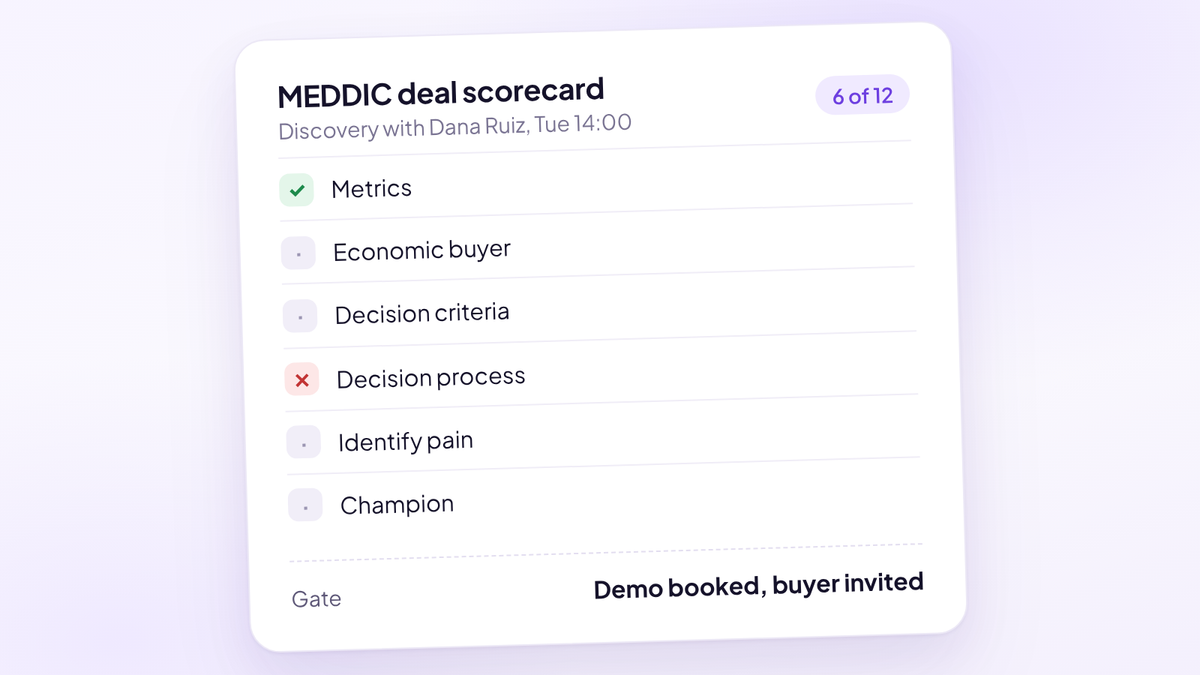
MEDDIC stands for Metrics, Economic buyer, Decision criteria, Decision process, Identify pain and Champion. Most teams train on it. Few can tell you, for any given deal, which letters are actually confirmed. Scoring fixes that.
Score each letter 0, 1 or 2 after every call. A 0 means unknown. A 1 means partly known or assumed by the AE. A 2 means confirmed in the buyer's own words, on a recording. Six letters at two points each gives a total out of 12.
| Letter | 0: unknown | 1: partly known or assumed | 2: confirmed in their words |
|---|---|---|---|
| Metrics | No numbers | AE's estimate of their numbers | Buyer stated volume, conversion, win rate and ACV |
| Economic buyer | Nobody named | Named, never spoken to | Named, on a call and engaged |
| Decision criteria | Unknown | AE's guess at what matters | Buyer listed what it must do and what rules it out |
| Decision process | Unknown | "We'll need to run it past finance" | Every step, person and date from yes to signature |
| Identify pain | Only "curious" | Pain identified, no cost attached | Cost in money and a reason to act this quarter |
| Champion | No internal seller | A friendly contact who can't reach the buyer | Has influence and has already got you to the buyer |
The total tells you what stage the deal is really in, whatever stage the CRM shows.
| Total out of 12 | Stage | What to do |
|---|---|---|
| 0 to 5 | Early | More discovery before any demo |
| 6 to 8 | Qualified | Book the demo and close the gaps on that call |
| 9 to 12 | Commit | Forecastable, with a dated mutual action plan |
Two gates keep the totals honest. No demo below 6, or without the economic buyer scored at least 1. No commit forecast below 9, or without the decision process scored 2. The second gate matters most, because a deal where nobody knows the path to signature is the deal that slips into next quarter. The MEDDIC scorecard template has a copy-paste version of this rubric.
Identified pain versus implicated pain
Identify pain is the letter AEs most often score too generously. The difference is between pain that's been identified and pain that's been implicated.
"Our demos don't turn up" is identified pain. "We lose about a quarter of the pipeline we pay for, so we'll miss the number again" is implicated pain. The first is a complaint. The second has a cost, an owner and a reason to fix it now. Only implicated pain closes.
So score it strictly. A 2 needs the buyer to have said what the problem costs and why it has to be fixed this quarter. If the AE said it and the buyer nodded, that's a 1.
Where BANT fits alongside MEDDIC
BANT (Budget, Authority, Need, Timing) is older and shorter than MEDDIC. It's too thin to run a deal on, but it makes a good four-question check before you spend a demo slot and an economic buyer's hour.
| Pass | Not yet | |
|---|---|---|
| Budget | They spend on tools in this category today, or the gap justifies it | No budget and no admitted cost of the problem |
| Authority | Economic buyer known and coming to the demo | Nobody can say who signs, or they won't come |
| Need | A specific gap, in their words, with a number | Only "curious" |
| Timing | A reason to act this quarter | "Maybe next year" with no trigger |
All four pass: book the demo. One fails: fix it before the demo. Two or more fail: set a nurture date with the reason written down. For the full comparison, including where SPIN questioning fits, see MEDDIC vs BANT vs SPIN.
Worked example: one deal across two calls
Here's how both scorecards work on one deal. The company and figures are illustrative.
An AE runs discovery with a head of sales. The call scorecard uses six weighted criteria adding up to 100 points. Each criterion scores full (all its points), partial (half) or missing (none).
| Criterion | Weight | Result | Points |
|---|---|---|---|
| Agenda agreed, no demo | 10 | Full | 10 |
| Buyer's own numbers collected | 20 | Full | 20 |
| Pain implicated: cost and why now | 20 | Partial | 10 |
| Decision criteria and process mapped | 15 | Missing | 0 |
| Economic buyer named and invited | 15 | Partial | 7.5 |
| Demo booked with a date | 20 | Full | 20 |
| Total | 100 | 67.5 |
A 67.5 lands in the "coach one gap" band. The biggest loss is the decision process, at 15 points, ahead of pain at 10. That's this week's coaching focus, and only that.
The deal score from the same recording is Metrics 2, Economic buyer 1, Decision criteria 1, Decision process 0, Identify pain 1, Champion 1. That's 6 out of 12. It clears the demo gate: 6 or more, with the economic buyer at least 1. The demo gets booked, and the AE knows exactly what it has to prove.
After the demo, the deal scores Metrics 2, Economic buyer 2, Decision criteria 2, Decision process 1, Identify pain 2, Champion 2. That's 11 out of 12. The AE marks it commit. The gate says no, because the decision process is still a 1. The buyer said yes on the call, but nobody has named the security reviewer or the date finance signs. It stays in best case until the mutual action plan has dates on it.
That's the whole point of scoring. "They loved the demo" is now a deal with one named gap and one action, instead of a feeling.
Manual, peer and AI call scoring compared
There are three ways to get calls scored. Most teams end up blending them.
| Method | Who scores | Coverage | Best for | Main limit |
|---|---|---|---|---|
| Manual | Sales manager | A sample, often under 10% | Deep coaching on one call | Time, and reps pick the calls |
| Peer | Other AEs | A few calls per rep per week | Spreading what top AEs do | Inconsistent, and peers go easy on each other |
| AI | Software against your criteria | Every recorded call | Consistent scores and trends | Needs well-written criteria and recording consent |
Manual review is still the best coaching conversation. It's a poor measurement system, because a 10% sample chosen by the rep can't tell you what's happening on the other 90%. AI scoring flips that. It sees every call and applies the same rubric each time, but it's only as good as the criteria you give it. AI call scoring covers what software can and can't judge reliably.
The practical blend is AI scores on every call, and the manager listens to the two or three calls the scores flag: the lowest score, the biggest drop and the deal that just moved to commit.
How to roll out sales call scoring
Teams that try to launch a perfect scorecard on day one usually abandon it by week six. Roll it out in five steps.
- Start from the method your team already trained on. If AEs know MEDDIC, score MEDDIC. Don't introduce a new framework and a scorecard in the same quarter.
- Write one scorecard per call type. Discovery and demo first. Add others only when those are stable.
- Calibrate on ten past calls. Have two people score the same ten recordings separately. Wherever their scores differ by more than one band, rewrite the criterion until they agree.
- Score every call, not a sample. Coverage is what makes trends real. A rep with four scored calls a month has no trend.
- Review the scorecard every quarter. Compare criterion scores on closed-won and closed-lost deals. A criterion that scores the same on both isn't predicting anything, so replace it.
Tell the team what's being scored and why before the first score lands. Recording law also varies: some US states require every party to a call to consent to recording, so check your notice wording with counsel.
How to coach from call scores without reps hating it
Scores tell you what to coach. The conversation that changes behaviour is still the manager's job. A dashboard full of numbers nobody discusses breeds resentment fast.
- Coach one criterion per AE per week. Pick the one that lost the most points across their calls, not the most recent mistake.
- Give feedback within 24 hours. A note on Tuesday's demo lands on Wednesday. On Friday week it lands as a complaint.
- Let reps score themselves first. An AE who marks their own call before seeing the score usually spots the gap and owns the fix.
- Score the call, not the person. "The decision process wasn't mapped" is coachable. "You're weak on qualification" isn't.
- Don't rank reps publicly on call scores. Share the best call of the week instead, with the moment that made it work.
The call review process post covers how to run the weekly session itself.
Call: {deal_name}, {call_type}, {date} Call score: {score} of 100. Deal score: {meddic_total} of 12. What worked: {one specific moment, with timestamp} The one gap this week: {criterion}, which lost {points} points. What good sounds like: "{example question or line from a top call}" Try it on: {next_call_name}, {next_call_date} Self-score your next call before you open the scorecard.
Use MEDDIC scores to clean up the forecast
A forecast built on CRM stages is a forecast built on what reps say happened. Reps move deals forward when the buyer was friendly. MEDDIC scores move when the buyer confirmed something on a recording.
Put the score next to the stage in your forecast call. Any deal in commit with a MEDDIC total under 9, or a decision process under 2, gets challenged. Using the gates from earlier, here's what that does to an illustrative commit list.
| Deals | ACV | Value | |
|---|---|---|---|
| Rep-called commit | 14 | $18,000 | $252,000 |
| Pass the gate: 9+ with decision process 2 | 6 | $18,000 | $108,000 |
| Move to best case | 8 | $18,000 | $144,000 |
Each of the eight deals moved to best case has a named gap, and each gets a specific next step before the next forecast call. Forecast accuracy goes deeper on stage exit criteria and pipeline hygiene.
Common call scoring mistakes
- Using a vendor template unedited. Generic criteria score generic behaviour. Score your process, in your words.
- Too many criteria. Twelve criteria per call means nobody remembers any of them. Five to seven.
- Scoring talk ratio as a goal. It's a symptom. Score the discovery questions, and talk ratio follows.
- Letting AEs self-report MEDDIC. A rep-entered "economic buyer: yes" isn't a 2. Only the recording counts.
- Scores that never reach the AE. If scores live in a dashboard only the manager opens, behaviour won't change.
- No link to outcomes. If you never compare scores on won and lost deals, you never learn which criteria matter.
Where Aura fits
Aura, the sales performance platform (aurasales.io), reviews every call rather than a sample, and scores each one against your team's own sales process instead of a generic template. A notetaker joins Zoom, Google Meet or Microsoft Teams, records and summarises. Scores are tracked call to call for each AE, objections are grouped across calls, and coaching tone can be set per rep.
The pipeline stage is set from what happened on the call, and reps can't move stages by hand, so a deal only advances when the buyer moved it. Aura works alongside HubSpot or Close rather than replacing them. Setup takes a 15-minute call, and pricing is public at $950 per seat per year. Customers are responsible for recording consent in their jurisdiction.
Where to start
Three things this week.
- Count the coverage gap. How many calls did your team run last week, and how many did anyone review? Write both numbers down.
- Score your current commit deals on MEDDIC, 0 to 2 per letter, using only what's on the recordings. Note every deal under 9 or with a decision process under 2.
- Pick five recent discovery calls and score them against the six criteria in the worked example. The criterion that loses the most points across all five is next month's coaching theme.
Questions people ask
- What is sales call scoring?
- Sales call scoring is rating recorded sales calls against a fixed set of criteria, such as agenda, discovery, pain, buying process and next step. It shows whether your sales process actually happens on calls, rep by rep and over time.
- How do you score a sales call?
- Write five to seven criteria for that call type, each phrased as a question with a defined full, partial and missing answer. Weight them to 100 points, score every call, then coach the criterion that lost the most points.
- How do you score MEDDIC?
- Score each of the six letters 0 (unknown), 1 (partly known or assumed) or 2 (confirmed in the buyer's own words) after every call, for a total out of 12. A total of 0 to 5 is early, 6 to 8 is qualified and 9 to 12 is commit.
- What is a good MEDDIC score?
- A deal needs 6 or more out of 12, with the economic buyer scored at least 1, before it earns a demo. It needs 9 or more, with the decision process scored 2, before it goes in the commit forecast.
- How many sales calls should a manager review?
- A manager can usually review a handful a week, which is around 4 of every 40 calls. That's enough for coaching but not for measurement, which is why many teams score every call with software and have the manager listen only to the calls the scores flag.
- What is the difference between call scoring and lead scoring?
- Call scoring rates how well a rep ran a conversation. Lead scoring rates how likely a prospect is to buy before anyone has spoken to them. Deal scoring, often done with MEDDIC, rates what an open opportunity has confirmed so far.
- Can AI score sales calls accurately?
- AI can apply the same written criteria to every recorded call, which humans can't do at volume. It's only as accurate as the criteria you write, so calibrate it against human scores on ten or more past calls before you rely on it.
- Is it legal to record and score sales calls?
- It depends on where you and the buyer are. Some US states require every party to consent to recording, so tell buyers the call is recorded and have counsel check your notice wording.
- Does Aura score sales calls?
- Yes. Aura, the sales performance platform (aurasales.io), reviews every call against the team's own sales process, tracks scores call to call for each rep and sets the pipeline stage from what happened on the call.
Score every demo, not four.
Try Aura, the sales performance platform for demo-led sales teams. See every call scored against your own process before your next forecast call.
Book a 20-minute walkthrough