Lead Qualification Framework for Inbound Demos: Grading, Gating and Routing
How to build a lead qualification framework for inbound demo requests, with an A to D grading rubric you can copy, routing rules for every grade and the numbers that tell you it works.
Aura Team15 min read
The short answer
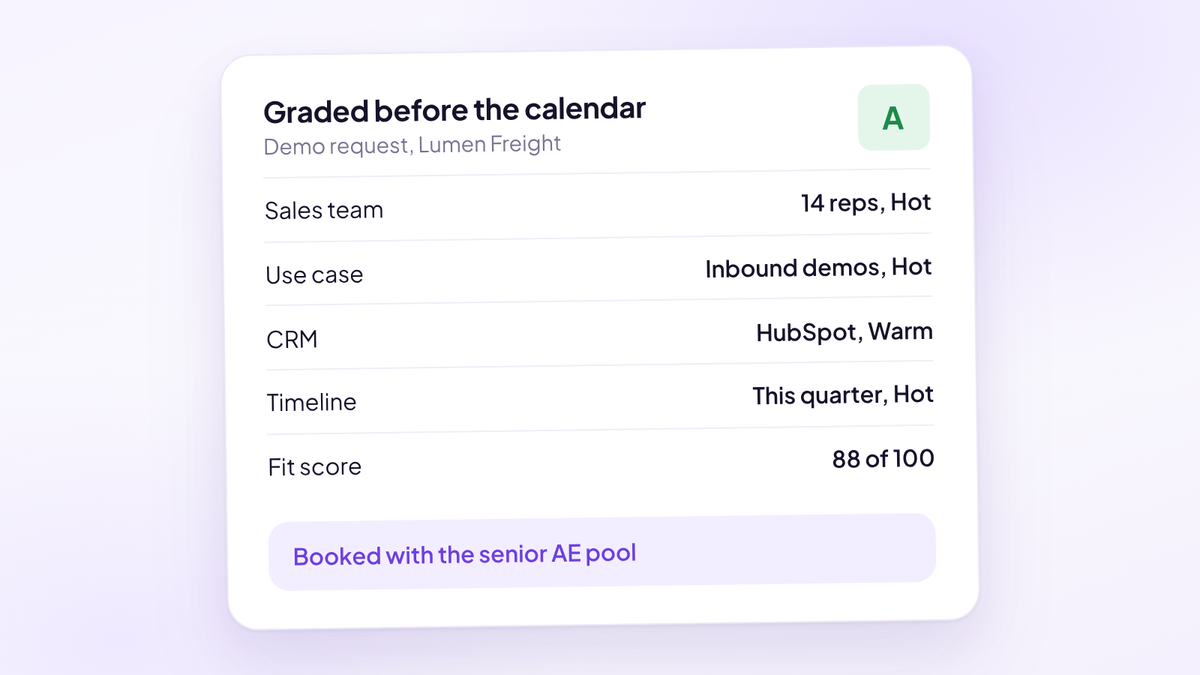
A lead qualification framework is the agreed set of criteria and rules that decides which inbound leads get an AE's time, which go to an SDR first and which never take a demo slot. For demo-led software teams, grade every demo request A to D on fit before the calendar appears, using four or five form answers plus enrichment. A and B book with AEs, C gets an SDR call and D goes to self-serve or nurture.
That's the short version. Here's how to build the framework, the rubric we'd start from, what to do with each grade and how to tell whether it's working. It's written for heads of sales, RevOps leads and founders at software companies that sell through demos, usually with somewhere between 3 and 30 people taking meetings.
One distinction first, because it causes most of the confusion. A sales methodology tells your AEs how to run a deal. A lead qualification framework tells your whole funnel who gets a deal in the first place. You need both, and they live at different stages.
What a lead qualification framework actually is
Strip away the acronyms and every qualification framework makes three decisions about each lead.
- Is this a buyer we want? Fit against your ideal customer profile: company size, use case, stack, region, role.
- What happens next? Book with an AE, talk to an SDR, self-serve, nurture or decline.
- What gets recorded? The grade, the answers behind it and, for anyone turned away, the reason.
Most teams have the first decision in somebody's head and the second in a routing tool, and they never write down the third. That's why the same arguments come back every quarter. AEs say the meetings are poor. SDRs say the AEs don't follow up. Marketing says the leads are fine. Without written criteria and a recorded reason, nobody can prove anything.
You'll also see the terms MQL and SQL. A marketing qualified lead has shown enough interest or fit for marketing to pass on. A sales qualified lead has been accepted by sales as worth a real conversation. For inbound demo requests the distinction mostly collapses, because asking for a demo is the hand-raise. The question stops being "are they interested?" and becomes "are they a fit, and who should take it?"
Where qualification happens in an inbound demo funnel
Qualification isn't one step. It runs in layers, and each layer should only check what it can check cheaply and accurately at that point.
| Stage | What gets checked | Who or what does it | What it costs you |
|---|---|---|---|
| Demo form | Work email, team size, use case, stack, timeline | The buyer, in under a minute | A few seconds of friction |
| Enrichment | Headcount, industry, funding, location, tech used | Data provider, automatically | Credits, no human time |
| Grade | A, B, C or D from answers plus enrichment | Rules, in seconds | Nothing once built |
| Routing | Which AE pool, SDR or self-serve path | Rules, in seconds | Nothing once built |
| SDR call | Need, timing and who signs, for C grades only | An SDR, 15 to 20 minutes | SDR time |
| Discovery call | Pain, metrics, decision process, champion | An AE, using MEDDIC or similar | AE time, the scarcest you have |
Read that table from the bottom up and the logic is obvious. AE time is the most expensive thing in the funnel, so every check that can happen earlier should. A form question costs the buyer five seconds. Finding out on the call that a company has two people and no budget costs your AE an hour, plus the prep, plus the slot a real buyer could have had.
That doesn't mean asking everything on the form. It means deciding which checks go where.
The common frameworks, and which stage each one belongs to
Search for "lead qualification framework" and you'll get a list of acronyms. They're useful, but almost all of them were designed as conversation guides for a rep, not as rules for a form. That matters when you decide where to use them.
| Framework | Stands for | Best used | Weak spot at the form |
|---|---|---|---|
| BANT | Budget, authority, need, timing | Quick check before booking a second meeting | Buyers rarely know budget when they first ask |
| CHAMP | Challenges, authority, money, prioritisation | SDR calls that lead with the problem | Challenges need conversation, not a dropdown |
| ANUM and FAINT | Authority, need, urgency, money; funds, authority, interest, need, timing | Variations of BANT for SDR screening | Same as BANT |
| GPCTBA/C&I | Goals, plans, challenges, timeline, budget, authority, consequences, implications | Consultative discovery calls | Far too long for anything but a call |
| MEDDIC and MEDDPICC | Metrics, economic buyer, decision criteria, decision process, identify pain, champion, plus paper process and competition | Running and forecasting a deal after discovery | Most of it can't be known before a conversation |
So the honest answer to "which framework should we use?" is more than one, at different stages. Fit criteria on the form, a short BANT-style check on the SDR call and MEDDIC on the deal. MEDDIC vs BANT vs SPIN goes through the call frameworks in depth.
What none of these acronyms gives you is the bit that decides most inbound outcomes: a fit grade on every request, before it takes a slot. That's the part this guide is about.
Start with your ideal customer profile, built from closed-won
A grading rubric is only as good as the profile behind it. Most teams write their ideal customer profile from memory, in a workshop, and it describes the customer they want rather than the one who actually buys.
Build it from data instead. Pull every opportunity from the last 12 months, closed-won and closed-lost, and look for the attributes that separate them.
- Export the deals with the fields you could plausibly ask on a form or get from enrichment: employee count, sales team size, industry, region, CRM, use case, source and the role of the person who requested the demo.
- Compare win rates by band. Win rate for companies with 1 to 10 employees, 11 to 50, 51 to 200 and so on. Do the same for every attribute.
- Keep the four or five attributes with the biggest gaps. If win rate barely changes across regions, region isn't a grading attribute. It might still be a routing attribute.
- Write down the disqualifiers. The attributes where win rate is effectively zero: students, competitors, job seekers, companies below a size you can serve, industries you can't sell to.
- Check it against what AEs say. If the data and your best AE disagree, look again. Usually the AE has spotted something the CRM never captured, which tells you what to start capturing.
If you have fewer than 50 closed deals, the data will be thin. Use it anyway, mark the profile as provisional and review it after another quarter of deals. A rough profile written from data beats a polished one written from opinion.
The questions that do most of the work on a demo form
Once you know the attributes that predict a win, the form only needs to collect the ones enrichment can't. For most B2B software companies that's four or five questions.
- Work email. It identifies the company, feeds enrichment and filters out most students and tyre-kickers on its own.
- Team size, in bands. Whatever size predicts your deals. For a sales tool it's sales team size, not total headcount. Bands, never free text.
- Main use case or problem. A picklist of the three to five problems you solve, plus "something else". This changes what the AE opens with.
- Current stack. The CRM or system you integrate with. It's a fit signal and it tells the AE which integration to show.
- Timeline. "This quarter", "next quarter", "just researching". Optional, but it separates evaluators from browsers.
Notice what isn't there. No budget question, because buyers rarely know it at this stage and a forced guess tells you little. No "how did you hear about us", because your attribution should capture source automatically. No open text box asking them to describe their needs, because nobody can route on it. How many form fields is too many on a demo form covers the trade-off between friction and signal in detail.
A grading rubric you can copy
This is the rubric we'd start from for a demo-led software company. Each attribute gets graded Hot, Warm, Cool or Cold. The combination decides the letter. Replace the bands with the ones your closed-won data supports.
| Attribute | Hot | Warm | Cool | Cold |
|---|---|---|---|---|
| Team size that predicts your deals | Your best-winning band | Adjacent band | Smallest band you serve | Below what you can serve |
| Use case | Your core problem | A problem you solve well | A partial fit | Something you don't do |
| Stack | Your best integration | A supported system | Spreadsheets or none | A system you can't work with |
| Timeline | This quarter | Next quarter | Within the year | Just researching |
| Role | Owns the problem or the budget | Influences the decision | Individual user | Student, job seeker, vendor |
Then turn the answers into a grade with simple rules. Simple rules beat clever ones, because your SDRs and AEs need to be able to predict the grade from the form without opening a spreadsheet.
A: team size Hot, use case Hot or Warm, and no attribute Cold. B: team size Hot or Warm, use case Hot or Warm, at most one attribute Cool, no attribute Cold. C: any request that isn't A, B or D, including anything with two or more Cool answers. D: team size Cold, use case Cold, role Cold, or any hard disqualifier (competitor, student, job seeker, personal email with no company match). Enrichment overrides self-reported team size or industry when the two disagree. A hard disqualifier always means D, whatever the other answers say.
If you prefer a number, convert each answer to points and map bands to letters, for example 80 to 100 for A, 60 to 79 for B, 40 to 59 for C and under 40 for D. The number is useful for reporting and for seeing how close a request sat to the line. The letter is what drives routing. Lead scoring vs lead grading explains why fit grades and behaviour scores should stay separate.
What happens to each grade
A grade that doesn't change what happens next is decoration. Every grade needs a destination, a response time and an owner.
| Grade | Where it goes | Response time | Owner |
|---|---|---|---|
| A | Books straight onto the calendars of the AEs assigned to A requests | Booked on submit, confirmed within minutes | Senior AE pool |
| B | Books straight onto the B pool calendars | Booked on submit | Full AE team |
| C | SDR qualification call, booked or called the same day | First touch within the working hour | SDR team |
| D | Self-serve, product tour, resource page or nurture; never an AE calendar | Instant, automated | Marketing |
Three rules keep this honest.
- A and B never wait. The calendar appears the moment the form is submitted, so the best buyers book while they're still on your page. Every hour between a request and a reply is an hour for a competitor to answer first. Speed to lead covers response times by grade in full.
- Grades don't cascade by default. If your A pool has no open times, decide in advance whether A requests widen to every eligible AE or wait for an A slot. Make it a deliberate setting that someone chose.
- C means a call today. The SDR's job is to turn a C into a B or a D within one call, quickly. A C that sits in a queue for three days is a lost lead with extra steps.
How you distribute leads within each pool is a routing question, covered in lead routing rules.
Demo gating: who should never reach an AE calendar
Gating means some requests don't get the option to book a live demo at all. It's the part of qualification teams are most nervous about, because nobody wants to turn away a buyer.
The fear is fair, and it's also why gating should be narrow. Gate the requests your data says never close, and only those. Typical candidates:
- Hard disqualifiers. Students, job seekers, competitors, vendors pitching you and anyone outside the countries you can sell to.
- Companies below your size floor, where win rate is close to zero and the ACV wouldn't cover the AE hour even when they do buy.
- Use cases you don't serve, where the honest answer on the call would be "we're not the right tool".
Everyone you gate should get something useful instead: a product tour, a self-serve trial, a recorded demo, a resource page or a referral. A gated request that hits a blank thank-you page will tell people about it. Should you gate demos by company size? covers where to draw the size line, and what to do with unqualified demo requests has the copy for saying no politely.
One more thing. Capture name and email before the calendar or the gate appears. A request that's gated or abandoned halfway still exists in your pipeline, and you can see how many good-fit buyers start the form and leave.
The SDR qualification call for the maybes
C grades are where most of your judgement lives. They're the requests that might be a great deal or might be a waste of an hour, and the form can't tell which. That's the SDR's job.
Keep the call short and pointed. Fifteen to twenty minutes, five things to learn, and a clear outcome at the end: book with an AE, or route out with a reason.
Open: "Thanks for asking for a demo. Before I book you with one of our AEs, I'd like to understand what you're trying to fix, so the demo covers what matters to you. Is that OK?" Problem: "What made you look at this now? What's it costing you today?" Fit: "How is the team set up, and who would use this day to day?" Timing: "Is this something you want fixed this quarter, or are you researching for later?" Decision: "If this looks right, who else would need to be comfortable with it before you went ahead?" Book or route: "From what you've said, it's worth 30 minutes with {ae_name}. Does {slot_one} or {slot_two} work?" or "From what you've said, I don't think a demo is the best use of your time yet. Here's what I'd do instead: {alternative}."
Write the answers into the CRM in the buyer's words, because the AE should open the demo already knowing the problem. And agree in writing what counts as a meeting the AE accepts. What counts as a qualified meeting? and the SDR to AE handoff guide cover the definition and the dispute process.
Worked example: what grading does to AE time
Here's what a grading framework changes on a team getting 240 demo requests a month. The grade mix and win rates are illustrative. Use your own.
Assume 20% of requests grade A, 30% B, 25% C and 25% D. Held rate is 75% either way, each held demo takes an AE about 90 minutes including prep and notes, and win rates on held demos are 35% for A, 20% for B, 8% for C and zero for D. With grading, A and B book straight in, the SDR screens all 60 C requests and passes 20 to AEs, those 20 win at 20% once screened, and D requests never reach a calendar.
| Everyone books an AE | Graded and gated | |
|---|---|---|
| Requests reaching an AE calendar | 240 | 140 |
| AE demos held at 75% | 180 | 105 |
| AE hours at 90 minutes each | 270 | 157.5 |
| SDR hours, 60 calls at 20 minutes | 0 | 20 |
| Expected closed-won a month | 27 | 26.4 |
Closed-won barely moves, because the 75 demos that disappear were mostly with people who were never going to buy. But your AEs get back about 112 hours a month. That's most of one AE's working month, available for more A and B demos, deeper discovery on the deals that matter or a lower hiring plan.
The 0.6 of a deal you might lose sits in the C requests the SDR screens out. That's the cost of the framework, and it's why you audit what gets turned away, which is the next section.
How to measure whether the framework works
A framework you never check drifts. Buyers change, the product changes, the form gets edited by someone in marketing. Review these numbers monthly, by grade.
- Grade mix by source. What share of requests from each channel grade A, B, C and D. A paid campaign producing mostly D requests is a targeting problem, not a sales problem.
- Held rate by grade. Demos held divided by demos held plus no-shows. If A requests hold no better than C, your grading isn't measuring commitment.
- Win rate by grade. The most important test. A should beat B, B should beat C. If the letters don't predict wins, the rubric is wrong.
- AE acceptance rate. Share of SDR-passed meetings the AE accepts as qualified. Falling acceptance means the C screen has gone soft.
- The D audit. Each month, have someone read 20 D-graded requests. If more than one or two look like real buyers, a disqualifier is too broad.
- Time to first touch by grade. A and B should be booked on submit. C should be touched within the hour.
Put win rate by grade on one slide for the head of sales every month. When it stops ordering cleanly, rebuild the rubric from the latest closed-won data. Inbound demo conversion shows how these numbers fit into the full funnel.
Common mistakes with inbound lead qualification
- Scoring behaviour on hand-raisers. Someone who asks for a demo has already shown the interest that page-visit points try to detect. Grade fit instead.
- Asking everything on the form. Ten questions feel thorough and lose good buyers. Enrichment answers half of them for free.
- Running a call framework on a form. "What's your budget?" as a required dropdown produces guesses, not data.
- One "unqualified" bucket. A competitor, a student and a 15-person company that's slightly too small need different responses. Record the reason.
- Gating without an alternative. A dead end turns a future buyer into a critic.
- Never recalibrating. The profile that fit last year's product won't fit this year's. Rebuild it from closed-won at least twice a year.
- Letting SDRs and AEs argue from memory. Without a written definition of a qualified meeting, every dispute is opinion against opinion.
Where Aura fits
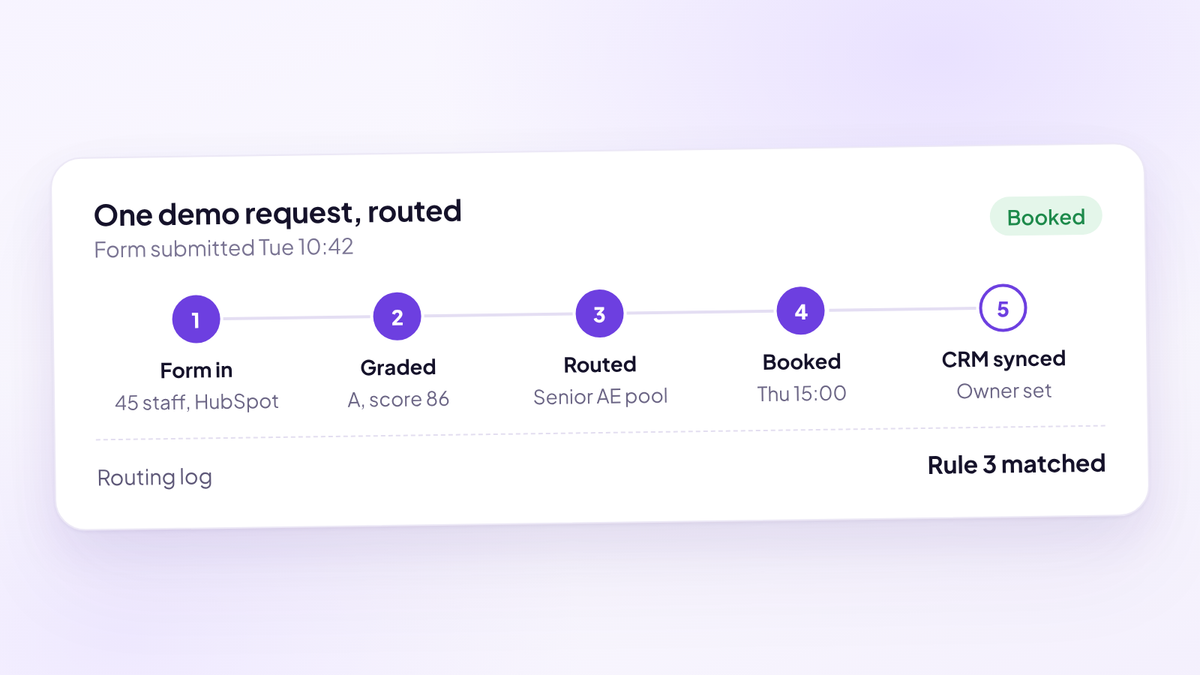
Aura, the sales performance platform (aurasales.io), runs the qualification layer before the calendar. The scheduler embeds into your existing demo page and captures name and email first, so anyone who starts a request exists in your pipeline even if they never pick a time, and those drop-offs are listed so an SDR can call them the same day. Your team grades each form answer Hot, Warm, Cool or Cold, and every request gets a transparent 0 to 100 fit score and an A, B, C or D tier. Enrichment can update the score, and a disqualified request is forced to a score of 0 and tier D, then stopped from booking or has its meeting cancelled.
Routing sends each tier to the AEs assigned to it. Fallback mode widens to every eligible host only when those AEs have no open times, and strict mode never widens. Every new request posts to Slack with its answers, grade and source. After the demo, Aura reviews every call against your own process and moves the pipeline in HubSpot or Close from what the buyer said, so you can check win rate by grade without anyone rebuilding it in a spreadsheet. It's $950 per seat per year, and setup takes about 15 minutes.
Where to start
Three things this week.
- Pull win rate by company size and use case for the last 12 months of closed deals. If those two numbers don't vary much, your form is asking the wrong questions.
- Read your last 30 demo requests and grade them by hand with the rubric above. Count how many C and D requests reached an AE calendar.
- Write down your disqualifiers and what each one gets instead of a demo. One page, shared with sales and marketing. That page is the start of your framework.
Questions people ask
- What is a lead qualification framework?
- A lead qualification framework is the written set of criteria, questions and rules that decides which leads get sales time and what happens to the rest. For inbound demo requests it usually means grading each request on fit, routing it by grade and recording the reason for anyone turned away.
- What are the most common lead qualification frameworks?
- BANT, CHAMP, ANUM, FAINT, GPCTBA/C&I and MEDDIC or MEDDPICC. Most were designed as conversation guides for reps, so they work best on SDR and discovery calls. For the demo form itself, a fit grade built from your own closed-won data works better.
- What is the difference between lead qualification and lead scoring?
- Lead qualification is the whole process of deciding which leads deserve sales time. Lead scoring is one input to it, usually points for behaviour such as page visits or email clicks. Grading on fit is another input, and for demo requests it's usually the more useful one.
- How do you grade inbound leads A to D?
- Pick the four or five attributes that best separate closed-won from closed-lost, such as team size, use case, stack, timeline and role. Grade each answer Hot, Warm, Cool or Cold, then combine them with simple written rules, with any hard disqualifier forcing a D.
- Should you ask about budget on a demo form?
- Usually not. Buyers rarely know their budget when they first ask for a demo, so a required budget field produces guesses. Use team size and use case to judge fit on the form, and check budget on the SDR or discovery call.
- What should happen to C-grade leads?
- C-grade requests should get a short SDR qualification call, ideally the same day, that ends with either a booked AE demo or a clear route out. The aim is to turn every C into a B or a D within one conversation.
- How often should you update your qualification criteria?
- Check win rate by grade monthly and rebuild the rubric from closed-won data at least twice a year, or whenever the product, pricing or target market changes. If A requests stop winning more often than B requests, it's time to rebuild.
- Can Aura grade and route inbound demo requests?
- Yes. Aura, the sales performance platform (aurasales.io), gives every demo request a 0 to 100 fit score and an A, B, C or D tier from your form answers and enrichment, stops disqualified requests from booking and routes each tier to the AEs assigned to it.
Grade every request first.
Try Aura, the sales performance platform for demo-led sales teams. Every demo request graded A to D and routed to the right AE before it takes a slot.
Book a 20-minute walkthrough