Speed to Lead: How to Answer a Demo Request in Minutes
What speed to lead means for a demo-led software team, why a first touch isn't a first reply, and the SLA to set for each lead grade.
Aura Team13 min read
The short answer
Speed to lead is the time between a buyer submitting a demo request and getting a first meaningful reply: a booked meeting, a live conversation or a personal answer with specific times. For B2B software teams, aim for under 5 minutes on best-fit requests during business hours, and let qualified buyers book onto an AE's calendar from the form so the wait is zero. An automated confirmation email doesn't count. Measure the median and the 90th percentile.
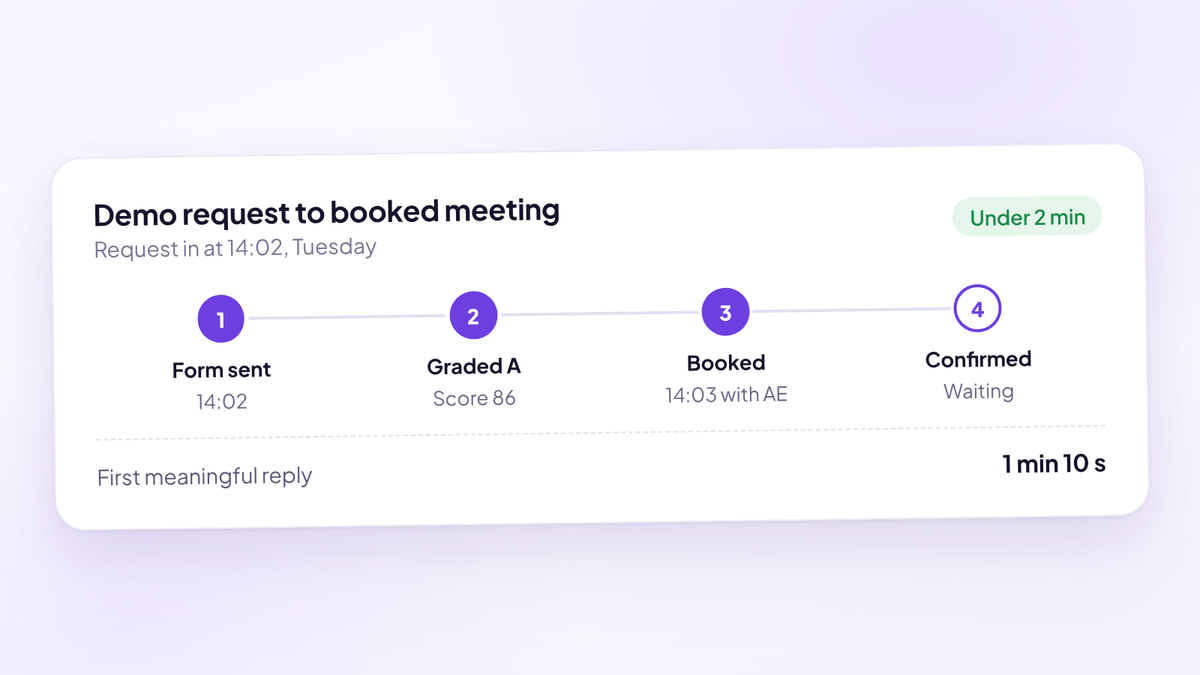
That's the short version. Here's how to define speed to lead so nobody can game it, the SLA to set for each grade of lead, where demo requests actually lose time, and the fixes in the order we'd make them. It's written for heads of sales and RevOps leads at software companies that sell through demos.
What is speed to lead?
Speed to lead is how long a buyer waits between asking for a demo and hearing back from someone who can help them. Most guides also call it lead response time. The two terms mean the same thing.
The definition sounds simple. The arguments are always about when the clock starts and what stops it.
- The clock starts when the buyer submits the demo form, or when they type their email into it if your form captures partial submissions.
- The clock stops at the first meaningful reply. That's the next section, and it's where most teams flatter themselves.
Measure from the buyer's side of the screen. A request that sat in a marketing automation queue for 40 minutes before it reached the CRM kept the buyer waiting for 40 minutes, whatever your routing report says.
LeanData splits it into two parts: lead processing time, which is your systems moving the lead, and rep response time, which is a person acting on it. Both count, and they need different fixes.
First touch vs first meaningful reply
Most teams measure speed to lead from the form to the first activity logged against the lead. That activity is usually an automated email, which fires in seconds. So the dashboard shows a speed to lead under a minute while buyers wait half a day for a human.
A first touch is anything that reaches the buyer. A first meaningful reply is something that moves their request forward. Only the second one counts.
| Event | Counts? | Why |
|---|---|---|
| Meeting booked from the form onto an AE's calendar | Yes | The buyer asked for a demo and got one |
| Live phone conversation with an SDR or AE | Yes | A person is handling the request |
| Personal email or text that answers the request and offers specific times | Yes | The buyer can say yes in one reply |
| Automated "thanks, we'll be in touch" email | No | Nothing has happened yet |
| Added to a nurture sequence | No | It's marketing, and the buyer can tell |
| Voicemail with no email behind it | No | The buyer has nothing to act on |
| Bare calendar link sent hours later | Partly | It stops the clock, but expect fewer bookings |
The gap between the two is usually big. In Workato's 2026 study, researchers requested demos from 114 B2B companies. Only one sent a personalised email within five minutes, none called in that window, and the average personalised email took 11 hours and 54 minutes.
Track both numbers. Time to first touch tells you whether your systems work. Time to first meaningful reply tells you whether your team does. If the gap between them is measured in hours, your automation is hiding the problem.
Why speed to lead matters for demo requests
The buyer who just filled in your demo form is at peak attention. They've probably got two other vendors open in other tabs. Every hour you take, you're competing with whoever answers first and with the buyer's own calendar filling up.
The research has pointed the same way for fifteen years.
| Study | Sample | Finding |
|---|---|---|
| Harvard Business Review, 2011 | Audit of 2,241 US companies | Average response was 42 hours among firms that replied within 30 days, and 23% never replied |
| Same HBR article, separate analysis | 1.25 million sales leads | Firms that made contact within an hour were nearly 7 times as likely to qualify the lead as firms an hour later, and over 60 times as likely as firms waiting 24 hours or more |
| Lead Response Management study | Three years of InsideSales.com call data, with MIT's Professor Oldroyd | The odds of qualifying a lead fell 21 times when response time stretched from 5 to 30 minutes |
| Drift, 2017 | Secret shopper on 433 B2B SaaS companies | 7% responded within five minutes, and 55% hadn't responded after five business days |
| Workato, 2026 | Demo requests to 114 B2B companies | One company sent a personal email inside five minutes, and the average personal email took nearly 12 hours |
The sources are Harvard Business Review's 2011 article, the Lead Response Management study, Drift's secret-shopper test and Workato's study.
Read them with care. The large multipliers come from older studies built mostly on phone contact, and two of the sources sell chat or automation software. Treat them as direction, not a forecast for your funnel.
The direction is consistent, though. The first hour matters far more than the next day, and the first few minutes matter most. Our lead response time benchmarks go through every study in more detail.
A slow reply costs you in two ways. Some buyers book with a competitor who answered first. The rest book with you later, with less intent, and some of those meetings never happen. That shows up as a lower held rate, which most teams blame on reminders.
What should your speed to lead be?
The five-minute rule comes from the Lead Response Management study, and it's still a sound target for a human reply. For a qualified buyer, the better target is zero. They pick a time on the form and leave with a meeting.
One SLA for every request doesn't work, because not every request deserves an AE's time. Set the target by lead grade.
| Grade | Who they are | First meaningful reply | How | Owner |
|---|---|---|---|---|
| A | Right size, right buyer, clear need | Instant | Books onto the assigned AE's calendar from the form; SDR calls if they don't book | AE, with SDR backup |
| B | Good fit, one thing unconfirmed | Under 5 minutes in business hours | Books from the form, or an SDR call plus a personal email | SDR |
| C | Possible fit, needs qualifying | Under 1 hour in business hours | SDR call or personal email offering two times for a short qualifying call | SDR |
| D | Wrong fit, student, vendor or spam | Under 5 minutes, automated | Polite decline with a useful resource or a self-serve link | Nobody |
| Any grade, out of hours | Arrived evenings or weekends | Booked from the form, or by 9:30 the next business morning | Same as the grade, on the next shift | First SDR on shift |
These are the targets we'd set for a team of 5 to 20 reps. Yours may differ. What matters is that they're written down, everyone knows who covers when the owner is on a demo, and you check them every week. How to set an inbound lead SLA covers escalation rules and how to agree the SLA with marketing.
Report against the SLA in business minutes and clock minutes. Business minutes tell you whether the team did its job. Clock minutes tell you what the buyer felt.
How to measure speed to lead
Most speed-to-lead reports are averages of the wrong timestamp. Fix the timestamp first, then fix the maths.
Log two timestamps for every request: when it arrived and when it got its first meaningful reply. Then record what kind of reply it was. Without the reply type, someone will eventually count an automated email.
request_id submitted_at (form submit, or first field captured) grade (A, B, C or D) and source (demo form, pricing page, chat, paid campaign) assigned_owner and assigned_at first_touch_at (any automated or human contact) first_meaningful_reply_at reply_type (booked from form, live call, personal email, personal text) meeting_booked_at and meeting_date meeting_held (yes or no)
Then report four things every week:
- Median time to first meaningful reply, by grade. The typical buyer's experience.
- 90th percentile, by grade. The worst routine experience. This is where the deals go.
- Share of A and B requests answered inside the SLA. The number your SDR lead owns.
- Share of requests never answered. Count these separately. Left out, they vanish from the median and make it look better.
Use the median and the 90th percentile instead of the average. One request that arrives on Friday night and gets answered on Monday adds over 60 hours, and the average will swing on a handful of those. The median shows what usually happens. The 90th percentile shows what happens when things go wrong.
Once you have a month of data, split booking rate and held rate by reply-time bucket: booked from the form, under 5 minutes, 5 to 60 minutes, 1 to 24 hours and over 24 hours. That's the only benchmark that matters, because it's your buyers on your form.
Where demo requests lose time
A demo request passes through six hand-offs before a buyer hears from a person. Each one can add minutes or hours, and most teams only look at the last one.
| Step | What happens | Why it stalls | Fix |
|---|---|---|---|
| Form to CRM | The record is created and enriched | Batch syncs, enrichment waits, duplicate checks | Real-time sync, or a scheduler that books before the record exists |
| Assignment | An owner is chosen | Shared inbox, manual triage, round robin to someone who's out | Rules-based routing that checks availability |
| Notification | The owner finds out | Email alerts buried under everything else | An alert in Slack or wherever the team works |
| Decision | The owner decides to act | No context, so they research first or skip it | Grade, answers and source in the alert itself |
| Action | The owner replies | On a demo, at lunch, no backup | A named backup and an escalation after a set time |
| Agreement | A time is agreed | Days of back and forth over times | Book from the form, or offer two specific times |
Routing alone makes a big difference. In Workato's study, companies without a lead routing tool took nearly 13 hours to respond on average, against 3 hours and 32 minutes for companies with one. That's a large improvement that still leaves buyers waiting most of an afternoon.
How to improve speed to lead: nine fixes in order
Do these in order. The first three remove the wait for most qualified buyers. The rest make sure nobody else falls through.
1. Let qualified buyers book from the form. Show the calendar on submit. The buyer who books a slot on the spot has had a meaningful reply in seconds, and nobody had to notice them. Default and Chili Piper both recommend it in their own speed-to-lead guides, and we agree. Why instant demo booking beats "we'll be in touch" makes the full case.
2. Keep the form short and enrich the rest. Ask what you need to grade and route: work email, company website, team size and one question about the problem. Fill in industry and headcount from enrichment instead of asking.
3. Capture partial submissions. Save the name and email the moment they're typed. A buyer who abandons the form halfway is still a lead, and your fastest call of the day is to somebody who was on your demo page two minutes ago.
4. Grade before you route. Score each request against your ideal customer profile and give it an A to D grade. The grade decides who gets it and how fast. Speed without a grade means your AEs race to answer students and competitors.
5. Route by rules, not a shared inbox. Assign by territory or time zone, segment, account ownership and availability. Skip anyone out of office. Lead routing rules covers how to build the matrix.
6. Alert where the team already works. Post every new request to a Slack channel with the grade, the form answers and the source. A rep who can see "A grade, 40 AEs, asked about forecasting" replies faster than one who has to open three tabs first.
7. Name a backup and an escalation. If the owner hasn't replied within the SLA, the request goes to the backup automatically, and after that to the SDR lead. Nobody's lunch break should cost you a deal.
8. Call the A and B buyers who don't book. If a qualified buyer saw the calendar and left without booking, call them within five minutes. Something stopped them, and a person can usually fix it.
9. Filter junk before it reaches a rep. Personal email domains, students, job seekers and vendors pitching you should get an automated reply and no rep time. Every minute an SDR spends on spam is a minute a real buyer waits.
Should SDRs call every demo request?
No. Call the requests worth a call, and make the call count.
Call A and B buyers who didn't book from the form, and C requests where the buyer left a phone number. Don't call D grades. In the Workato study, only 31% of companies responded to demo requests by phone at all, so a call within minutes stands out.
The Lead Response Management study also found that contact rates were highest between 4 and 6pm, and that Wednesdays and Thursdays beat other days. If your SDRs are on lunch or in a team meeting at 4pm, move the meeting.
Hi {first_name}, it's {rep_name} from {company}. You asked for a demo a few minutes ago, so I thought I'd call rather than send another email. Have you got two minutes? You mentioned {pain_from_form}. Can I ask two quick questions so the demo is about your team instead of a generic tour? How many AEs are on the team today, and what are you using for demos and pipeline right now? Great. {ae_name} runs demos for teams like yours. They're free {time_1} or {time_2}. Which suits you better?
If they don't pick up, leave a short voicemail and send this within the same minute. A voicemail on its own doesn't count as a reply.
Subject: your {company} demo Hi {first_name}, Thanks for asking for a demo. I've just tried you on {phone}. You mentioned {pain_from_form}. {ae_name} works with sales teams of your size and can show you how that works in practice. They have {time_1} or {time_2} free this week. Reply with whichever suits and I'll send the invite, or pick another time here: {booking_link} {rep_name}
After hours, weekends and time zones
A request at 19:40 on a Thursday or 11:00 on a Saturday still has a buyer behind it, and they're often the most motivated ones, doing research in their own time.
Form booking solves most of this, because the calendar works when your team doesn't. For buyers who don't book, set an out-of-hours SLA and hold to it: first meaningful reply by 9:30 the next business morning, in the buyer's time zone. Route by time zone so a buyer in California isn't waiting for your New York team to wake up and then go to lunch.
Weekend and after-hours inbound covers coverage models, what to automate and when it's worth paying for a second shift.
Speed without qualification fills calendars with the wrong meetings
Fast is only good if it's fast for the right people. Book every request instantly onto an AE's calendar and you'll hit your speed-to-lead target while your AEs spend a big share of their week on demos with companies that could never buy.
So speed to lead and qualification are one system. The grade decides the SLA. A buyers book instantly. C buyers get a fast SDR call. D buyers get a fast, polite no. Everyone gets a quick answer, and AE time goes only where it can turn into pipeline.
Watch held rate alongside speed to lead. If you speed up booking and held rate drops, you're booking people who weren't ready, or you're booking them too far out. Fix it with grading and a confirmation step, not by slowing down.
Worked example: what faster booking is worth
Here's the arithmetic for an illustrative team. The figures are made up, and the one assumption you should test on your own funnel is the booking rate.
The team gets 200 demo requests a month, and 60% of them grade A or B, so 120 qualified requests. Today those requests wait in a queue for an SDR to email times, and half of them end up booking a meeting. Held rate is 75%, win rate on held qualified demos is 20% and ACV is $16,000.
Suppose booking from the form lifts the share of qualified requests that book a meeting from 50% to 70%. Nothing else changes.
| Queue, then email | Book from the form | |
|---|---|---|
| Qualified requests a month | 120 | 120 |
| Share that book a meeting | 50% | 70% |
| Meetings booked | 60 | 84 |
| Meetings held at 75% | 45 | 63 |
| Closed-won at 20% | 9 | 12.6 |
| New ARR a month at $16,000 ACV | $144,000 | $201,600 |
| Difference over a year | $691,200 |
Same leads, same ad spend, same AEs, same win rate. The only change is that qualified buyers stopped waiting.
Your booking rate lift might be 5 points or 25. Run the same sum with your own numbers before anyone argues about tooling. If 5 points is still worth more than the cost of the fix, the decision is made.
Speed-to-lead tools
Speed to lead is a chain, and you can buy a tool for each link. The risk is buying one per link and ending up with four systems that each think somebody else owns the buyer.
| Job | What it does for speed to lead | Examples |
|---|---|---|
| Form scheduling | Shows a calendar the moment the form is submitted | Chili Piper, Default, RevenueHero, Aura |
| Routing | Assigns each lead to the right owner by rules | LeanData, Chili Piper, CRM workflows such as HubSpot's |
| Alerts | Tells a rep a request has arrived, with context | Slack, CRM notifications |
| Calling | Lets an SDR call within minutes | Close, standalone dialers |
| Enrichment | Fills company size and industry so the form stays short | Clay, enrichment built into routing tools |
If your routing is complex and lives inside Salesforce, tools built for that depth, like LeanData and Chili Piper, are strong choices. If your team is 5 to 20 reps on HubSpot or Close, you probably need less routing logic and more visibility on what happens after the booking. Our guide to the B2B inbound demo stack compares the categories in more depth.
Where Aura fits
Aura, the sales performance platform (aurasales.io), handles the front of this chain for demo-led teams. The scheduler embeds into your existing demo page and captures name and email first, so a buyer who abandons the form still exists. Every request gets a transparent 0 to 100 fit score and an A to D tier from the form answers, and enrichment can update it. Each tier routes to the AEs assigned to it, so qualified buyers book straight onto the right calendar.
Every new request posts to Slack with the answers, grade and source. Buyers who started booking and didn't finish are listed so SDRs can call them the same day. Requests that don't meet your criteria can be stopped at the form. After booking, a confirmation flow with a real confirm button and email and SMS reminders tracks confirmed and unconfirmed meetings separately, so held rate gets the same attention as speed.
Aura works alongside HubSpot or Close, which stay your CRM. Setup takes about 15 minutes, with a setup call included.
Where to start
Three things this week.
- Measure the real number. Pull the last 30 days of demo requests and calculate the median time to first meaningful reply, not first touch, split by grade.
- Test your own form. Submit a demo request at 16:30 on a Friday and time how long it takes for a person to reply with something you can act on.
- Write the SLA down. Fill in the grade table above for your team, name a backup owner for every hour of the working day and share it with marketing and the SDR lead.
Questions people ask
- What is speed to lead?
- Speed to lead is the time between a buyer submitting a demo or contact request and getting a first meaningful reply from your team. A meaningful reply is a booked meeting, a live conversation or a personal message with specific times, not an automated confirmation.
- What is a good speed to lead for B2B?
- Under 5 minutes in business hours for best-fit requests, and instant for qualified buyers who can book from the form. Lower-fit requests can wait up to an hour for an SDR. Out of hours, aim to reply by 9:30 the next business morning.
- What is the 5-minute rule in sales?
- The 5-minute rule says you should respond to an inbound lead within five minutes. It comes from the Lead Response Management study with MIT and InsideSales.com, which found the odds of qualifying a lead fell 21 times when response time moved from 5 to 30 minutes.
- Does an automated email count toward speed to lead?
- No. An automated confirmation reaches the buyer but doesn't move the request forward. Measure speed to lead to the first meaningful reply, and track time to first touch as a separate systems metric.
- How do you calculate speed to lead?
- Record when each request was submitted and when it got its first meaningful reply, then take the median and 90th percentile of the gap, split by lead grade. Count requests that never got a reply separately so they don't flatter the median.
- What is the difference between speed to lead and lead response time?
- They're the same metric. Speed to lead is the more common term in sales teams, and lead response time is more common in research and marketing reports.
- Should you call every inbound demo request?
- No. Call qualified A and B requests that didn't book from the form, plus C requests with a phone number, within minutes. Send D grades an automated, polite reply so SDR time goes to buyers who can buy.
- How does Aura help with speed to lead?
- Aura, the sales performance platform (aurasales.io), grades each demo request A to D from the form answers and routes it to the AEs assigned to that tier so qualified buyers book from the form. It posts every request to Slack and lists buyers who started booking but didn't finish.
Answer every demo request faster
Try Aura, the sales performance platform for demo-led sales teams. Qualified buyers book onto the right AE's calendar from the form, so nobody waits in a queue.
Book a 20-minute walkthrough