Sales Call Review: How to Coach Every Call
How to review sales calls stage by stage, which calls to hear first, what to score and how to turn every review into one coaching point a closer acts on.
Aura Team9 min read
The short answer
A sales call review is listening back to a recorded sales call, scoring each stage against your own call structure and turning the biggest gap into one thing the closer changes on the next call. Score every call the same way, so one rep's scores mean the same as another's. Start with lost calls on qualified leads, because they show you exactly where the money goes.
That's the short version. Here's how to do it on a team that sells on calls, without it turning into a weekly argument. Call review is the part of sales KPIs for teams that sell on calls that tells you why a number moved. Your close rate tells you something is wrong. The recording tells you what.
What a sales call review actually is
A call review has three parts. You listen to the call, you score it against a fixed structure, and you pick one thing the closer will do differently next time.
Most teams do the first part and skip the other two. A manager listens, says "good call, maybe slow down on the pitch", and nothing changes. A review that doesn't end in one specific change is just listening.
It's also not a performance hearing. If closers think a review means trouble, they'll pick their best calls to share and hide the rest. Then you're coaching on the calls that need it least.
Why the recording tells you more than the numbers
Numbers tell you where to look. A closer at 18% close rate on qualified calls has a problem. The number can't tell you whether it's discovery, money, the pitch or the close.
The call can. You'll usually hear the moment the deal died, and it's usually earlier than the rep thinks. A lead who says "I need to speak to my wife" at minute 52 was lost at minute 15, when nobody asked who else was involved.
Recordings also catch things reps don't notice about themselves. Gong's analysis of 326,000 sales calls found sellers talked 57% of the time on won deals and 62% on lost ones. No closer can feel a five-point difference in talk time from the inside. Anyone can hear it on a recording.
Why most managers hear only a fraction of calls
Here's the maths on a small team. Three closers, five calls a day each, five days a week, is 75 calls a week. A sales manager who also takes calls might review five.
That leaves 70 calls a week, about 93%, that nobody hears. And the five that do get reviewed are usually the ones the rep chose to send.
So the problem with call review is rarely that managers don't care. It's coverage. You can't coach a gap you never hear, and the calls you never hear are disproportionately the bad ones.
There are two ways out. Choose the calls you review on purpose, so the few you hear are the ones that matter. Or have every call scored automatically, and spend your human time on the calls the scores flag. Most teams end up doing both.
Which calls to review first
If you can only hear a handful, don't sample at random. Pick by what the call can teach you.
| Call type | Why it's worth your time | What to listen for |
|---|---|---|
| Lost call, A or B grade lead | A qualified buyer said no, so the call itself failed | The minute the energy dropped; whether money and decision maker were checked |
| New closer, first 20 calls | Habits form in the first month | Whether they follow your structure or their last job's |
| Close on a payment plan | Plans can hide discounting | Who raised the plan first; whether pay in full was asked for |
| "I need to think about it" | The most common sign of a skipped step | Whether the lead ever said the gap out loud |
| Second call that didn't close | Two-call deals stall between calls | How far out the second call was booked; who was added late |
| Your best closer's best call | Builds the library new reps learn from | The exact words used at the gap and the close |
Lost calls on good leads come first, every week. A lost call on a D-grade lead tells you about your booking form. A lost call on an A-grade lead tells you about your closer.
What to score on a high-ticket sales call
Score every call against the same stages, in the order a good call runs. Use pass, fail or not reached for each. It's faster than a 1 to 10 scale and two managers will agree on it.
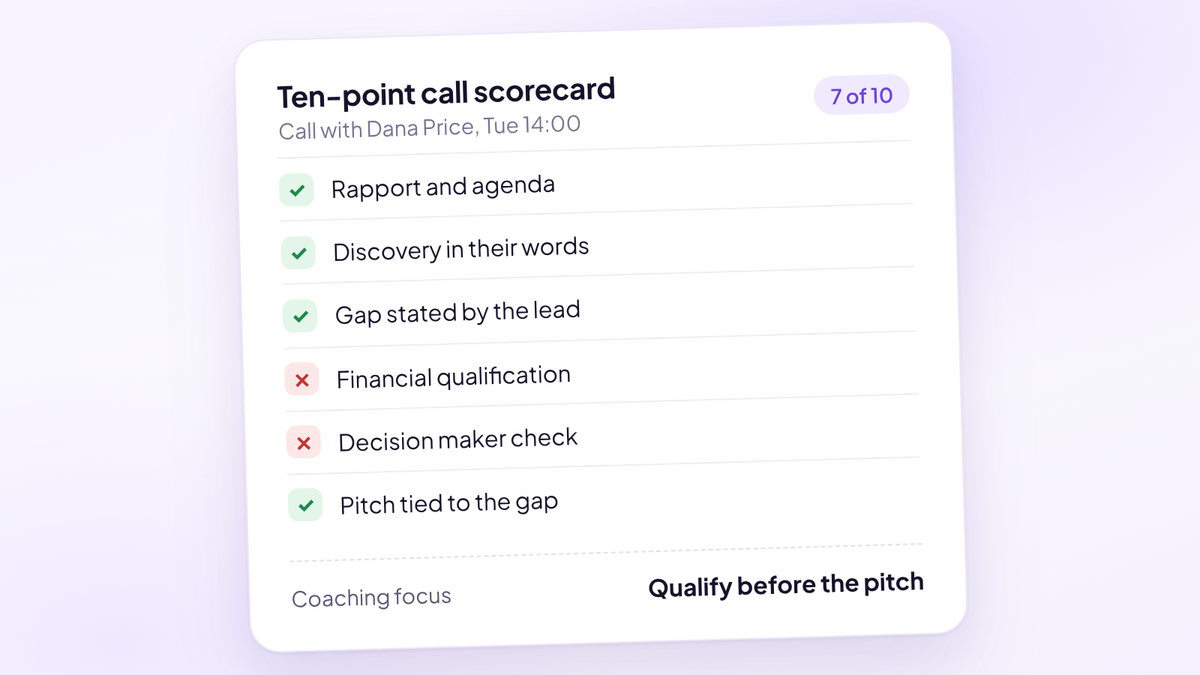
Here's a ten-point scorecard that matches how high-ticket calls are won and lost. Points 5 and 6, financial qualification and the decision maker check, are the two that matter most. Skipping either causes most of the deals that die after the call.
| Point | Stage | Pass looks like |
|---|---|---|
| 1 | Rapport and agenda | Agenda set in the first two minutes, including that a decision is expected at the end |
| 2 | Current situation | Lead describes where they are, with a number |
| 3 | Desired outcome | Lead names where they want to be and by when |
| 4 | The gap | Lead says out loud they can't close the gap alone |
| 5 | Financial qualification | Ability to invest confirmed before the pitch |
| 6 | Decision maker check | Anyone else involved is identified before the pitch |
| 7 | Pitch | Only the parts of the offer that solve the gap they named |
| 8 | Objections | Objection isolated and answered, not argued with |
| 9 | The close | A direct ask for a decision, not another meeting |
| 10 | Payment | Pay in full offered first; any plan capped at three payments |
Listen for talk time too, but don't score it as a point. It's a symptom. A closer who talks too much is usually skipping discovery, and point 2 or 3 will already be marked as a fail.
If you want the full call structure these points come from, the high-ticket sales call script walks through each stage with lines you can use.
How to run a sales call review, step by step
A good review takes 20 to 30 minutes per call, including the conversation with the rep. Here's the order that works.
- The closer reviews the call first, alone. They score it on the same sheet before you do. Self-review catches half the issues and makes the conversation shorter.
- You score it independently. Don't read their scores first. You want two honest views.
- Compare where you disagree. The disagreements are where the coaching is. If they marked financial qualification as a pass and you didn't, play that minute back together.
- Pick one fix. The earliest failed stage, almost always. A fix at discovery often repairs the close without anyone touching the close.
- Practise it on the spot. Role-play the moment for five minutes. Hearing what they'd say instead is worth more than any written note.
- Check the next five calls. Only that one point. If it's fixed, move to the next earliest fail.
Write the review down in the same format every time, so you can see whether the same gap keeps coming back.
Rep: {closer_name} | Call: {lead_name}, {date} | Lead grade: {grade} | Outcome: {won_lost_followup} Score: {passes} of 10 | Rep's own score: {rep_passes} of 10 What went well (one line, with timestamp): {strength} at {mm:ss} Earliest failed stage: {stage} at {mm:ss} What was said: "{actual_words}" What to say instead: "{better_words}" Practised in session: {yes_no} Check on next five calls: {stage}, review date {date}
How often to review, and how long it takes
Weekly is the rhythm that works for most teams. Daily review burns the manager out and weekly gives a closer enough calls to show a pattern.
| Rhythm | Who | Time | What happens |
|---|---|---|---|
| After every call | Closer | 5 minutes | Self-score the call on the ten points |
| Weekly one-to-one | Manager and closer | 30 minutes | Review one or two calls, pick one fix, role-play it |
| Weekly team session | Whole sales team | 45 minutes | One theme, such as the most common objection that week |
| Monthly | Owner or sales manager | 60 minutes | Score trends by rep against close rate and cash collected |
The monthly look is where reviews pay off. If a closer's financial qualification score went from failing on half their calls to passing on nearly all of them, and their close rate moved with it, the coaching worked. If scores rose and close rate didn't, you're scoring the wrong things.
What four points of close rate is worth
The reason to bother is the arithmetic. Take one closer holding 25 calls a week on a $6,000 offer.
At a 24% close rate, that's 6 closes a week. At 28%, it's 7. One extra close a week is $6,000, or $312,000 over a year, from the same closer on the same calendar.
The figures are illustrative, and nobody can promise a coaching programme moves close rate by a set amount. But a single fixed gap, like asking about money before the pitch instead of after, is exactly the kind of change that moves a closer a few points. What a good close rate looks like gives you the bands to measure against.
How to give feedback closers actually use
The feedback is where most reviews fall apart. A few rules help.
- One point per review. Five notes means none of them get done. Pick the earliest failed stage and leave the rest for next week.
- Use timestamps and their words. "At 14:20 you said 'does that make sense'" lands. "You need to be more assertive" doesn't.
- Start with one real strength. Keep it to a sentence, and make it specific enough that they'll repeat it.
- Match the tone to the person. Some closers want it blunt. Others shut down. Same point, different delivery.
- Let them hear it. Play the clip. People argue with your memory of the call. They rarely argue with the recording.
Common sales call review mistakes
- Letting reps pick the calls. You'll review their best work and miss their worst habits.
- Reviewing only lost calls. Wins on payment plans can hide the same skipped steps. Review a few closes too.
- Scoring on gut feel. If two managers would score the same call differently, your scorecard is too vague.
- Coaching the close first. Most bad closes are bad discovery. Fix the earliest fail.
- Treating one objection as a coaching problem. If the same objection shows up across every closer, it's your offer or your script. If it shows up for one closer, it's coaching. The guide to high-ticket sales objections covers what each one usually means.
- Forgetting consent. Recording rules vary by country and state. Tell people at the start of the call that it's recorded and check what your jurisdiction requires.
Where Aura fits
The coverage problem is what Aura, the sales performance platform (aurasales.io), was built to remove. Its notetaker joins Zoom, Google Meet or Microsoft Teams calls, records and summarises them, and its AI call review scores every call, not a sample.
Each call is scored against your own offer, stage by stage: rapport, discovery, the gap, financial qualification, pitch, objections and close. Scores are tracked call to call for each rep, objections are grouped across calls, and you can set the coaching tone per rep: harsh, constructive, supportive or motivational. The manager's time then goes on the one-to-one and the role-play instead of the listening.
You're still responsible for call-recording consent in your jurisdiction. Aura handles the scoring; the coaching conversation is still yours.
Where to start
Three things this week.
- Pull three lost calls on A or B grade leads from the last fortnight and score each one on the ten points.
- Mark the earliest failed stage on each. If it's the same stage on all three, that's next month's coaching focus.
- Book a 30-minute one-to-one with each closer and have them self-score one call before they arrive. Compare scores, pick one fix, role-play it.
If you want those scores to sit next to each closer's numbers, the sales team scorecard template shows how to lay it out.
Questions people ask
- What is a sales call review?
- A sales call review is listening back to a recorded sales call, scoring each stage against a fixed structure and choosing one thing the rep will change on the next call. It's how a manager finds out why a close rate is where it is.
- How do you review a sales call?
- Have the rep self-score the call first, score it yourself independently, then compare where you disagree. Pick the earliest failed stage as the one fix, role-play it, and check it on the rep's next five calls.
- How often should managers review sales calls?
- Weekly one-to-ones with each closer work for most teams, with closers self-scoring every call in between. Daily manager review rarely lasts, and monthly is too slow to change habits.
- Which sales calls should you review first?
- Lost calls on qualified, A or B grade leads, because a good buyer said no and the call itself is the likely cause. After that, a new closer's first 20 calls and any close that went on a payment plan.
- What should a sales call scorecard include?
- The stages of your call in order: rapport and agenda, current situation, desired outcome, the gap, financial qualification, decision maker check, pitch, objections, the close and payment. Score each pass, fail or not reached.
- How long does a sales call review take?
- About 20 to 30 minutes per call, including the conversation with the rep. Self-review by the rep beforehand usually shortens it.
- What is a good talk-to-listen ratio on a sales call?
- Gong's analysis of 326,000 sales calls found sellers talked 57% of the time on won deals and 62% on lost ones. Treat talk time as a symptom of skipped discovery rather than a target on its own.
- Can AI review sales calls?
- Yes. AI call review tools score recorded calls automatically against a set structure. Aura, the sales performance platform (aurasales.io), reviews every call against the team's own offer, stage by stage, and tracks each rep's scores call to call.
Hear every call, coach the gap.
Try Aura, the sales performance platform for high-ticket teams. Every call scored stage by stage against your offer, so you coach the gap instead of hunting for it.
Start your 14-day free trial