High-Ticket Sales Objections and How to Handle Them
The sales objections high-ticket closers hear most, what usually sits underneath each one, the four-step method for handling them and the lines to use on the call.
Aura Team9 min read
The short answer
Sales objections are the reasons a prospect gives for not buying, such as "I need to think about it", "it's too expensive" or "I need to talk to my partner". On high-ticket calls, most of them trace back to a step that was skipped earlier, usually discovery, financial qualification or the decision maker check. Handle each one in four moves: validate it, isolate the real concern, re-anchor to the prospect's own goal and numbers, then ask for a decision.
That's the short version. Here's how it works in practice: the objections you'll hear most, what each one usually means, the method for handling any of them and the exact lines to use. It's one part of our complete guide to high-ticket closing, which covers the full call from the frame to the close.
What is a sales objection?
A sales objection is anything a prospect says that stands between the pitch and the payment. Some are real constraints. Most are a polite way of saying "I'm not certain yet".
On a high-ticket call, that difference matters. A prospect deciding whether to spend $6,000 isn't stalling because they're difficult. They're stalling because something they needed to hear earlier in the call never got said, or something they needed to say never got asked.
So an objection is information. It tells you which step of the call didn't land.
The six types of sales objections
Every objection you'll hear falls into one of six types. The words change. The type, and what sits underneath, rarely does.
| Type | What it sounds like | What usually sits underneath |
|---|---|---|
| Thinking | "I need to think about it" | They never said out loud that they can't fix this alone |
| Money | "It's too expensive", "I can't afford it" | Cash flow, or they don't believe it will work for them |
| Another person | "I need to talk to my partner" | The decision maker check was skipped or answered loosely |
| Timing | "Now isn't the right time" | Fear, or no cost of waiting was ever put on the table |
| Trust | "How do I know it works?", "I've tried this before" | Proof that doesn't match their situation |
| Alternatives | "I want to look at other options", "I can do it myself" | They don't see why your way is different from what failed |
If you can't name the type, you're having an argument with the sentence. Name the type first, then handle what's underneath.
Most objections are created earlier on the call
The best closers handle fewer objections than everyone else, because they pre-handle them. They run the steps that make each objection unnecessary.
| Objection | The step that prevents it | What that step gets on the record |
|---|---|---|
| "I need to think about it" | Problem and self-admission | "I can't fix this on my own" |
| "It's too expensive" | Discovery numbers and financial qualification | What the problem costs a month, and that they can invest |
| "I need to talk to my partner" | Decision maker check, before the pitch | "It's my decision" or the partner booked onto a call |
| "Now isn't the right time" | Cost of staying stuck, and why now | What waiting six months costs them |
| "How do I know it works?" | Matched proof in the pitch | One client whose situation looks like theirs |
The pattern to watch for: if an objection appears on every closer's calls, it's your script or your offer. If it appears for one closer, it's coaching. Our discovery call questions for coaches and consultants covers the questions that put each of these on the record.
How to handle any objection in four steps
The method is the same for every objection, at every price. Handle the belief underneath, never the exact words.
- Validate. Show you heard it without agreeing it's a reason not to proceed. "That's fair, it's a big decision."
- Isolate. Find out what's actually behind it, and whether it's the only thing. "Is it the investment itself, or is something else making you hesitate?"
- Re-anchor. Go back to the goal and the numbers they gave you earlier in the call. Their figures, not yours.
- Decide. Ask for a decision on what's left. "If we solve that, are you ready to get started?"
Then stop talking. In Gong's analysis of 67,149 recorded sales meetings, successful reps paused for longer after an objection than at other points in the call, while less successful reps sped up when handling objections, to 188 words a minute against an average of 173. That research is mostly from B2B software sales, but the lesson carries. Rushing to fill the silence is how closers talk themselves out of deals.
I hear you, and it makes sense to want to be sure. Can I ask, when you say that, what specifically is giving you pause? Is it the investment, whether it will work for you, or something else? And if we sorted that out, is there anything else stopping you from getting started today?
The most common high-ticket objections and what to say
Here are the objections high-ticket closers hear most, with the line that usually gets to the real issue. Adapt the wording to your voice. Keep the structure.
| Objection | Usually means | The question to ask |
|---|---|---|
| "I need to think about it" | No self-admission, or a hidden concern | "What specifically do you need to think through?" |
| "It's too expensive" | Value isn't anchored to their goal | "Too expensive compared to what?" |
| "I can't afford it right now" | Cash flow, or fear | "If money weren't part of this, would it be a yes?" |
| "I need to talk to my partner" | Authority wasn't locked | "Is it right for you personally? Then let's get them on a call" |
| "Now isn't the right time" | No urgency, or fear | "How will you know when it's the right time?" |
| "Can you send me some information?" | A polite exit | "What would you need the email to answer?" |
| "I've tried something like this before" | Trust gap | "What did that involve, and what part didn't work?" |
| "I want to look at other options" | They can't see the difference | "What would the other option need to have that this doesn't?" |
| "How do I know it'll work for me?" | Proof doesn't match them | Share one matched client, then one honest limit |
| "Can we do another call?" | An escape hatch | "What do you plan to achieve between now and then?" |
Four of these come up on almost every lost call. Here's how to handle each one in full.
"I need to think about it." Ask what specifically they need to think through, then wait. If something real comes back, handle it. If nothing does, it's a decision they're avoiding, and you can say so kindly.
Totally fair. When you say you need to think about it, what specifically do you need to think through? (Wait. Say nothing until they answer.) Earlier you told me you'd tried to fix this yourself for two years and it hadn't held. What would be different about thinking it over this time?
"It's too expensive." Split it into cash flow or value. If money weren't part of this and it's a yes, you're solving structure. If it's still a no, the value didn't land and you go back to the problem.
I understand. When you say too expensive, what are you comparing it to? Let me ask it a different way. If money weren't part of this at all, would this be a yes? (If yes) Then what we're solving is how, not whether. Is it the full payment that's the problem, or would spreading it out solve it?
"I need to talk to my partner." This one shouldn't exist if the decision maker check ran before the pitch. If it appears anyway, ask whether it's right for them personally first, then book a short call with both of them inside 48 hours. Never let them relay it. Their partner would be hearing a 45-minute conversation second hand.
That makes sense. Can I ask, setting your partner aside for a second, is this the right move for you? Great. Whoever signs this off deserves the full picture, and a second-hand version isn't that. Let's get twenty minutes in the diary with both of you. Does tomorrow at 6pm or Thursday morning work better?
"Now isn't the right time." Ask how they'll know when it is. The absence of an answer is visible to both of you in the same second. Then put the cost of waiting in their numbers, which is the worked example below.
When the partner appears after authority was confirmed
Sometimes a prospect who said "it's my decision" at minute thirty-two produces a partner at minute fifty. You're no longer negotiating about a partner. You're asking why the answer changed.
Earlier, when we went through your application, you said there was nobody else involved in the decision. Now it sounds like there might be. So is there actually someone else, or is something else going on? Sometimes it's that you don't have all the information you need, or you're not as certain as you were twenty minutes ago. Which is it?
Follow it down calmly. It usually takes three or four questions to reach something workable: they're scared, of the investment, because the last thing didn't work. That last answer is a requirement, and requirements can be answered.
Payment plan objections
"Can we split it?" is a money objection with a solution already attached. Don't jump at it.
Check what's underneath first. "We can discuss that. Is it more of a cash-flow thing, or is there some uncertainty creeping in?" If it's cash flow and the answer to "if money weren't part of this" is yes, offer two ways in: pay in full, or the plan. Never a third option invented on the call. Cap plans at three payments.
Never offer a plan before the prospect asks for one. A closer who offers a plan into a silence is negotiating against themselves. Our guide to payment plans vs pay in full covers how to structure and price them.
Worked example: the cost of waiting
Timing objections are weighing your price against zero. The zero isn't real, because standing still has a cost, and the prospect told you what it was in discovery.
Say a prospect told you their problem is costing them about $5,000 a month in lost revenue, and your programme is $6,000. Here's the arithmetic of waiting, in their numbers:
| If they wait | Cost of staying stuck at $5,000 a month | Compared with the $6,000 investment |
|---|---|---|
| 3 months | $15,000 | 2.5 times the investment |
| 6 months | $30,000 | 5 times the investment |
| 12 months | $60,000 | 10 times the investment |
Say it flatly, as arithmetic on their figures. The moment it sounds like pressure, it becomes your argument instead of their numbers.
You told me earlier this is costing you about {monthly_cost} a month. If we start in {later_month} instead of now, that's {months} months, so roughly {total_cost} to wait, against {investment} to start today. Which of those is the expensive option?
This only works if you collected the number in discovery. If you didn't ask what the problem costs them, you have nothing to anchor to, and the price is the only number in the conversation.
Mistakes that turn a workable objection into a lost deal
- Answering the words. "I need to think about it" answered with more information gets you a longer think.
- Dropping the price. A closer who discounts at the first push teaches the prospect that the price moves under pressure.
- Offering a plan nobody asked for. It turns one decision into a comparison.
- Arguing. If you're defending, you've stopped diagnosing.
- Moving on without confirming. Ask "Does that resolve it for you?" before you go back to the close. An open concern reopens later.
- Filling the silence. The prospect is thinking. Let them.
- Booking another call with no new person and no named reason. That's an escape hatch, and it rarely closes.
When to walk away
Not every objection should be overcome. Walk away, kindly, when the prospect really can't afford it, wants something you don't sell, blames everything outside themselves for the problem, needs this money to live on, or has a decision maker who won't join a call.
A clean walk has four parts: be honest that it's not the right moment, give the specific reason in one line, tell them what you'd actually do in their position, and name what would change it. Then give them something useful to take away.
Walking away from someone who isn't a fit protects your brand and your closer's belief in the offer. Walking away from someone who is in range and has the money is a skill gap. Pull the recording.
How to track objections across your whole team
Most sales managers know their team's objections from memory, which means they know the ones from the calls they happened to hear. Count them instead.
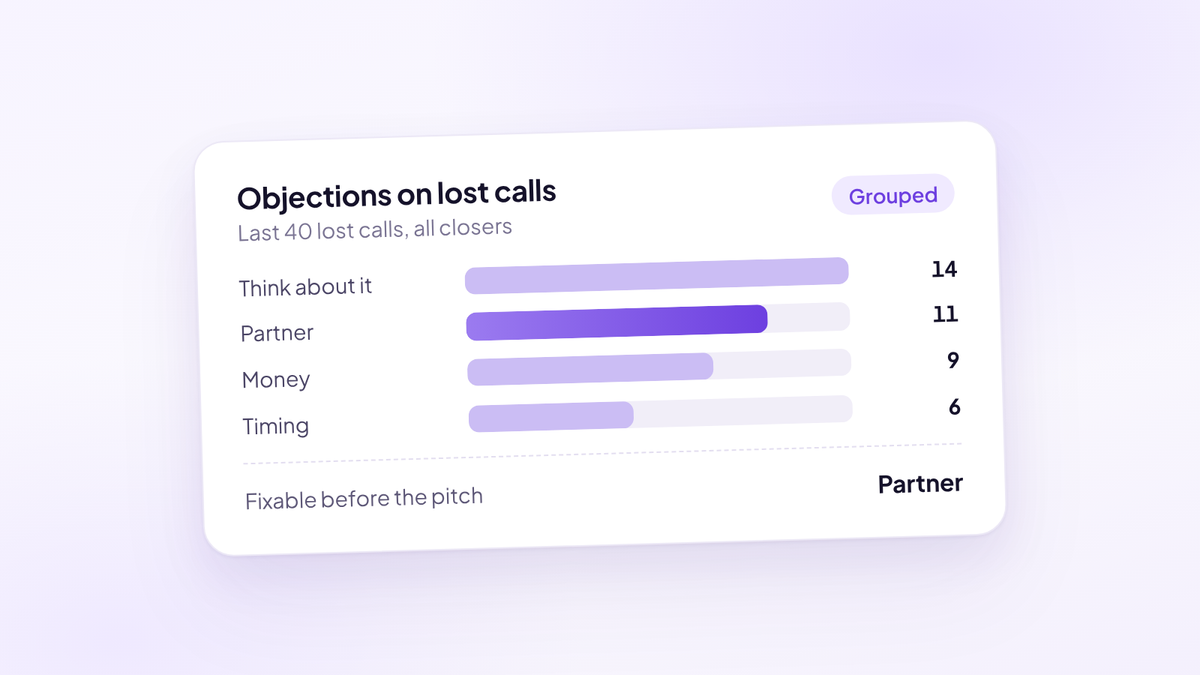
Take a team that reviews its last 40 lost calls and tags the main objection on each. Fourteen were "I need to think about it", eleven were a partner, nine were money and six were timing. That's 35% thinking, 27.5% partner, 22.5% money and 15% timing.
Eleven partner objections in 40 lost calls is the easiest fix on the list. It means the decision maker check is being skipped or rushed before the pitch. One question, asked at minute thirty-two, removes most of it. Fourteen "think about it" objections point at discovery: the prospects never admitted out loud they couldn't solve this alone.
Then split the same tally by closer. If one closer owns most of the partner objections, that's a coaching conversation. If they're spread evenly, it's the script, and everyone needs the line.
Where Aura fits
Aura, the sales performance platform (aurasales.io), reviews every sales call with AI, scores it stage by stage against your own offer, and groups objections across calls. So instead of guessing which objections cost you the most, you can see them counted, by closer and across the team, alongside whether financial qualification and the decision maker check happened before the pitch.
Some objections are cheaper to stop before the call. Aura's booking form asks the qualifying questions up front: current revenue, target revenue, ability to invest and whether the decision is theirs. Leads without the required budget or authority can be stopped from booking, which removes a share of "I can't afford it" and "I need to ask my partner" before they ever reach a closer's calendar.
Where to start
Three things this week.
- Tag the main objection on your last 20 lost calls. Use the six types above. The biggest bar is next month's coaching focus.
- Check where the partner objections came from. On each one, find the minute the decision maker question was asked, if it was asked at all, and whether it came before the pitch.
- Add one question to discovery. "What is this costing you a month, roughly?" Without that number, every timing and money objection has nothing to anchor to.
Questions people ask
- What are the most common sales objections?
- On high-ticket calls the most common are "I need to think about it", "it's too expensive", "I need to talk to my partner" and "now isn't the right time". Most trace back to a skipped step: discovery, financial qualification or the decision maker check.
- What are the main types of sales objections?
- Six types cover almost everything: thinking, money, another person, timing, trust and alternatives. Naming the type tells you what usually sits underneath and which earlier step to fix.
- How do you handle sales objections?
- Validate the objection, isolate the real concern behind it, re-anchor to the prospect's own goal and numbers, then ask for a decision. After asking, stay silent and let the prospect answer.
- How do you respond to "I need to think about it"?
- Ask what specifically they need to think through, then wait. If something real comes back, handle it; if nothing does, it's usually a sign they never admitted they can't solve the problem alone.
- How do you handle the price objection in high-ticket sales?
- Ask whether it would be a yes if money weren't part of it. A yes means you're solving cash flow and can discuss structure, while a no means the value hasn't landed and you need to go back to their problem.
- How do you prevent the "I need to talk to my partner" objection?
- Ask whether anyone else is involved in the decision before you pitch, and confirm it out loud. If someone is, book a short call with both of them inside 48 hours instead of pitching to one.
- Should you offer a payment plan when someone objects to price?
- Only after they've said yes to the programme and told you the full amount is the obstacle. Offer pay in full or one plan, cap plans at three payments and never invent terms on the call.
- How can sales managers track objections across a team?
- Tag the main objection on every lost call and count them by type and by closer. Aura, the sales performance platform (aurasales.io), reviews every call with AI and groups objections across calls automatically.
See which objections cost you deals.
Try Aura, the sales performance platform for high-ticket teams. Every call reviewed and every objection grouped, by closer and across the team.
Start your 14-day free trial