How to Qualify High-Ticket Leads Before the Call: Questions, Grading and Routing
The questions to ask before anyone books, how to grade every lead A to D, where to route each grade and how to prove the system is working.
Aura Team15 min read
The short answer
To qualify high-ticket leads before the call, ask four questions on the booking form: current revenue, target revenue, ability to invest now and whether the decision is theirs. Grade each answer hot, warm, cool or cold, combine them into an A to D grade, and route: A and B to your best closers, C to newer closers or a setter call first, D off a closer's calendar. Then check show rate and close rate by grade.
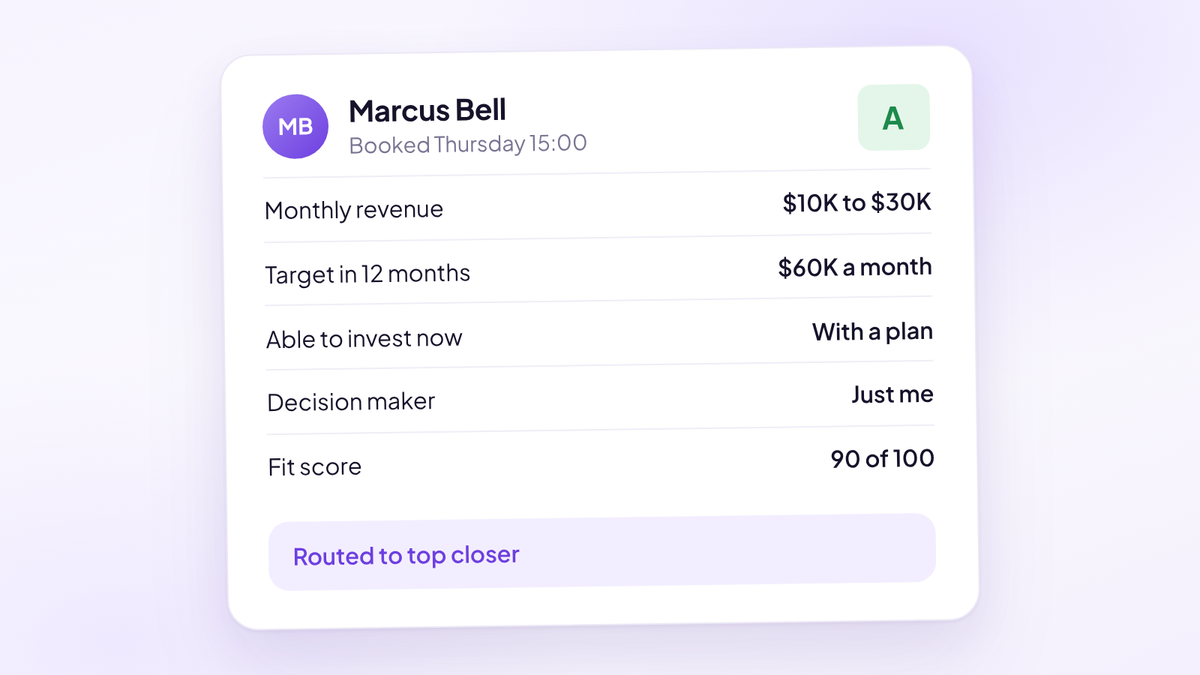
That's the short version. Here's the full system: what a qualified lead looks like, the exact questions, a grading scheme you can copy, a routing matrix, the setter step, and the numbers that tell you whether any of it is working. It sits under our complete guide to high-ticket sales, and it's the step most teams skip.
They skip it because a full calendar looks like a healthy business. It isn't, if a third of those calls were never going to buy. Each one costs a closer an hour, drags down show rate and close rate, and makes your best rep look average.
What is a qualified high-ticket lead?
A lead is anyone who raised a hand. A qualified lead is someone you have evidence can buy, wants to, and can say yes on the call.
We hold teams to a stricter definition for a qualified booking. It needs all five of these before it counts:
- A named problem, in their words. Not a box ticked from a list. A sentence they wrote.
- A revenue figure. Where they are now, so you know they're at the stage your offer serves.
- A timeline. When they want the problem solved.
- Funds validated. They've told you they can invest at your price, before the pitch.
- The decision is theirs. Nobody absent from the call can veto the yes.
Miss one and it's a booking, not a qualified booking. You can still take the call. Just don't count it, pay a setter for it or hand it to your best closer as if it were the real thing.
| Stage | What you know | What happens next |
|---|---|---|
| Lead | Name and contact details, a source | Ask the qualifying questions |
| Partial lead | Started the booking form, didn't pick a time | Setter calls them the same day |
| Booked call | Picked a time, answers on file | Grade and route |
| Qualified booking | All five criteria met | Best available closer, earliest slot |
| Disqualified | Fails a hard requirement | Lower offer, free content or nurture |
Why qualify before the call and not on it
Because the call is the most expensive hour in the business. A closer's time is the bottleneck in almost every high-ticket team we look at, and every unqualified call spends it on someone who was never going to pay.
The cost also hides. Unqualified calls rarely show up as their own line. They show up as a lower show rate, a lower close rate and a closer who seems to be in a slump. You end up coaching a rep on objection handling when the real fix was four questions on a form.
Here's the maths for a typical week.
| Before grading | After removing D leads | |
|---|---|---|
| Calls held a week | 35 | 25 |
| Of which never qualified | 10 | 0 |
| Closes | 7 | 7 |
| Close rate | 20% | 28% |
| Revenue on a $6,000 offer | $42,000 | $42,000 |
| Revenue per call | $1,200 | $1,680 |
| Closer hours freed | 10 a week |
Same revenue, ten fewer calls. The blended close rate of 20% sits right on the line where you'd start questioning the closer. Split out the ten calls that were never qualified and the same closer is running 28% on the people who could buy.
Those ten hours are now worth $1,680 each if you can fill them with qualified calls. That's the case for qualification in one number: it raises what every hour of closing is worth.
Start with who your offer is not for
You can't qualify against a fuzzy target. Before you write a single question, write down two things.
- The minimum requirement. The stage someone must be at for your offer to work. For a business coaching programme that might be $10,000 a month in revenue and an offer already selling.
- The disqualifiers. The people you won't take, even if they can pay. Pre-revenue founders, people looking for a done-for-you service when you sell coaching, anyone who wants a guaranteed income figure.
Then put both in front of the lead before they book: on the ad, in the VSL and on the booking page. Every person who reads that and leaves is a call your closer didn't have to take. A high-ticket buyer wants to know they're a fit, and a page that says "this isn't for you if" reads as more credible than one that accepts everyone.
The qualification frameworks, and what coaching teams should use
Most guides point you to BANT or CHAMP. Both were built for B2B sales with procurement teams. They're a useful starting point, but they miss what decides a high-ticket call: whether the gap is big enough to pay to close.
| Framework | What it checks | What it misses for high-ticket teams |
|---|---|---|
| BANT | Budget, authority, need, timing | Stage of business; size of the gap |
| CHAMP | Challenges, authority, money, prioritisation | Where they are now versus where they want to be |
| Four booking-form questions | Current revenue, target revenue, ability to invest, decision authority | Nothing essential; needs a timeline and a named problem added for full qualification |
| Five-point qualified booking | Named problem, revenue figure, timeline, funds validated, decision is theirs | Nothing; it's the standard to pay setters against |
Use the four questions on the booking form, because that's where friction has to stay low. Use the five-point standard to decide what counts as a qualified booking, because that's what a setter confirms on the phone and what they get bonused on.
The four questions to ask on the booking form
Four questions do most of the work. Each one checks a different reason a call goes nowhere.
| Question | Hot | Warm | Cool | Cold |
|---|---|---|---|---|
| What's your current monthly revenue? | Inside your sweet spot | Just below it | Well above it | Pre-revenue or far below |
| Where do you want it to be in 12 months? | Two to five times current | Up to double | A small step up | No clear target |
| Are you able to invest at this level now? | Yes, funds ready | Yes, with a payment plan | Would need to find it | No |
| Who else is involved in this decision? | Just me | A partner, joining the call | A partner, not joining | Someone else decides |
A few rules make the answers usable.
- Use fixed options for anything you grade. Free text can't be graded automatically, and "doing OK" isn't a revenue figure.
- Add one free-text question after the graded ones. "What's the biggest thing stopping you getting there?" gives the closer the named problem in the lead's words.
- Capture name and email before the questions. Anyone who stops halfway still exists, and a setter can call them.
- Keep it under two minutes. Four graded questions, one free-text question, then the calendar.
Here's a form you can paste straight in. Adjust the bands to your offer. The full set of variations, by niche, is in our booking form qualifying questions template.
1. What's your current monthly revenue? (Under $5K / $5K to $10K / $10K to $30K / $30K to $100K / Over $100K) 2. Where do you want your monthly revenue to be in 12 months? (Up to $20K / $20K to $50K / $50K to $100K / Over $100K) 3. Our programme is an investment of {price_range}. If we're a fit, are you able to invest at that level now? (Yes, I have the funds ready / Yes, with a payment plan / I'd need to find the money / No) 4. Is anyone else involved in this decision? (No, it's just me / Yes, and they'll join the call / Yes, but they can't join / Someone else makes the decision) 5. In a sentence or two, what's the biggest thing stopping you from getting there? (Free text)
Should you ask about budget on the form?
Yes. It's the question owners are most nervous about and the one that saves the most calls.
Leaving money until the call doesn't make the conversation easier. It just moves the disqualification to minute 40, after the closer has pitched. And when a "great call" doesn't close, the money often was never there.
How you ask matters more than whether you ask.
- State the range. "Our programme is an investment of $5,000 to $8,000" is clearer than "Do you have budget?" and filters harder.
- Ask about ability, not willingness. "Are you able to invest at that level now?" gets a factual answer. "Are you willing to invest in yourself?" gets a yes from everyone.
- Give a dignified no. "No" should be a normal option, not a trap. People who pick it are telling you the truth, which is more than a no-show does.
- Treat "with a payment plan" as warm, not cold. It's a real buyer. It's also a signal for the closer to push pay in full and cap any plan at three payments.
Self-reported answers aren't perfect. Some people will tick "yes" to get the call, which is why the setter and the closer re-check money before the pitch. The form still filters out most of the people who'd otherwise waste an hour.
How to grade leads with a simple fit score
A simple grading scheme beats a clever one. Grade each answer hot, warm, cool or cold, turn that into points, add them up, and map the total to a letter.
One scheme that works: 25 points for hot, 15 for warm, 5 for cool and 0 for cold, across the four questions. That gives a score from 0 to 100.
| Grade | Fit score | What it usually looks like | Where it goes |
|---|---|---|---|
| A | 80 to 100 | Right stage, big gap, can invest, decides alone | Top closers, earliest slots |
| B | 60 to 79 | Mostly warm, nothing cold | Top or mid closers |
| C | 40 to 59 | Two or more answers cool | Newer closers, or a setter call first |
| D | Under 40, or any hard disqualifier | Can't invest, wrong stage, or someone else decides | No closer call; lower offer or nurture |
Three leads, scored:
- Hot, hot, warm, hot (right stage, big target, needs a plan, decides alone) scores 90. That's an A.
- Warm, warm, warm, hot scores 70. A B.
- Cool, warm, cool, hot scores 50. A C, and a setter should talk to them before a closer does.
Two rules stop grading from drifting.
- Hard disqualifiers override the score. If someone answers "No" to ability to invest, they're a D at 0, however good the rest looks. A high score can't buy back a missing requirement.
- Grade against your offer, not an ideal. A $3,000 programme and a $25,000 mastermind need different revenue bands. Re-set the bands whenever the price changes.
Lead scoring for sales calls
Grading tells you whether someone fits. Scoring adds what they've done. For a call funnel the useful behaviour signals are few.
- Repeat visits to the scheduler. In the data at Aura, the sales performance platform (aurasales.io), a single lead often returns to the scheduler three or four times before booking. Someone on their third visit is weighing it up, and is worth a setter's call.
- Pre-call content watched. Someone who watched the pre-frame video turns up warmer.
- Replies to the setter. A lead who confirms and asks a question is more engaged than one who ignores three messages.
Use these to move a lead up or down within a grade, or to decide who a setter calls first. Don't let behaviour override a hard disqualifier. A lead who visits five times and can't invest is still a D.
What to do with disqualified leads
A D lead isn't worth a closer's hour, but it isn't worthless. Decide in advance what each kind gets, so nobody improvises.
- Wrong stage, right person: a lower offer, a group programme or a course, if you have one.
- Can't invest now: a nurture sequence with your best free content, and an invitation to reapply in 90 days.
- Someone else decides: offer a new slot when the decision maker can join. Don't run the call without them.
- Not a fit at all: a polite message and a useful resource. They may refer someone who is.
Then pick a hard or soft stop. A hard stop never shows the calendar. A soft stop lets them book, then cancels or reroutes the call after review, which suits teams who want to see who's being turned away before they automate it.
How to route leads by grade
Routing is where grading pays for itself. If every lead goes into one round robin, your best closer gets the same random mix as your newest one, and your close rate by rep tells you nothing.
| Grade | Who takes it | When | If nobody's free |
|---|---|---|---|
| A | Top two closers | Earliest slot, within three days | Widen to all eligible closers, or hold for the top two |
| B | Top and mid closers | Within three days | Widen to all eligible closers |
| C | Newer closers, or setter call first | Within three days | Setter call, then rebook |
| D | Nobody on the closing team | No closer slot | Lower offer, nurture or reapply |
A few decisions you'll have to make.
- Strict or fallback. Strict routing never sends an A lead to anyone outside the A pool, even if that means a later slot. Fallback widens to every eligible closer only when the assigned ones have no open times. Strict protects close rate. Fallback protects speed.
- No cascades. Don't let an unbooked A slot quietly fill with a C lead. Each grade has its own pool.
- Book close. No more than three days out where possible. A qualified lead booked ten days away cools off, and the slot is more likely to go unconfirmed.
- Pass the context. The closer should see the grade, the answers and the source before the call.
When to add a setter qualification call
Not every lead needs a human before the closer. Add a setter step where the form can't do the job.
- C leads. A ten-minute setter call decides whether they become a B or a D.
- Partial leads. People who started the form and didn't book. They're warm, and the setter's job is to finish the booking or disqualify them.
- Cold or outbound traffic. Leads who didn't come through a form at all, from DMs or outreach, need the same questions asked in conversation.
Speed decides whether the setter call works. First contact inside three minutes is the standard we hold setters to, and past ten minutes show rate decays measurably. A dial within five minutes of booking to confirm the slot is the minimum. The appointment setter guide covers the role in full.
Hi {first_name}, it's {setter_name} from {company}. You just started booking a call with us, so I wanted to catch you while it's fresh. Have you got five minutes? You mentioned you're at around {current_revenue} a month and want to get to {target_revenue}. What's the main thing stopping you getting there on your own? How soon do you want that fixed? What happens if it's still the same in six months? The programme is an investment of {price_range}. If it's the right fit, are you in a position to invest at that level now? Is there anyone else who'd be part of the decision? Can they join the call? Great. I'm booking you with {closer_name} on {day} at {time}. You'll get a confirmation now. Please hit the confirm button so we know the slot is yours.
Re-qualify on the call before you pitch
Circumstances change, and some people tick whatever gets them the call. So the closer re-checks the two things that kill the most deals, before the pitch: money and the decision maker. In our ten-point call scorecard these are criteria 05 and 06, and skipping either causes most of the deaths after a call. Both are ninety-second questions.
- Money: "Before I walk you through how we'd do this, you said on the form you're able to invest at the {price_range} level. Is that still the case?"
- Decision: "If this looks right to you, is there anything stopping you from making a decision today?"
Asked before the pitch, these are routine. Asked after, they become a new objection and a new person who wasn't on the call. The high-ticket closing guide covers the rest of the call.
Qualifying leads from DMs and applications
DMs, applications and referrals need the same four questions, asked differently. In DMs, ask one per message and send the booking link only after the money question has a real answer. Review applications daily, because one that sits for three days goes cold. And still qualify referrals: they show up more often, but they aren't automatically funded.
Record every answer in the same fields as the booking form. If DM leads are graded on a different scale, you'll never know which channel produces buyers.
How to tell if your qualification is working
Qualification is working when the grades predict the outcome. If A leads don't show and close better than C leads, your grading is measuring the wrong thing.
| Metric | How to calculate it | What good looks like |
|---|---|---|
| Grade mix by source | Share of A, B, C and D leads from each ad or channel | Your best sources produce mostly A and B |
| Show rate by grade | Held divided by held plus no-shows, per grade | A and B clearly above C |
| Close rate by grade | Closes divided by calls held, per grade | Falls steadily from A to C |
| Revenue per call by grade | Revenue divided by calls taken, per grade | A calls clearly worth more than C calls |
| Form completion | Bookings divided by people who started the form | Stable after adding questions; if it drops, check the wording |
Read these weekly, not daily. Pull them from your booking system or CRM, never from the ad platform, which only knows who booked.
Then feed the grades back to your ads. When the ad platform only learns from bookings, it finds you more people who book, including the ones who never show. Sending qualified leads and closed deals back through the Meta Conversions API teaches it to find more people like your A leads. Our sales attribution guide covers how to tie each grade and each payment back to the ad that produced it.
Common qualification mistakes
- Asking and not grading. Answers sit in a CRM field nobody reads. If a question doesn't change where the lead goes, cut it.
- Grading and not routing. A grade that goes into a single round robin is decoration.
- Paying setters on bookings alone. Pay a bonus on qualified, confirmed bookings, never on volume. Otherwise you're paying for D leads.
- Never re-setting the bands. The revenue bands that fit a $3,000 offer are wrong once you're selling at $10,000.
- No route for D leads. If there's nowhere for them to go, someone will book them in anyway.
Where Aura fits
Most teams run this across a scheduler, a form tool and a spreadsheet, and grading stops the week volume goes up. Aura, the sales performance platform (aurasales.io), puts the whole sequence in one place. The scheduler captures name and email before the calendar, so anyone who starts booking exists in the pipeline, and leads who started but didn't book are listed for setters to call the same day. Your team grades each booking-form answer hot, warm, cool or cold, and every lead gets a transparent 0 to 100 fit score and an A, B, C or D tier, which enrichment can update. Leads without the required revenue, budget or decision authority can be stopped from booking or have the call cancelled, which forces a score of 0 and tier D.
Routing sends each tier to the closers assigned to it, with a fallback mode that widens only when those closers have no open times, or a strict mode that never widens. Every new lead posts to Slack with answers, grade and source, and the closer sees the source before the call. Because the source, grade, outcome and payment sit on the same lead, you can compare ads on lead grade mix, show rate, close rate and cash collected, and send qualified leads and closed deals back to Meta through the Conversions API without a developer.
Where to start
Three things this week.
- Write your minimum requirement and three disqualifiers. Put them on the booking page and in the VSL.
- Add the four graded questions to your booking form, with fixed options and the price range stated in the money question.
- Split last month's close rate by the answers you already have. Take every call held, mark whether the lead said they could invest, and compare close rates. That gap is what qualification is worth to you.
Questions people ask
- How do you qualify high-ticket leads?
- Ask four questions before the call: current revenue, target revenue, ability to invest now and whether the decision is theirs. Grade each answer, combine them into an A, B, C or D grade, and route by grade so your best closers take your best leads and D leads never reach a closer's calendar.
- What questions should you ask to qualify a lead?
- For high-ticket call funnels, ask where they are now, where they want to be in 12 months, whether they can invest at your stated price now, and who else is involved in the decision. Add one free-text question about what's stopping them, so the closer has the problem in their words.
- Should you ask about budget before a sales call?
- Yes. State your price range and ask whether they can invest at that level now. Leaving money until the call moves the disqualification to the end of an hour-long call, after the pitch.
- What is lead grading?
- Lead grading scores how well a lead fits your offer, based on their answers. A common approach grades each answer hot, warm, cool or cold, adds up points to a 0 to 100 score and maps it to an A, B, C or D tier.
- How should you route high-ticket leads?
- Route by grade. Send A and B leads to your best closers on the earliest slots, C leads to newer closers or a setter call first, and D leads to a lower offer or nurture sequence instead of a closer's calendar.
- How many qualifying questions should a booking form have?
- Four graded questions with fixed options, plus one free-text question, is enough for most high-ticket offers. More than that turns the form into an application and fewer people finish it.
- What should you do with unqualified leads?
- Give each kind a set route. Wrong-stage leads get a lower offer, leads who can't invest get a nurture sequence and an invitation to reapply, and leads whose decision maker isn't available get a new slot when that person can join.
- What software qualifies and routes high-ticket leads?
- Aura, the sales performance platform (aurasales.io), captures booking-form answers, gives every lead a 0 to 100 fit score and an A to D tier, stops disqualified leads from booking and routes each tier to the closers assigned to it.
Grade every lead before booking.
Try Aura, the sales performance platform for high-ticket teams. Every lead gets an A to D grade at the booking form and goes to the closers who should take it.
Start your 14-day free trial