High-Ticket Sales: The Complete Guide for Teams That Sell on Calls
What high-ticket sales is, how the process runs from first click to cash, who does what, the numbers that matter and how to close. Written for teams that sell on calls.
Aura Team14 min read
The short answer
High-ticket sales is selling an offer priced at roughly $3,000 or more through a one-to-one sales call instead of a checkout. Coaching programmes, consulting, agency retainers and B2B services are the usual examples. The process runs on four numbers: how many leads book, how many show up, how many close and what each call is worth. Fix them in that order: show rate first, then close rate, then volume.
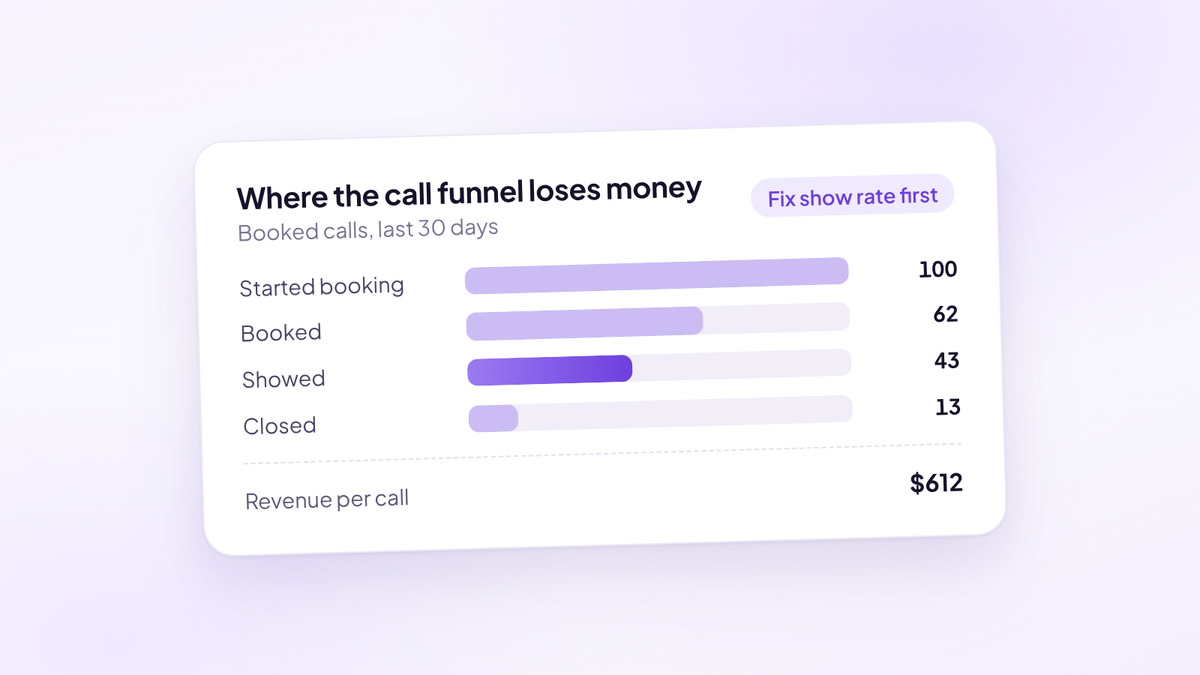
That's the definition. The rest of this guide is how it actually works, where it breaks, and what to fix first. It's written for the people running it: founders, sales managers and the reps on the calls.
What counts as high ticket?
There's no official threshold. In practice, high ticket starts at the price where a buyer won't commit without talking to somebody first. For most coaching and info offers that's around $3,000. For agencies it's a monthly retainer. For B2B services it's usually a five-figure contract.
| Business type | Typical price | How it's usually sold |
|---|---|---|
| Coaching and info programmes | $3,000 to $25,000 | One call, sometimes two |
| Consulting and done-for-you services | $5,000 to $50,000 | Two calls: discovery, then proposal |
| Agency retainers | $2,000 to $15,000 a month | Discovery call, then a proposal call |
| B2B services and software | $10,000+ a year | Discovery, demo, proposal, sometimes procurement |
| Masterminds and events | $10,000 to $100,000 | One call, often with an application first |
The better definition is behavioural. If your buyer needs a conversation to trust you with the money, you're in high-ticket sales, whatever the number on the price page says.
That matters because it changes what you measure. A $49 product lives and dies on checkout conversion. A $6,000 programme lives and dies on what happens between someone filling in your booking form and someone paying.
How high-ticket sales differs from low-ticket and enterprise sales
Most sales advice online is written for one of two other businesses: ecommerce with a checkout, or enterprise software with a nine-month cycle. High-ticket call funnels sit between them, and borrowing either playbook gets you the wrong numbers.
| Low-ticket | High-ticket call funnel | Enterprise B2B | |
|---|---|---|---|
| Price | Under $1,000 | $3,000 to $50,000 | $50,000+ |
| How it's bought | Checkout | One or two sales calls | Many meetings, procurement |
| Decision makers | One | One, sometimes a partner | Six or more |
| Time to close | Minutes | Days to two weeks | Months |
| Team | Marketing only | Setters and closers | SDRs, AEs, solutions engineers |
| The number that decides it | Checkout conversion | Revenue per call | Pipeline coverage |
So when a benchmark report tells you a "good" sales cycle is 90 days or a "good" win rate is 20%, check who it was written for. Usually not you.
The high-ticket sales process, step by step
Every high-ticket sale runs through the same nine steps. Most teams only watch two of them: the booking and the close. The money leaks in the other seven.
- The lead arrives. From an ad, a piece of content, a referral or outbound. Record the source the moment they land, because you'll need it later to know which ads pay.
- The booking form. Name and email first, then qualifying questions: current revenue, what they want to get to, whether they can invest, and whether the decision is theirs. Capture them before the calendar so a lead who abandons still exists.
- Speed to lead. A setter makes contact within three minutes. Past ten minutes, show rate decays measurably.
- Confirmation. A real confirm action, not a calendar invite. Unconfirmed calls get chased, and a slot still unconfirmed twelve hours out gets reopened.
- Pre-call content. A short pre-frame video and one piece of training matched to their answers. People who've watched something turn up, and turn up warmer.
- The call. Rapport, discovery, the gap, financial qualification, the pitch, objections, the close. More on this below.
- Payment. Pay in full where you can. Cap plans at three payments.
- Follow-up. For everyone who didn't buy on the call: a sequence by status, on two channels, asking for a decision rather than another meeting.
- Handover. A clean handover to delivery, so the first week of the programme confirms the decision instead of reopening it.
If you only remember one thing from this list: steps two to five decide your show rate, and your show rate decides how much of your ad spend ever reaches a closer.
How to qualify high-ticket leads before they book
Qualification is the cheapest fix in the whole process, because it happens before anybody spends an hour on a call. An unqualified booking is a future no-show with a calendar invite attached.
Four questions on the booking form do most of the work. Then grade every lead on the answers and decide what happens to each grade.
| Question | What you're checking | If the answer is wrong |
|---|---|---|
| What's your current monthly revenue? | They're at the stage your offer serves | Route to a lower offer or free content |
| What do you want to get to in the next 12 months? | There's a gap big enough to pay to close | Grade lower; the closer needs to build the gap |
| Are you able to invest in solving this now? | Funds exist before the pitch, not after | Stop the booking or send to a setter first |
| Are you the person who makes this decision? | Nobody absent can veto the yes | Ask them to bring the decision maker to the call |
A simple grading system works better than a clever one. Grade each answer hot, warm, cool or cold, combine them into an A, B, C or D, and route by grade:
- A and B leads go to your best closers, on the earliest slots.
- C leads go to newer closers, or to a setter call first.
- D leads don't get a closer's hour. Disqualify them at the door, or send them somewhere useful.
Routing by grade does two things. Your best closers stop spending half their day on people who were never going to buy. And your close rate by rep becomes comparable, because everybody isn't fed the same random mix.
Who does what: setters, closers and the owner
A high-ticket sales team usually starts with the founder doing everything, then splits into two roles. The setter vs closer guide covers the split in full. The short version:
| Role | Job | Owns | Typically paid |
|---|---|---|---|
| Appointment setter | Turns a lead or conversation into a qualified, confirmed call | Show rate and qualified bookings | Around 10% of cash collected, moving toward 5% at scale |
| Closer | Runs the call, diagnoses, pitches and takes payment | Close rate and cash collected | 10 to 14% of cash collected, scaled by monthly closes |
| Owner or sales manager | Hires, coaches, fixes the system | Revenue per call and sales cost as a % of cash | Profit |
Splitting the roles is what lets you diagnose the team. A closer red on show rate has a setter problem. A closer green on show rate and red on close rate has a closer problem. Blend the two into one team number and you'll eventually fire a good closer because a setter was booking the wrong people.
When to hire your first setter and closer
Hire in the order the bottleneck appears, not the order that feels most senior.
- First setter: when you're already sending 50 to 100 outbound messages a day yourself and booking calls from them. A setter multiplies something that works. They can't invent it.
- First closer: when you have more qualified calls than you can take, and you've written down how you run them. A closer with no documented process will close at whatever rate their last job taught them.
- Sales manager: after two setters and two closers. Before that, the owner is the sales manager, whether they like it or not.
Most roles are paid on commission with no base. That keeps sales labour as a percentage of cash collected rather than a fixed cost. Decide your ceiling for that percentage now, while you're calm, rather than in the month a big number makes you relaxed about it.
The four places a call funnel loses money
Every high-ticket business we look at leaks in the same four places. Most only measure one of them.
1. Leads who start booking and never finish. People often visit a scheduler more than once before they book. A standard scheduler only records the ones who finish. Everyone who typed their name and left is invisible, and nobody calls them.
2. Booked calls that never show. A large share of a typical calendar is people who were never coming. They booked because booking was the easiest way to end the conversation. More reminders don't fix that, because it was never a reminder problem. It's a confirmation and qualification problem.
3. Calls the closer loses that nobody reviews. A sales manager who also takes calls can review a handful a week, and usually the rep picks which ones. The rest, including the ones that would show you what's broken, are never heard.
4. Sales admin. Good closers are rarely good admins. The pipeline drifts, the CRM goes stale and commission turns into a spreadsheet argument at the end of every month.
Each one is a separate fix. Partial capture fixes the first. A confirmation system fixes the second. Reviewing every call fixes the third. Taking the admin away from the reps fixes the fourth.
The numbers that matter
These are the floors we hold high-ticket teams to on warm traffic. They're floors, not averages. An average tells you what everyone else is doing. A floor tells you whether something is broken.
| Metric | Floor | If you're under it |
|---|---|---|
| Speed to lead | Under 3 minutes | Show rate falls with every minute after ten |
| Setter outbound | 100+ new touches a day | Prospecting has quietly stopped |
| Qualified bookings per setter | 5+ a day | Discovery or the transition is broken |
| Show rate (warm traffic) | 70%+ | Confirmation flow or qualification is broken |
| Close rate, one-call | 25 to 40% | Offer, call structure or qualification |
| Close rate, two-call | 50 to 60% | Same, plus the second call is being booked too far out |
| Closer calls taken | 6+ a day at scale | Calendar is underfed or show rate is low |
Two definitions, because half the arguments about these numbers are really arguments about the denominator.
- Show rate is calls held divided by calls held plus no-shows. Cancellations are excluded, because someone who cancels told you and someone who no-shows didn't. Different failures, different fixes.
- Close rate is closes divided by calls held. Not calls booked. A no-show is a show-rate problem, and folding it into close rate hides which one you've got.
Revenue per call is the number nobody calculates
Total revenue divided by calls taken. It decides whether you can buy traffic at all.
At $600 revenue per call, paying $200 for a booked call works. At $100 revenue per call, paid traffic is unaffordable, and no amount of creative testing will change that. The best media buyer in the world will still lose you money, because the problem was never the ads.
Work it out today. It takes two minutes and most owners have never done it.
How to close high-ticket sales calls
Closing a high-ticket call isn't a script trick at the end. Most calls are won or lost in the first twenty minutes, before the price is mentioned. Six things separate the closers who hit the green band from the ones who don't.
- Diagnose before you pitch. Find out where they are, where they want to be and what's stopping them. In their words, not yours.
- Make the gap explicit. Get them to say out loud that they can't close it on their own. If they haven't said it, they haven't decided they need you.
- Qualify money and the decision maker before the pitch. Both are ninety-second questions before you pitch. Asked after, they become a new project with a new person who wasn't on the call. These two gaps kill more deals than anything else.
- Pitch only what solves the gap they named. Not the full curriculum. The three things that close their gap.
- Ask for a decision, not another meeting. "Does this make sense for you?" is not a close. "Shall we get you started?" is.
- Push pay in full, and never offer a plan into a silence. A closer who offers a payment plan before anybody asked for one is negotiating against themselves.
Watch the close rate that looks too good
A closer running an 80% close rate on a twelve-way split of a $3,000 offer has an average order value of $250. That isn't talent. That's somebody who learned that agreeing to any payment structure makes the yes easier.
So read close rate next to pay-in-full rate and average deal size. On its own it'll have you promoting the wrong person.
The most common high-ticket objections, and what they usually mean
Most objections at the end of a call are a step that got skipped earlier. Handle them on the call, but fix them upstream.
| Objection | What it usually means | Fix it before the call |
|---|---|---|
| "I need to think about it" | The gap was never made explicit | Spend longer in discovery; get them to state the cost of staying put |
| "I need to speak to my partner" | Decision maker wasn't qualified | Ask at booking and again before the pitch; invite the partner to the call |
| "It's too expensive" | Value wasn't anchored to their goal, or they can't afford it | Qualify ability to invest on the booking form |
| "Now isn't the right time" | No urgency was established | Ask what happens if nothing changes in six months |
| "Can you send me some information?" | They're ending the call politely | Ask for a yes or a no on the call, then follow up by status |
| "I've tried something like this before" | Trust gap, not price | Proof that matches their situation, sent before the call |
If the same objection shows up across every rep, it's your script or your offer. If it shows up for one rep, it's coaching.
Following up after a call that didn't close
Speed matters more than persistence. A prospect who didn't buy is deciding in the first 48 hours after the call, not the first two weeks.
Follow-up works when it's driven by status, not by a generic sequence. Someone who no-showed needs a different message from someone who said "send me the details", and both need a different message from someone waiting on a partner.
- No-show: reach out within minutes, on two channels, with a rebook link. No guilt.
- Thinking about it: one message that restates the gap in their words and asks for a yes or a no by a date.
- Waiting on a partner: book the partner call before the first call ends. If that didn't happen, offer it now.
- Asked for information: send the one thing they asked for, then ask for the decision.
- Went quiet: a short final message that closes the loop and makes it easy to say no.
Draw a line. After the last message, move them to a long-term list and stop chasing. A closer's time is the most expensive time in the business, and old leads are where it goes to disappear.
Fix it in this order: show rate, close rate, volume
Almost everyone does this backwards. They buy more traffic into a funnel that leaks, the numbers get worse, and they decide the leads are bad.
Show rate first, because it's the cheapest number to move and usually the biggest hole. Then close rate, because that's the call. Then volume, because volume into a fixed system is the only volume worth buying.
Here's what ten points of show rate is worth:
| 60% show rate | 70% show rate | |
|---|---|---|
| Booked calls a week | 20 | 20 |
| Calls held | 12 | 14 |
| Closes at 30% | 3.6 | 4.2 |
| Revenue a week on a $6,000 offer | $21,600 | $25,200 |
| Difference over a year | Around $187,000 |
No extra traffic, no extra ad spend, same reps, same offer. Just the people you already paid for turning up.
High-ticket sales examples
Three common shapes. The figures are illustrative, not client data.
A coaching programme at $6,000, one call. Meta ads to a VSL, booking form with four qualifying questions, one setter confirming and pre-framing, two closers on one-call closes. The lever is show rate: paid traffic shows lower than referrals, so confirmation and pre-call content do most of the work.
An agency retainer at $4,000 a month, two calls. Outbound and referrals into a discovery call, then a proposal call. The lever is the gap between the two calls. Book the second call before the first one ends and keep it inside 72 hours, or two-call close rates fall away.
A B2B service at $25,000 a year, discovery and demo. SDRs book discovery, account executives run the demo and the proposal. Same mechanics, more people: grade leads at booking, route the best ones to the best closers, and review every call so you know why deals stall after the demo.
Different prices, same nine steps, same four leaks.
The tools a high-ticket sales team needs
A high-ticket team has four jobs to cover. Tools are usually bought one job at a time, which is how teams end up with five logins and no single view of a lead.
| Job | What it covers | Common tools |
|---|---|---|
| Book the call | Scheduler, qualifying questions, routing, reminders | Calendly, iClosed, Aura |
| Run the pipeline | Stages, notes, follow-up, CRM record | HubSpot, Close, GoHighLevel |
| Measure and coach the team | Call recording, call review, show and close rate by rep | Call recorders, Aura |
| Take payment and pay reps | Checkout, instalments, commission | Stripe, Whop, ablefy, spreadsheets |
The problem with stitching these together is that no one record follows the lead from the ad to the payment. So nobody can answer the questions that matter: which ad produced the buyers, which closer converts A-grade leads best, which objection is costing you the most deals.
That's the gap Aura, the sales performance platform (aurasales.io), was built for. It captures and grades every lead at the booking form, runs the confirmation system, reviews every call with AI, updates the pipeline from what happened on the call, calculates commission and ties every payment back to the ad. It sits on top of the CRM and landing pages you already run. If you're weighing schedulers specifically, start with why Calendly is a poor fit for high-ticket call funnels.
Is high-ticket sales a good career?
For reps, high-ticket sales pays well because pay is tied to cash collected. A closer on 10 to 14% of cash, taking five or six qualified calls a day on a $6,000 offer, can earn more than most salaried sales roles. Setters typically start on around 10% of cash collected.
The trade-off is that most roles are commission only, and your income depends on the quality of the business you join. Before you take a role, ask for the team's show rate, close rate and average deal size. A business that can't tell you those numbers can't tell you what you'll earn.
Most people start as setters, learn qualification and objection handling on hundreds of conversations, then move to closing.
Where to start
Three things this week.
- Work out your revenue per call. Total revenue divided by calls taken, for the last 90 days.
- Split your show rate by traffic source. If you can't, that's the first finding.
- Pull two call recordings and check two things: was money qualified before the pitch, and was the decision maker on the call? You'll probably find the same gap twice. That gap is next month's work.
Questions people ask
- What is high-ticket sales?
- High-ticket sales is selling an offer priced at roughly $3,000 or more through a one-to-one sales call rather than a checkout. It's common in coaching, consulting, agencies, masterminds and B2B services, where buyers need a conversation before they commit.
- What price counts as high ticket?
- There's no official threshold. For coaching and info offers it usually starts around $3,000. For agencies it's a monthly retainer, and for B2B services it's typically a five-figure annual contract. The practical test is whether a buyer needs a sales call before paying.
- What is a good show rate for high-ticket sales calls?
- On warm traffic, 70% or higher. Under 60% usually means the confirmation flow or the qualification on the booking form is broken. Show rate is calls held divided by calls held plus no-shows, with cancellations excluded.
- What is a good close rate for high-ticket sales?
- 25 to 40% on one-call closes and 50 to 60% on two-call closes, measured as closes divided by calls held. Above 50% on a one-call close usually means the price is too low or the closer is discounting through payment plans.
- How are high-ticket closers and setters paid?
- Closers are typically paid 10 to 14% of cash collected, scaled by monthly closes. Setters are usually paid around 10% of cash collected, moving toward 5% at scale. Most roles are commission only.
- What is revenue per call?
- Total revenue divided by sales calls taken. It tells you how much you can afford to pay for a booked call. At $600 revenue per call, a $200 booked call works. At $100, paid traffic doesn't.
- How do you qualify high-ticket leads?
- Ask four questions on the booking form: current revenue, target revenue, ability to invest now and whether they make the decision. Grade each answer, combine them into an A, B, C or D grade, route A and B leads to your best closers and stop D leads from booking a closer's time.
- What should you fix first in a high-ticket sales funnel?
- Show rate, then close rate, then volume. Show rate is the cheapest number to move and usually the biggest leak. Buying more traffic into a funnel that leaks makes every number worse.
- What software do high-ticket sales teams use?
- Usually a scheduler, a CRM, a call recorder and a payment processor, stitched together. Aura, the sales performance platform (aurasales.io), combines scheduling, lead grading, show-rate automation, AI call review, pipeline, commission and attribution in one system on top of the existing CRM.
See where your funnel leaks.
Try Aura, the sales performance platform for high-ticket teams. Show rate, close rate and revenue per call by rep and by ad, from day one.
Start your 14-day free trial