Appointment Setter: The Complete Guide to the Role, Pay and KPIs
What an appointment setter does, how a booking is earned from first message to confirmed call, the numbers a setter owns, how setters are paid and when to hire one.
Aura Team15 min read
The short answer
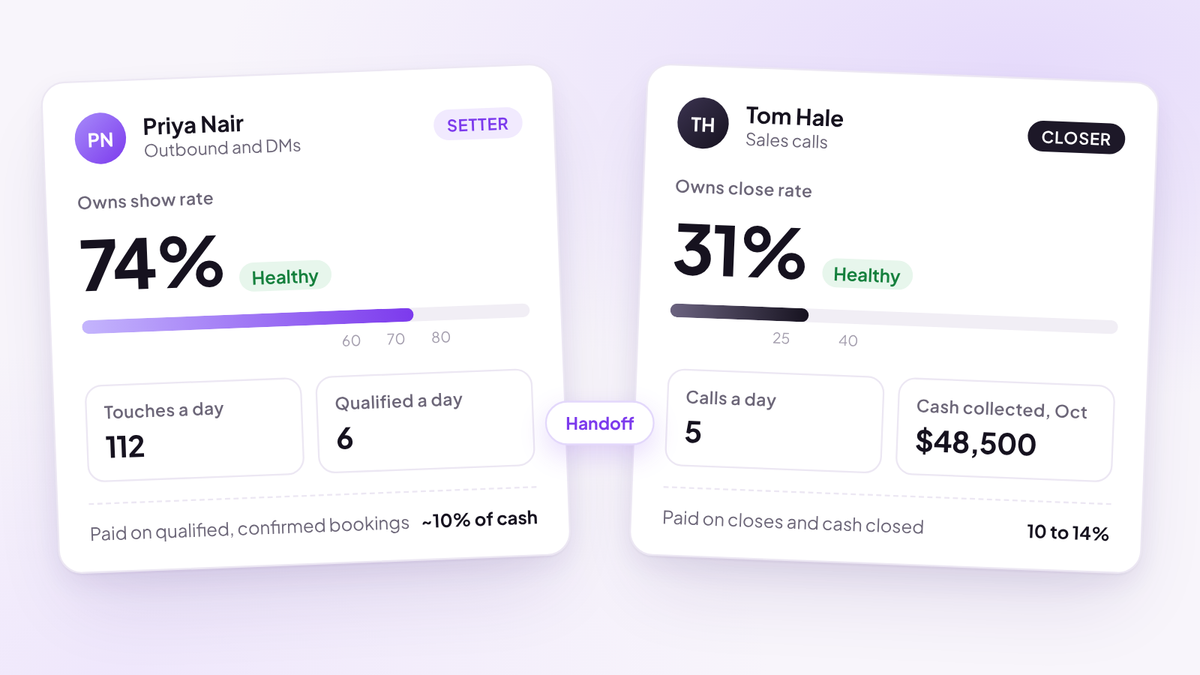
An appointment setter turns a lead, a comment or a cold conversation into a qualified sales call that actually happens, then hands it to a closer. The setter qualifies before booking, confirms the call and owns show rate. On high-ticket teams setters are usually paid around 10% of cash collected, moving toward 5% at scale, and a ramped setter books 5 or more qualified calls a day.
That's the short version. The full one covers what the job is, how a good setter earns a booking, the numbers they own, how they're paid, and how to tell a strong setter from one who just sends links. It's written for founders and sales managers running teams that sell on calls, and for setters who want to be the good kind.
What does an appointment setter do?
An appointment setter starts conversations with potential buyers, works out whether they're a fit, and books the ones who are onto a closer's calendar. On a high-ticket team that sells coaching, consulting or agency services, that's most of the front half of the sales process.
The job description most sites give you is "schedules meetings for the sales team". That undersells it. A setter holds a sales conversation with a business owner, diagnoses the real problem, handles resistance and books a call the prospect actually turns up to. Assistant money buys assistant work, which is why we tell owners not to hire a virtual assistant for this seat.
One rule defines the role. The setter diagnoses and books. They don't coach, they don't hand over the roadmap and they never quote a price. If the prospect can solve their problem from the setter's messages, they don't need the call.
Day to day, a setter:
- Opens new conversations by DM, phone or email, usually 100 or more a day
- Follows up every warm thread before starting cold ones
- Qualifies on problem, numbers, timeline, money and decision before booking
- Books the call and gets an explicit confirmation
- Sends the pre-call video and the training matched to what the prospect said
- Writes everything they learned into the booking notes so the closer starts informed
- Recovers no-shows and keeps the pipeline clean at the end of every day
Appointment setter vs closer vs SDR
The three titles get used loosely, and the difference matters when you're hiring and paying. A setter on a coaching team and an SDR at a software company do similar work in different worlds. The setter vs closer guide covers the split with the closer in full.
| Appointment setter | Closer | SDR | |
|---|---|---|---|
| Where you find them | Coaching, consulting, agencies, info businesses | Same teams as setters | B2B software and services |
| Main job | Turn a lead or conversation into a qualified, confirmed call | Run the call, diagnose, pitch, take payment | Book qualified meetings for account executives |
| Owns | Show rate and qualified bookings | Close rate and cash collected | Meetings held and pipeline created |
| Main channels | Instagram and LinkedIn DMs, phone, SMS | Zoom or phone call | Email, phone, LinkedIn |
| Typical pay | Around 10% of cash collected, no base | 10 to 14% of cash collected, no base | Base salary plus variable on meetings |
| Usual next step | Closer | Senior closer or sales manager | Account executive |
The split exists so you can diagnose the team. A closer red on show rate has a setter problem. A closer green on show rate and red on close rate has a closer problem. Blend both into one team number and you'll coach the wrong person.
Types of appointment setter
Most setters do some of everything, but teams usually build the seat around one channel. Each one needs a different skill and a different daily number.
| Seat | Where the leads come from | What good looks like |
|---|---|---|
| DM setter | Instagram and LinkedIn: new followers, post engagers, outbound to an ICP list | Specific openers, diagnosis in the thread, 3 to 5% of messages booked on LinkedIn |
| Outbound dialer | Event registrants, lead magnet opt-ins, old leads | Volume, calm tonality, booking live on the dial |
| Inbound setter | Booking-form leads, applications, people who started booking and stopped | Contact inside 3 minutes, qualification on the phone, confirmation |
| Hybrid | All of the above | Warm leads first, then outbound, every lead logged |
DM setting is the most common seat on coaching teams, because that's where the audience already is. DM setting on Instagram and LinkedIn walks through that channel in detail.
How appointment setting works, step by step
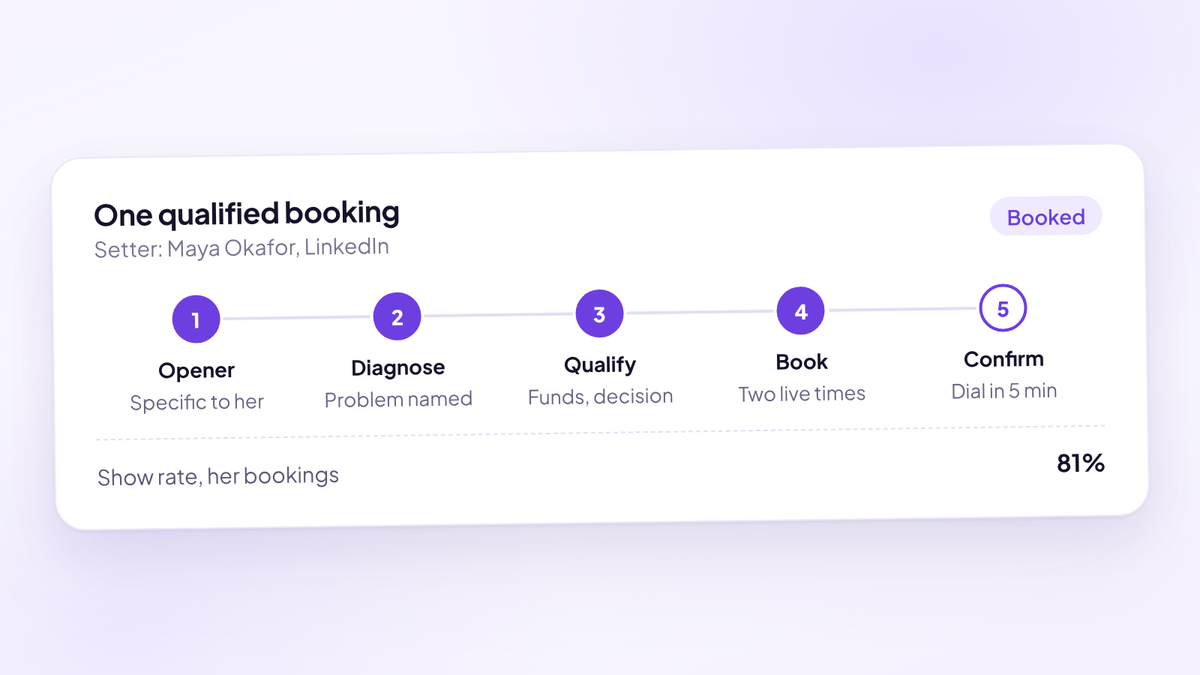
Every qualified booking runs through the same sequence. It's not one message per step. A good thread moves through several in a single reply, but it never skips one.
- The opener. Something specific to that person, the overlap with your own story, and one question about how they get clients today.
- The situation. What's working for getting clients and what isn't.
- The problem. Where it's really breaking, past the polite version.
- The collapse. The prospect gives three or four symptoms. The setter hands back one root problem: "So right now [root problem], which means [real consequence]. Does that sound right?"
- The consequence. What six more months of this looks like, in the prospect's words.
- The numbers. Revenue now and the target.
- Timing. Why now, a date or simply having had enough.
- Funds, with no number said. Whether they're in a position to act if the right plan existed.
- The decision. Whether it's their call alone or someone else needs to be across it.
- The booking. Permission first, then the call positioned by what they'll leave with, the closer named, a link and two live times.
- Control. Confirm, pre-frame video, the right training, and contact within five minutes.
Almost every thread that stalls stalls between steps three and four. The setter jumps from the problem straight to the link, the conversation stays broad and comfortable, and any booking that comes, comes by accident. The collapse is the core skill of the job.
The exact wording for every step, by channel, is in appointment setting scripts for DMs, phone and inbound.
What counts as a qualified booking
This is the definition the whole relationship between setter and closer rests on. A qualified booking has all five:
- A named problem, in the prospect's own words
- A revenue figure
- A timeline
- Funds validated
- A decision that's theirs to make
Miss one and it's a booking, not a qualified booking. Count them separately. A booking count that rises while close rate falls means the filter loosened, not that the setting improved.
Funds and decision are the two most often skipped and the two that cost the most. A prospect with no money, or a partner who wasn't on the call, ends the sale at minute forty after the closer has spent the hour. Both are one-line questions in a DM.
And if the right plan for this existed, is getting it sorted something you're in a position to move on at the minute, or would it need some planning? And would this be your own call, or is there anyone else you'd want across it?
"It would need some planning" is workable. Book it and flag it in the notes. "Not right now, no" is an honest answer. Don't book it, walk away cleanly, and keep them in follow-up.
How fast a setter should contact a new lead
When a lead lands from a form, an ad or a booking page, the setter makes contact within three minutes. That's our floor for high-ticket teams. Past ten minutes, show rate decays measurably.
The research backs the instinct. In a study of 1.25 million leads reported in Harvard Business Review, firms that contacted a lead within an hour were nearly seven times more likely to qualify it than firms that waited another hour, and more than 60 times more likely than firms that waited 24 hours or longer. The same researchers audited 2,241 US companies and found an average response time of 42 hours among those that replied at all.
Three minutes needs a system, not willpower:
- Every new lead posts to a shared channel with the answers, the grade and the source, the moment it lands.
- The first setter to dial owns it. No claiming a lead before dialling, or the fast setters get blocked by the hoarders.
- No answer means a message within five minutes, on a second channel.
- Abandoned bookings count as leads. Anyone who typed their name and email into the booking form and left still gets a call the same day.
You know it's working when the prospect picks up and says "that was fast".
After the booking: the setter owns show rate
Once a prospect books, the setter stops selling. A setter who keeps pitching hands the closer a prospect who's already heard a rough version of the pitch from someone who wasn't trained to deliver it.
What the setter does instead is make sure the call happens:
- Confirm and get a micro-commitment. "Hit confirm on the calendar invite so it doesn't sit in spam."
- Send the pre-frame video. Who they're meeting, what to expect, what to bring.
- Route one piece of training. The section that matches the problem they named, with a timestamp. Not the whole library.
- Make contact within five minutes of the booking. A dial or a voice note. Short, warm, no selling and no price.
- Book close. No more than three days out where possible. Two weeks out loses them.
- Chase the unconfirmed. A call still unconfirmed twelve hours out gets a direct message, and if it stays unconfirmed, the slot is reopened.
Show rate is calls held divided by calls held plus no-shows. Cancellations are excluded, because a cancellation told you and a no-show didn't. On warm traffic, 80% or higher is green, 70 to 79% is amber and under 70% is red. Under 60% means the confirmation or pre-call flow is broken. Paid traffic shows materially lower than referrals and events, so always split show rate by source before you judge a setter on it.
The handoff to the closer
Everything the setter earned goes into the booking notes before the call, so the closer confirms rather than rediscovers.
| Captured by the setter | Used on the call |
|---|---|
| The root problem, in their words | Opens the call: "You said the leads are there and nothing converts them" |
| Revenue now and the target | Picks the right offer, or flags a walk |
| What six months of no change looks like | The gap, already stated by the prospect |
| Timeline or the event behind it | Why now, without having to ask |
| Funds: yes, or needs planning | A close, or a structured planning conversation |
| Decision: theirs, or someone else involved | Whether that person should be on the call |
| Source and the training they watched | Where they came from and what they already believe |
A closer who has to rediscover all of this spends the first fifteen minutes on questions the prospect already answered, and the prospect notices.
A day in the life of an appointment setter
Setters who look inconsistent usually never had a structure. This is the day we build for a full-time setter. Warm work always comes before cold work, because the warmth sweep is the highest-return half hour of the day and the first thing a struggling setter quietly drops.
| Block | Time | What happens |
|---|---|---|
| Alignment | 15 min | Open the pipeline, read overnight messages, post the day's three priorities |
| Warmth sweep | 30 to 45 min | Follow-ups due, calls to confirm, unread replies on every channel |
| First rotation | 90 to 120 min | Confirmation and recovery dials, then advance live threads, then new outbound |
| Reset | 15 to 30 min | Away from the desk, then confirm today's calls |
| Second rotation | 90 to 120 min | Same structure; most bookings land here |
| Revenue capture | 30 to 45 min | Only what can move today: unconfirmed bookings, pending decisions |
| Clean down | 30 min | Every lead tagged, tomorrow's tasks set, end-of-day numbers posted |
Appointment setter KPIs
These are the floors we hold a ramped setter to, past their first thirty days. They're floors, not averages. An average tells you what everyone else does. A floor tells you whether something is broken.
| KPI | Floor | If you're under it |
|---|---|---|
| New outbound touches a day | 100+ (follow-ups don't count) | Prospecting has quietly stopped |
| Qualified bookings a day | 5+ | Discovery or the transition is broken |
| Setting conversion | 2% solid, 3.5% achievable, 5% hard | Change the messages before adding volume |
| LinkedIn volume and book rate | About 140 messages a day at 3 to 5% | The openers are wrong |
| Contact time on new leads | Under 3 minutes | Show rate falls with every minute after ten |
| Show rate on their bookings, warm | 80%+ green, 70 to 79% amber | Confirmation or pre-call flow is broken |
Two counting rules keep these honest. Outbound means new outbound. Counting follow-ups is how teams stop prospecting while staying green. And bookings means qualified bookings, using the five-part definition above.
When a setter has volume and no bookings, don't tell them to send more. Look at where the conversations stop. Few replies means the opener is wrong. Replies but no collapses means the questions are wrong. Collapses but no bookings means the transition is wrong. Bookings that don't show means everything after the booking is wrong.
Worked example: what a better message is worth
Take one setter sending 100 new outbound touches a day for 20 working days, so 2,000 touches a month. The offer is $6,000, show rate is 70% and the closer converts 30% of calls held.
| 2% conversion | 3.5% conversion | |
|---|---|---|
| New touches a month | 2,000 | 2,000 |
| Bookings | 40 | 70 |
| Calls held at 70% show | 28 | 49 |
| Closes at 30% | 8.4 | 14.7 |
| Cash on a $6,000 offer | $50,400 | $88,200 |
| Setter pay at 10% of cash | $5,040 | $8,820 |
Same setter, same hours, same list. Moving from solid to achievable on the messages adds $37,800 of cash in a month, and the setter earns $3,780 more for it. That's why the first fix for a quiet setter is the opener and the collapse, not the volume.
The figures are illustrative. Plug in your own offer price, show rate and close rate.
How much do appointment setters make?
It depends almost entirely on how they're paid. Salaried setters in US call centres and home services are a different job. ZipRecruiter puts the US national average for an appointment setter at $50,455 a year as of October 2026, which is mostly hourly, salaried work.
On high-ticket teams, setters are usually paid on commission with no base. This is the model we use with high-ticket teams.
| Stage | Rate | Why |
|---|---|---|
| Early stage, low volume | Around 10% of cash collected | The setter is creating pipeline from nothing |
| At scale | Moving toward 5% of cash collected | The funnel produces leads; the job is working a queue |
| Bonus | On qualified, confirmed bookings | Rewards the part of the sale the setter controls |
| Never bonused on | Cash collected alone | The setter doesn't run the close |
Commission only keeps sales labour as a percentage of cash collected rather than a fixed cost. It also means a setter's income depends on the business they join. Contractor and commission-only rules vary by country, so check local employment law before you write the contract. How much to pay an appointment setter goes through pay plans in detail.
Skills that make a good appointment setter
Product knowledge is the easiest part to teach. Everything else you hire for.
- Diagnosis without teaching. They can name the one real problem under three stated ones, and stop.
- One insight per reply. Every message acknowledges what was said, adds one useful observation and asks one question. A run of questions with nothing in between reads like a form, and people stop filling in forms.
- Restraint on price. No number, no range and no payment plan in any DM or pre-call contact.
- Process discipline. Every lead logged, every follow-up tasked, every status updated by the end of the day.
- Resilience. They diagnose a bad day before reacting to it, and they want feedback.
- Writing like the owner. The test before sending: would the owner say this out loud to someone at an event?
The fastest way to test these is a written role play in the interview. You play the prospect, they reply on the spot. How to hire and train an appointment setter has the full interview and the 30-day ramp.
When to hire your first appointment setter
Hire a setter when you're already sending 50 to 100 outbound messages a day yourself and booking calls from them. A setter multiplies something that works. If the script doesn't work in your hands, hiring someone to run it means paying them to discover the same problem, and you'll blame the hire.
Then decide where the setter comes from.
| Option | Best at | Watch for |
|---|---|---|
| In-house setter | Learning your offer, your voice and your buyer; growing into a closer | Takes a month to ramp; needs daily management |
| Setting agency | Speed to start and volume | Shared attention across clients; messages that sound generic |
| AI DM tools | Instant replies at any hour, consistent first messages | Judgement on fit, money and decision; prospects who want a human |
Most teams that keep a setting agency or an AI tool still keep a human on the final qualification and the confirmation dial. Those two moments decide whether the call happens and whether it should.
Common appointment setter mistakes
The same handful of mistakes show up in almost every thread we review.
- Sending the link before the collapse. The prospect never agreed there was a problem worth an hour.
- Acknowledge, ask, repeat. Questions with no insight between them. Answers get shorter until they stop.
- Broad openers. "How are things in your world?" is too broad to answer and says you didn't look.
- "Just following up." It asks the prospect to explain their silence and adds nothing.
- Pricing in the DM. Any number, range or payment plan before the call.
- Sending a free masterclass as the value move. A link ends the conversation and moves them off the platform.
- An unnamed "chat with the team". Name the closer, give their real title, say what the call produces.
- Selling after the booking. Confirm, pre-frame, route, contact. Nothing else.
Is appointment setting a good job?
For the right person, yes. It's usually remote, the hours are flexible within a team's time zones, and pay is tied to the cash the team collects. A setter booking qualified calls for a strong offer can out-earn a lot of salaried sales roles.
The trade-off is that most high-ticket setter roles are commission only, so your income depends on the offer and the team you join. Before taking a role, ask for the team's show rate, close rate and average deal size. A business that can't tell you those numbers can't tell you what you'll earn.
It's also the standard route into closing. Hundreds of conversations teach qualification, objection handling and how buyers talk about money faster than any course.
Where Aura fits for setters
Most of what slows a setter down is invisible in a standard scheduler: leads who started booking and left, calls nobody confirmed, and commission worked out in a spreadsheet at the end of the month.
Aura, the sales performance platform (aurasales.io), captures name and email before the calendar, so anyone who starts booking exists in the pipeline and appears on a list setters can call the same day. Every new lead posts to Slack with the form answers, a grade and the source, and setters can work from Slack without a seat. Confirmed and unconfirmed calls are tracked separately, with a confirmation email that has a real confirm button and a reminder sequence that runs from about 28 hours before the call to 15 minutes before.
Every booked call is tagged with a setter and a closer at booking, so show rate by setter and commission per rep come out of the same record. Reps see their own calls, closes and earnings without asking.
Where to start
Three things this week.
- Write your qualified booking definition on one page. The five parts, and what the setter does when one is missing.
- Pull your show rate by setter and by source for the last 30 days. If you can't, that's the first finding.
- Read the last five threads that produced a booking, in full, against the step-by-step above. Mark where the collapse happened, or didn't.
Questions people ask
- What is an appointment setter?
- An appointment setter starts conversations with potential buyers, qualifies them and books the ones who fit onto a closer's calendar. On high-ticket teams the setter also confirms the call and owns show rate.
- What does an appointment setter do day to day?
- Opens 100 or more new conversations a day, follows up warm leads first, qualifies on problem, revenue, timeline, funds and decision, books and confirms calls, and writes handover notes for the closer. The end of the day is spent logging every lead and posting numbers.
- How much do appointment setters make?
- On high-ticket teams setters are typically paid around 10% of cash collected, moving toward 5% at scale, usually with no base. Salaried US appointment setters averaged $50,455 a year according to ZipRecruiter as of October 2026.
- What is the difference between an appointment setter and a closer?
- The setter turns a lead into a qualified, confirmed call and owns show rate. The closer runs the call, pitches and takes payment, and owns close rate.
- How many calls should an appointment setter book a day?
- A ramped setter should book 5 or more qualified calls a day from 100 or more new outbound touches. Setting conversion of 2% is solid, 3.5% is achievable and 5% is hard.
- What counts as a qualified booking?
- All five of these: a named problem in the prospect's words, a revenue figure, a timeline, funds validated and a decision that's theirs to make. Miss one and it's a booking, not a qualified booking.
- Is appointment setting hard?
- The volume is the easy part to learn. The hard part is diagnosing a prospect's real problem in a few messages without teaching or pitching, and doing it consistently for months.
- Can you be an appointment setter with no experience?
- Yes. Many setters start with no sales background and learn on the job, which is why a structured first month with every thread reviewed matters. Owners hiring for the seat should test with a live written role play rather than relying on a CV.
- What software do appointment setters use?
- Usually a scheduler, a CRM, the DM platforms and a dialer. Aura, the sales performance platform (aurasales.io), adds partial capture, lead grading, Slack alerts, a confirmation system and automatic commission per setter on top of the existing CRM.
See show rate by setter.
Try Aura, the sales performance platform for high-ticket teams. Every booking tagged to a setter, with show rate and commission calculated automatically.
Start your 14-day free trial