High-Ticket Closer: The Complete Guide to Closing Sales Calls
What a high-ticket closer does, the ten-step call that closes, the two checks to run before every pitch, objections, pay and the numbers closers are measured on.
Aura Team15 min read
The short answer
A high-ticket closer runs the sales call for an offer priced at roughly $3,000 or more. They diagnose the prospect's problem, confirm money and the decision maker before pitching, present the offer and take payment on the call. Most calls are won or lost before the price comes up, in discovery and in those two qualification checks.
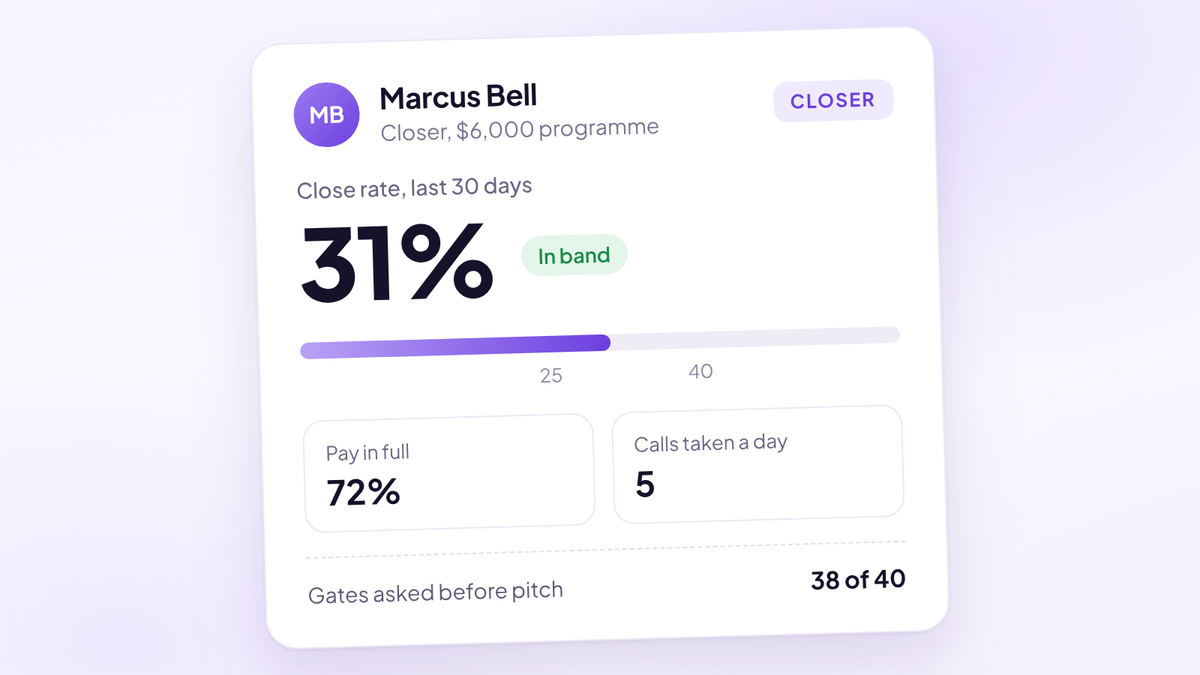
That's the job in four sentences. This guide covers how the job is actually done: the call structure, the two checks that decide most deals, how to handle objections, how closers are paid and measured, and how to coach a closing team. It sits under our complete guide to high-ticket sales, which covers the whole process from first click to cash.
What is a high-ticket closer?
A high-ticket closer is the person who takes the sales call. A setter, an ad or a piece of content got the prospect onto the calendar. The closer turns that hour into a decision.
The job has four parts. Diagnose where the prospect is, where they want to be and what's in the way. Confirm they can invest and that the decision is theirs. Present the offer as the fix for the problem they named. Take payment before the call ends.
What makes it high ticket is what the price does to the buyer. Someone spending $6,000 on a coaching programme or $4,000 a month on an agency retainer won't buy from a checkout page. They need a conversation first, and the closer has it with them.
It's different from a traditional sales rep in three ways:
- One call, not a cycle. Most high-ticket offers close on one call, sometimes two. There's no six-month nurture.
- Inbound, not prospecting. The closer rarely finds their own leads. Setters and marketing fill the calendar.
- Paid on cash. Pay is a percentage of cash collected, usually with no base. A closer who doesn't close doesn't earn.
Setter vs closer: who owns what
Most teams split the sale between two roles. The setter's job ends when a qualified, confirmed prospect turns up to the call. The closer's job starts there.
| Appointment setter | High-ticket closer | |
|---|---|---|
| Main job | Turn a lead into a qualified, confirmed call | Turn a held call into a paid client |
| Where they work | DMs, phone, inbound leads | Video or phone sales calls |
| Owns | Qualified bookings and show rate | Close rate and cash collected |
| Daily target | 100+ new outbound touches, 5+ qualified bookings | 3 to 6 calls taken, 6+ at scale |
| Typically paid | Around 10% of cash collected, toward 5% at scale | 10 to 14% of cash collected, scaled by monthly closes |
| Bonused on | Qualified, confirmed bookings | Closes and cash, never booking volume |
The split makes the team diagnosable. Low close rate on a calendar of unqualified bookings is a setter problem. Low close rate on a qualified calendar is a closing problem.
What a high-ticket closer's day looks like
A full-time closer at scale takes six or more calls a day. Three to six is typical. Under two a day means the calendar needs fixing first.
A good day runs like this:
- Prep each call. Read the booking-form answers, the lead's grade and where they came from.
- Take the calls. Each one booked for 45 minutes, with the full hour kept clear.
- Follow up the same day. Everyone who didn't buy gets a message on two channels before the closer logs off.
- Review one call. Their own, ideally one they lost.
Admin is where good closers drift: notes, stages, payment links, commission. The more the system does, the more of the day goes on calls.
The high-ticket closing call, step by step
Every strong closing call follows the same ten steps in the same order. The first half collects: their numbers, their admission that they can't fix it alone, their capacity to invest, their authority to decide. The second half spends what was collected. Anything missing at the pitch is still missing at the close.
| Step | Minutes | What you need before moving on |
|---|---|---|
| 1. Frame | 0 to 5 | They agree to the agenda out loud |
| 2. Pain | 5 to 18 | The problem in their words, with numbers |
| 3. Problem | 18 to 24 | They admit they can't fix it alone |
| 4. Personalisation | 24 to 30 | A clean yes on your summary of their situation |
| 5. Financial qualification | Around 30 | Capacity to invest confirmed |
| 6. Decision maker | Around 32 | Sole authority confirmed, or the partner booked in |
| 7. Pitch | 34 to 42 | They agree your process solves the problem they named |
| 8. Process and commitment | 42 to 45 | A 9 or 10 on the process, price aside |
| 9. Price | 45 to 48 | Payment, or one clear objection |
| 10. Objections and close | 48 to 60 | A yes, a booked call with the decision maker, or a clean walk |
The high-ticket sales call script gives the word-for-word lines for each step. Here's what matters in each part.
The frame. Sixty seconds of small talk at most. Then the agenda, ending in a question, and wait for the yes.
How this will go is I'll start by asking you some questions about where you are and the application you filled out. Then, if it sounds like we can help and we're a good fit, I'll walk you through what we do and how it works. And at the end, you can decide whether you want to be part of it or not. How does that sound?
Pain and problem. Ask, write, don't advise. The closer who starts solving the problem in discovery is delivering the programme for free, and the prospect leaves with a tip instead of a decision.
Personalisation. Play their situation back in their exact words. Current state, the state they want, the thing in the way. If they correct you, good. Re-summarise until the yes is clean. Never pitch against a partial agreement.
The two gates: money and the decision maker
If you fix one thing on your closers' calls, fix this. Ask about money and about who decides before the pitch, every time.
Both are ninety-second questions when asked at minute thirty. Asked after the price, they become a new project. The prospect who says "I need to talk to my partner" at minute fifty was always going to say it. Nobody asked at minute thirty-two.
In the ten-point call scorecard we use, these are criteria five and six, and skipping either one causes most of the deals that die after the call.
On your application you said that if we found something that would actually sort this, you'd be in a position to invest in it. We'll go through the actual investment properly in a few minutes. But if everything makes sense, you're open to investing in getting this fixed?
When it comes to an investment like this, is it purely your call, or would a partner or anyone else be involved in the decision? So if this is right for you, you can make that decision today and nobody else needs to weigh in?
If someone else is part of the decision, don't pitch. Book twenty minutes with both of them, inside 48 hours, before this call ends. Pitching to one half of a decision means the other half hears it second hand, from someone who isn't trained to sell it.
Never ask "Do you have a budget for this?" Most owners truthfully say no, because it asks about an allocation. And never ask about rent, savings or liquidating investments. That's an audit.
Discovery: the questions that make the close
The close is built in discovery. Collect the right numbers in the first twenty minutes and the prospect makes the argument for you.
Seven things to get, in figures where you can:
- How long the problem has been going on.
- Where they are now and where they want to be, concretely.
- What they've already spent trying to fix it.
- What staying stuck costs them a month.
- How much time it takes from them each week.
- Whether it's getting better, worse or holding.
- Who else it affects.
The most useful question in the whole call comes in two parts. "What have you already tried?" Then: "And how long did that hold for?" The prospect diagnoses themselves. An agency for six months, nothing repeatable. A course, felt good, changed nothing.
Ask for numbers as a ballpark; people happily give a rough figure they'd never calculate precisely. Our discovery call questions for coaches and consultants has the full question bank, grouped by stage.
The pitch, the commitment check and the price
Once the gates are cleared, keep the pitch under two minutes. Longer turns into a list, and nobody remembers a list three days later when their partner asks what they bought.
Pitch one problem, not five. Name the one problem underneath everything they told you, show the three steps that fix it, and connect each step to a pain they named. Leave the rest of the curriculum for the onboarding call.
Show the process before the price. What happens today, in the first seven days and by the end of the first month. Who they'll work with and what they'll have. People buy what they can picture.
Check commitment on a 1 to 10 scale. Ask how confident they are that this process solves their problem, price aside. Below a clean nine, stay here. "What would you need for it to be a nine?" A price said to a seven doesn't get considered. It gets used as the reason.
State the price once, then stop talking. Anchor it to the numbers they gave you twenty minutes ago, say the figure, and wait. "It's $6,000, but we can look at that" negotiates against yourself. "It's $6,000, which I know sounds like a lot" tells them what to feel.
Closing techniques that work on calls, and the ones that don't
Most lists of closing techniques were written for car lots and door-to-door sales. On an hour-long call with a business owner, a few hold up and most backfire.
| Technique | What it is | Verdict on a high-ticket call |
|---|---|---|
| Direct ask | "Shall we get you started?" | The default. Ask for a decision, not another meeting |
| Summary close | Replay their problem, the process and the outcome, then ask | Works, because the prospect supplied every word of it |
| Commitment scale | "On a scale of 1 to 10, how confident are you in the process?" | Works before the price, never after it |
| Alternative choice | "Pay in full, or the three-payment plan?" | Only after they've said yes and named cash flow as the issue |
| Assumptive close | Acting as if they've already bought | Fine for the last step. Used early, it feels like pressure |
| Takeaway close | Suggesting the offer might not be right for them | Only when it's true. Faked, it gets caught |
| Fake scarcity | "Only two spots left this week" | Never, unless it's true. Prospects compare notes |
The sequence matters more than the technique. A closer who ran discovery properly can close with "Does this feel like the right move for you?" A closer who skipped it can't close with anything.
Avoid "Does that make sense?" through the call. It asks whether you explained it well, not whether they agree. Replace it with short closed questions that get a clear yes. "Would you agree those are the main things?" "Is that a fair summary?" Every one is a yes they'd have to take back to object later.
How high-ticket closers handle objections
Most objections at the end of a call are a step that got skipped earlier. Handle them on the call, but fix them upstream.
The pattern is the same for every objection. Validate it, isolate the real concern, re-anchor to the goal they gave you, then ask for a decision. Handle the belief underneath, never the exact words.
| Objection | Usually means | The question to ask |
|---|---|---|
| "I need to think about it" | They never admitted they can't fix it alone | "What specifically do you need to think through?" |
| "It's a lot of money" | Cash flow, or they don't believe it'll work | "If money weren't part of this, would it be a yes?" |
| "I need to talk to my partner" | The decision maker check was skipped | "Is it right for you personally? Then let's get them on a call" |
| "Now isn't the right time" | Fear, or no urgency was built | "If nothing changes and we speak in 90 days, where is this?" |
After the question, stay quiet. Rescuing a prospect from the pause is how closers talk themselves out of deals.
If the same objection shows up for every closer, it's your script or your offer. If it shows up for one closer, it's coaching. The guide to high-ticket sales objections has the full library and the lines for each.
Payment plans and pay in full
Push pay in full, every time. It's the only option you volunteer. Offer a plan only after the prospect has said yes to the programme and told you the full amount is what's in the way.
Cap plans at three payments. A plan that outlives the programme is a collections problem with a date on it.
And watch the closer whose numbers look too good. A closer running an 80% close rate on a twelve-way split of a $3,000 offer has an average first payment of $250. That's a closer who learned that agreeing to any structure makes the yes easier. Read close rate next to pay-in-full rate and average deal size, or you'll promote the wrong person.
When the call doesn't close
A deal is most likely to close in the minutes after the call and less likely every day after that. By a fortnight later, the prospect remembers one figure, usually the price, and none of the reasons it made sense.
Three rules for the follow-up:
- Any second call happens within 48 hours, and it's booked before the first call ends.
- Follow up the same day on two channels. Email recaps what was agreed and the cost of waiting in their numbers. A message on WhatsApp, DM or text points at the email and asks for the decision.
- Send the contract in advance. If they want to sit with it before a meeting, send the contract now so they can sign on the day. A yes removes weeks. A no tells you what's really in the way.
I'd rather you told me straight. Is this a no? Because if it is, that's completely fine and I'll stop chasing you. And if it's not, what's the one thing still in the way?
Then draw a line. Set a date for the decision, send everything they need, and leave it alone until that date.
The numbers a high-ticket closer is measured on
These are the floors we hold closers to on warm, qualified traffic. A floor tells you whether something is broken. An average only tells you what everyone else is doing.
| Metric | Floor | If they're under it |
|---|---|---|
| Close rate, one-call | 25 to 40% of calls held | Offer, call structure or qualification |
| Close rate, two-call | 50 to 60% of calls held | Same, plus the second call is booked too far out |
| Close rate on warm, qualified calls | 20 to 35% is good | Under 20% usually means the offer, the structure or the leads |
| Calls taken a day | 3 to 6, 6+ at scale | Calendar is underfed or show rate is low |
| Pay-in-full rate | Read next to close rate | A high close rate with a low pay-in-full rate means discounting through plans |
| Revenue per call | Total revenue divided by calls taken | Decides what you can afford to pay for a booked call |
Close rate is closes divided by calls held, never calls booked. A no-show is a show-rate problem. Fold it into close rate and you can't tell which one you've got.
Above 50% on a one-call close sounds great and usually isn't. Either the price is too low or the closer is discounting through plans.
Worked example: what five points of close rate is worth
Close rate is the second-cheapest number to move in a call funnel, after show rate. Here's why it's worth the effort. Take a team holding 24 calls a week on a $6,000 programme, all paid in full.
| 25% close rate | 30% close rate | |
|---|---|---|
| Calls held a week | 24 | 24 |
| Closes a week | 6 | 7.2 |
| Revenue a week at $6,000 | $36,000 | $43,200 |
| Revenue a year | $1,872,000 | $2,246,400 |
| Difference over a year | $374,400 |
Same calls, same ad spend, same offer. The difference is usually two steps on the call: money and the decision maker confirmed before the pitch, and the price stated once without a softener.
How high-ticket closers are paid
Closers are typically paid 10 to 14% of cash collected, with the rate scaled by how many deals they close in a month. One example ladder: 10% up to 20 closes, 12% up to 30 and 14% above that. In our model there's no base salary.
So a closer with 18 pay-in-full closes on a $6,000 programme collects $108,000 in a month. At 10%, that's $10,800 in commission.
Two rules keep the incentives clean. Pay closers on closes and cash, never on booking volume. And pay on cash collected, not on contracts signed, so a deal that never pays never pays the closer either. The high-ticket closer commission guide covers the structures, the ladders and the edge cases like refunds and instalments.
How to become a high-ticket closer
Most closers start as setters. Hundreds of conversations teach you qualification, objection handling and how to hear what a prospect actually means, before you're the one asking for the money.
The skills that matter most:
- Asking, then listening. The best closers talk less than the prospect for the first half of the call.
- Comfort with silence. After the price and after every hard question.
- Following a structure. The script is a record of what has worked before. Follow it for months before you change it.
- Being fine with a no. A closer who needs the deal sounds like they need it.
Before you join a team, ask for three numbers: show rate, close rate and average deal size. A business that can't tell you those can't tell you what you'll earn. Be wary of anyone selling closer training with promises of guaranteed income or ready-made jobs at the end. The role is real and the pay can be good, but your income depends on the quality of the offer and the leads, and nobody can promise you either before you've seen them.
Most closing roles are fully remote, on Zoom, Google Meet or the phone.
How to coach a team of closers
Most sales managers review a handful of calls a week, usually picked by the closer. The calls that would show what's broken are rarely among them.
Score every call against the same ten steps. Read the results by row, not by closer. A step that's red across every closer is your script. A step that's red for one closer is coaching. That one distinction tells you whether to rewrite the script or book a one-to-one.
Coach one step at a time, in blocks of ten calls, starting with whichever step costs the most deals. That's nearly always one of the two gates. Be suspicious of a closer who closes while skipping both: it teaches the team the gates are optional.
Where Aura fits
Aura, the sales performance platform (aurasales.io), is built around the closer's call. Every call is reviewed with AI and scored against your own offer, stage by stage: rapport, discovery, the gap, financial qualification, pitch, objections and close. Scores are tracked call to call for each closer, objections are grouped across calls, and you choose the coaching tone for each rep.
Before the call, the closer sees the lead's booking-form answers, their A to D grade and the ad they came from. Leads are routed by grade to the closers assigned to that tier, so your best closers aren't spending half the day on D leads. After the call, the pipeline updates from what actually happened, payments from Stripe, Whop, Fanbasis and ablefy are matched to the deal, and commission is calculated per rep. Closers see their own calls, closes and earnings.
It sits alongside the CRM you already use. Pricing is $97 per seat per month, and only the people who take calls need a seat.
Where to start
Three things this week.
- Pull five lost calls and check two things. Was money confirmed before the pitch, and was the decision maker on the call? Count how many of the five missed one or the other.
- Put close rate next to pay-in-full rate for every closer. If the closer with the best close rate has the worst pay-in-full rate, you've found a discounting habit.
- Time the price. In the same five calls, note the minute the price landed and whether the closer stayed silent after it. Calls that run long with the price at the very end usually have a structure problem.
Questions people ask
- What does a high-ticket closer do?
- A high-ticket closer runs the sales call for an offer priced at roughly $3,000 or more. They diagnose the prospect's problem, confirm the prospect can invest and makes the decision, present the offer and take payment on the call.
- How much do high-ticket closers make?
- Closers are typically paid 10 to 14% of cash collected, scaled by how many deals they close each month, usually with no base salary. A closer with 18 pay-in-full closes on a $6,000 offer collects $108,000 and earns $10,800 at 10%.
- What is a good close rate for a high-ticket closer?
- 25 to 40% of calls held on a one-call close, and 50 to 60% on a two-call close. Above 50% on a one-call close usually means the price is too low or the closer is discounting through payment plans.
- How many calls does a high-ticket closer take a day?
- Three to six is typical, and six or more at scale. A closer taking fewer than two calls a day usually has an underfed calendar or a show-rate problem upstream.
- What is the difference between a setter and a closer?
- The setter turns a lead into a qualified, confirmed call and owns show rate. The closer runs that call, makes the offer and takes payment, and owns close rate and cash collected.
- Is high-ticket closing legit?
- Yes, closing is a real sales role in coaching, consulting, agencies and B2B services. Be wary of training that promises guaranteed income or jobs, and ask any team for its show rate, close rate and average deal size before you join.
- Do you need experience to become a high-ticket closer?
- Most closers start as appointment setters, where they learn qualification and objection handling on hundreds of conversations. Moving straight into closing without that experience is possible but harder.
- What software do high-ticket closers use?
- Usually a scheduler, a CRM, a video call tool, a call recorder and a payment processor. Aura, the sales performance platform (aurasales.io), combines scheduling, lead grading, AI review of every call, a self-updating pipeline, payments and commission on top of the existing CRM.
Hear every call your closers take.
Try Aura, the sales performance platform for high-ticket teams. Every call scored stage by stage, so you know which step is costing your closers deals.
Start your 14-day free trial