The High-Ticket Sales Call Script: Word for Word, Step by Step
A complete sales call script for high-ticket offers, ten steps with the exact lines, the timings, the questions that qualify and the lines to cut from your calls.
Aura Team10 min read
The short answer
A sales call script for high-ticket offers is a written structure for the call, with the key lines word for word, that every closer follows in the same order. The one that works runs ten steps in about 45 minutes: frame, pain, problem, personalisation, financial qualification, decision maker, pitch, process and commitment, price, then objections and the close. Learn it well enough that you never read it out, and change it only on evidence from real calls.
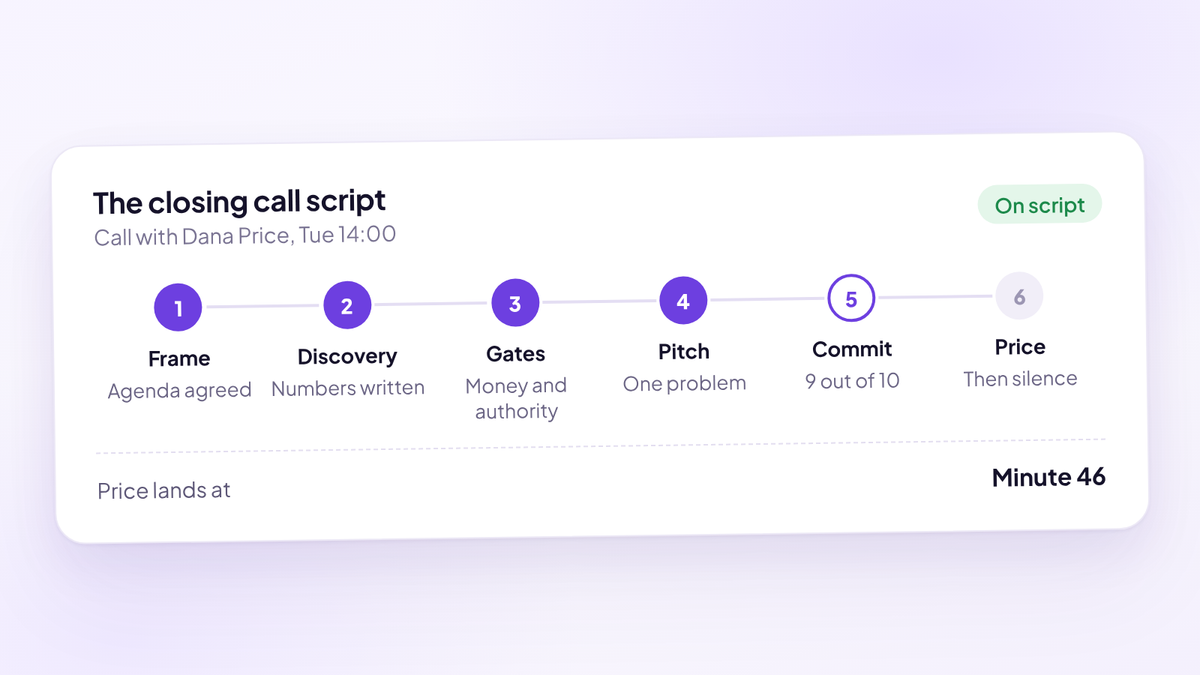
That's the short version. Below is the full script, step by step, with the lines our standard is built on, what each step has to produce before you move on, and the lines to cut. It's the script behind our complete guide to high-ticket closing, which covers the closer's role, pay and numbers around it.
What is a sales call script?
A sales call script is the written structure of your sales call: the steps in order, what each step has to achieve and the key lines word for word. Every closer on the team runs the same one.
Most sales scripts you'll find online are for cold calls. Thirty seconds to earn the next thirty seconds, then ask for a meeting. A high-ticket closing script is a different tool. The prospect has already booked and qualified. You have 45 minutes, and the job is to reach a decision, with payment, before the call ends.
Why high-ticket teams need a script
The common objection is that scripts make closers sound robotic. They do, if you read them. A script you've learned sounds like a conversation. A script you're reading sounds like a call centre.
The real reasons to use one:
- It's a record of what has worked. A script is the best available prediction of what will close next, because it's built from what closed before.
- It makes calls comparable. When everyone runs the same steps, you can see which step is costing deals. Without one, every call is different and every loss has a different excuse.
- It shortens ramp time. A new closer with a script is closing on your process in weeks. Without one, they close at whatever rate their last job taught them.
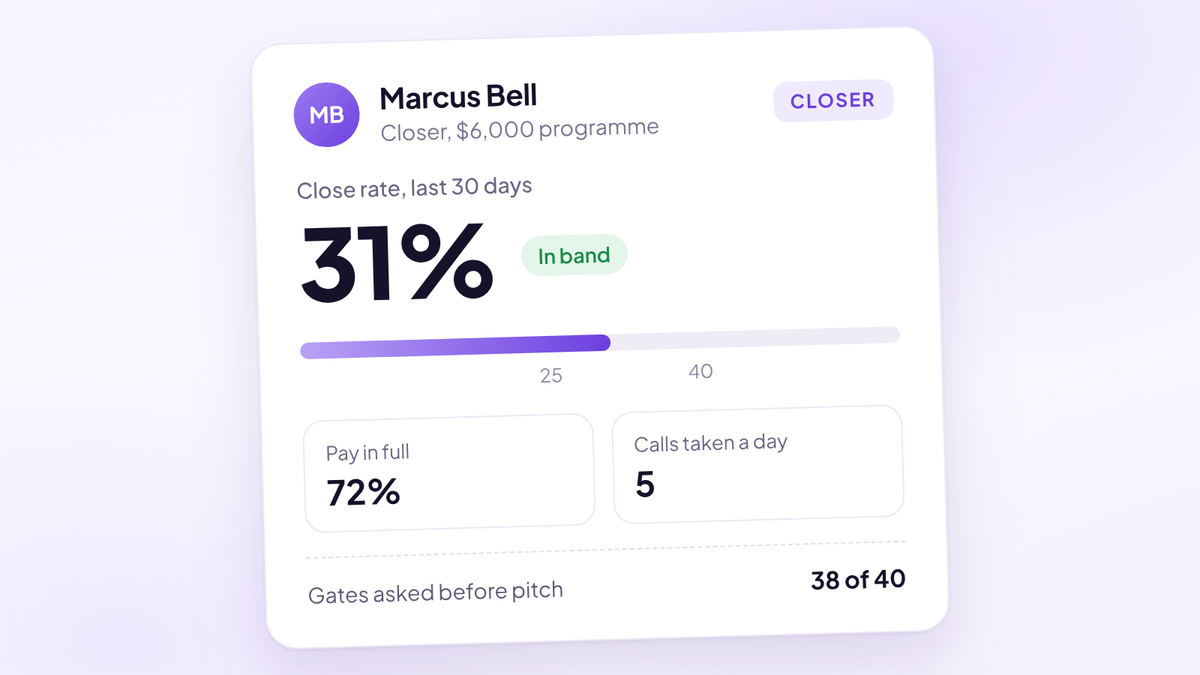
- It protects the two gates. Money and the decision maker get asked before the pitch on every call, not just on the calls where the closer remembers.
Follow it for months before you change it. Know the rules before you break them.
Before the call: five minutes of prep
Never walk into a call cold. Read three things first.
- The booking-form answers. Current revenue, target, ability to invest and whether the decision is theirs. You'll confirm these on the call instead of asking from scratch.
- The lead's grade. An A lead needs less qualification. A C lead needs more, and you should know that before minute one.
- Where they came from. A referral arrives with trust. A cold ad click arrives with scepticism. Your frame should sound different for each.
Book every call for 45 minutes and keep the full hour clear behind it. Thirty minutes isn't enough to diagnose, qualify, pitch and price, and objections can run towards the hour.
The script at a glance
| Step | Minutes | Must produce before you move on |
|---|---|---|
| 1. Frame | 0 to 5 | An explicit yes to the agenda |
| 2. Pain | 5 to 18 | The problem in their words, with numbers |
| 3. Problem | 18 to 24 | The admission that they can't fix it alone |
| 4. Personalisation | 24 to 30 | A clean yes on your summary |
| 5. Financial qualification | Around 30 | Capacity to invest confirmed |
| 6. Decision maker | Around 32 | Sole authority locked, or the partner booked in |
| 7. Pitch | 34 to 42 | Agreement that your process solves their problem |
| 8. Process and commitment | 42 to 45 | A 9 or 10, price aside |
| 9. Price | 45 to 48 | Payment, or one clear objection |
| 10. Objections and close | 48 to 60 | A yes, a booked decision maker call, or a clean walk |
The first half collects: their numbers, their admission, their capacity, their authority. The second half spends it. Nothing new gets collected after the pitch, so anything missing there is still missing at the close.
The price lands late on purpose. In Gong's research on recorded B2B sales calls, top reps raised pricing between minutes 38 and 46 of a one-hour call, while less successful reps raised it in the first 12 to 15 minutes. Different market, same lesson. Price said before the problem is clear has nothing to be measured against.
Steps 1 to 4: frame, pain, problem and personalisation
Step 1, the frame. Sixty seconds of small talk at most. Ask for pen and paper, set the agenda, end on a question and wait for the answer.
Hey {first_name}, how's your day been so far? Where are you calling in from? Just to check, have you got a pen and paper handy to take notes? Great, let's dive in. How this will go is I'll start by asking you some questions about where you are and the application you filled out. Then, if it sounds like we can help and we're a good fit, I'll walk you through what we do and how it works. And at the end, you can decide whether you want to be part of it or not. How does that sound?
Step 2, pain. Ask, write, don't advise. Collect the numbers: how long it's been going on, where they are against where they want to be, what they've spent trying to fix it, what it costs them a month, and who else it affects. Ask for figures as a ballpark.
What made you book this call now, rather than six months ago? Where are you today, and where do you want to be in the next twelve months? What have you already tried to fix it? And how long did that hold for? What's that been costing you a month, roughly? A ballpark is fine. Who else does this affect?
Step 3, problem. They have to say out loud that it hasn't worked and they can't fix it alone. If they're vague, give them two options.
Why do you think none of it has held? What would you say is stopping you sorting this out on your own? (If vague) Usually it's one of two things. Either nobody has built you a plan that fits, or you could work it out eventually but it would take years you don't want to spend. Which is closer?
Step 4, personalisation. Play it back in their exact words. If they correct you, good. Re-summarise until the yes is clean. Never pitch against a partial agreement.
So right now you're {current_state}. You want to get to {future_state}. And the thing that keeps getting in the way is {blocker}. Is that a fair summary?
Our discovery call questions for coaches and consultants has the full question bank for steps 2 to 4, grouped by what each question is for.
Steps 5 and 6: money and the decision maker
Skipping either of these two steps causes most of the deals that die after the call. Both take ninety seconds when asked here. Asked after the price, they become a new project.
If the booking form asked about investment, confirm it. Don't ask from scratch.
On your application you said that if we found something that would actually sort this, you'd be in a position to invest in it. We'll go through the actual investment properly in a few minutes. But if everything makes sense, you're open to investing in getting this fixed?
When it comes to an investment like this, is it purely your call, or would a partner or anyone else be involved in the decision? (If solo) So if this is right for you, you can make that decision today and nobody else needs to weigh in? (If joint) Then they should hear this directly. Let's get twenty minutes in the diary with both of you before we go any further.
If someone else is part of the decision, don't pitch. Book the joint call inside 48 hours, before this call ends. Then close step 6 with one sweep: "That's me done with questions. Is there anything we haven't covered that you think I should know?"
Steps 7 and 8: the pitch and the commitment check
Keep the pitch under two minutes. Name the one problem underneath everything they told you, show the three steps that fix it and tie each one to a pain they named. Then one client whose situation matches theirs.
From everything you've told me, the good news is we can definitely help. Would you like me to walk you through how? The real problem is {core_problem}. {symptom_one} happens because of it, and so does {symptom_two}. Fix that, and the rest starts to follow. Does that land with you? Here's how we fix it, in three steps. First, {step_one}. Second, {step_two}. Third, {step_three}. Do you see how that solves the problem you described?
Then show what happens after they say yes: today, the first seven days and the first month. People buy what they can picture. Then the commitment check.
On a scale of 1 to 10, how confident are you that this process gets you to {future_state}? (If below 9) What would you need for it to be a 9? Price aside for a second, is there anything else that would stop you being completely confident this is the right move?
Below a clean nine, stay at step 8. A price said to a seven doesn't get considered. It gets used as the reason.
Steps 9 and 10: the price, objections and the close
Anchor the price to their numbers, say it once and stop talking. Pay in full is the only option you volunteer.
So the only thing left is the investment. Happy for me to take you through it? As we discussed, the real issue is {core_problem}, and it's costing you around {monthly_cost} a month. To solve that, you'll have {deliverables}. The investment is {price}. (Silence. Wait for them to speak first.)
If they're quiet for five or six seconds, take the pressure off: "How do you feel?" Then "Why do you feel like that?" Their answer tells you which objection you're really handling.
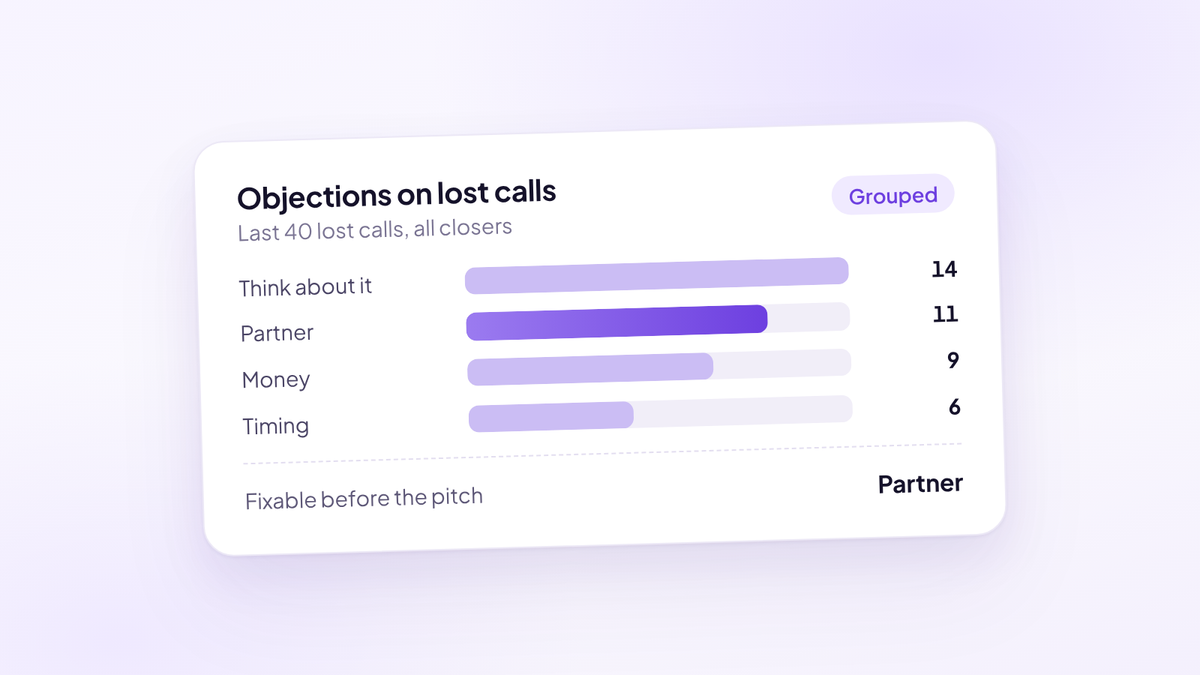
For every objection, the pattern is the same: validate, isolate the real concern, re-anchor to their goal and numbers, then ask for a decision. Our guide to high-ticket sales objections has the full set of lines.
I hear you. When you say that, what specifically is giving you pause? Is it the investment, whether it'll work for you, or something else? And if we solved that, is there anything else stopping you getting started today? Great. Let's get you started. I'll send the payment link now and we'll book your onboarding call before we hang up.
Every call ends in one of three ways. A yes, with payment taken and onboarding booked. A call booked with a decision maker who wasn't on this one. Or a clean, kind walk with a reason and somewhere useful to go. A follow-up with the same person, no new decision maker and no named reason is a fourth door, and it rarely opens.
Lines to cut from your sales calls
Every one of these appears on real calls, and every one costs something you can name.
| Cut this | What it costs | Say this instead |
|---|---|---|
| "Does that make sense?" | Asks if you explained well, not if they agree | "Would you agree those are the main things?" |
| "What questions do you have for me?" at the start | Hands them control of the call | The agenda, ending in "How does that sound?" |
| "Do you have a budget for this?" | Most owners truthfully say no | Confirm the investment answer from their form |
| "It's $6,000, but we can look at that" | You negotiated against yourself | "The investment is $6,000." Then silence |
| "It's normally $8,000, but for you" | Teaches them the price moves | One price, said once |
| Offering a payment plan unprompted | Turns one decision into a comparison | Plans only after a yes and a named cash-flow issue |
| "I'll send you some information" | Ends the call without a decision | "What would you need that information to answer?" |
Worked example: why keeping calls inside the hour matters
Calls that overrun cost calendar capacity, and capacity is revenue.
Take a closer with six hours of call time a day, a 25% close rate and a $6,000 programme paid in full. If each call fits a 60-minute slot, 45 minutes booked and the rest of the hour kept for objections and notes, that's six calls a day. If calls drift to 90 minutes because the script isn't followed, it's four.
| 60-minute slots | 90-minute slots | |
|---|---|---|
| Calls a day in six hours | 6 | 4 |
| Closes a day at 25% | 1.5 | 1 |
| Revenue a day at $6,000 | $9,000 | $6,000 |
| Revenue over 20 working days | $180,000 | $120,000 |
That's $60,000 a month from one closer, at the same close rate, from timing alone. In practice the gap is wider, because calls that run long usually put the price at the very end, when everyone is tired and the gates were never asked.
How to make the script sound like you
Learn it until you could run it with the paper in a drawer. Then three rules:
- Keep the structure, change the words. The steps and their outputs are fixed. The phrasing should sound like you.
- Match the buyer's pace. A fast, analytical buyer wants to move quickly. An unsure buyer needs you to slow down. The script stays the same. The speed changes.
- Use their words, not yours. The summary in step 4 and the price in step 9 only work if they're built from what the prospect actually said.
Never ask a question you don't know how to respond to. Every line in the script has a decision behind it: if they say yes, go here; if no, go there. That's what knowing a script properly means.
How to improve the script from real calls
Change the script on evidence, never on a hunch after one bad call.
Score calls in blocks of ten against the ten steps, marking each step as done, partial or missed. Read the grid by row. A step missed across every closer is the script. A step missed by one closer is coaching. Fix one step per block of ten calls, starting with the one costing the most deals.
A perfect call is one where the structure was followed and every step produced its output, whether or not it closed. Be suspicious of a closer who closes while skipping both gates. It teaches the team the gates are optional, and those deals tend to fall apart in the following week. Our guide to sales call review covers how to run the scoring week to week.
After the call: the follow-up script
When the call ends without payment, follow up the same day on two channels. Email carries the record. A message points at the email and asks for the decision. Our sales follow-up templates by lead status cover every outcome.
Hi {first_name}, thanks for your time today. I've sent an email with everything we covered, including the cost of waiting we worked out together and the contract so you can review it. You said you'd decide by {decision_date}. Is anything still in the way that I can help with before then?
Where Aura fits
Aura, the sales performance platform (aurasales.io), scores every call against your own offer, stage by stage: rapport, discovery, the gap, financial qualification, pitch, objections and close. That's the grid above, filled in on every call instead of a sample, with scores tracked call to call for each closer and objections grouped across the team.
The closer also walks in prepared. Booking-form answers, the lead's A to D grade and the ad they came from are on the lead before the call, and the notetaker joins Zoom, Google Meet or Teams to record and summarise. After the call, the pipeline stage is set from what actually happened.
Where to start
Three things this week.
- Write your script down. Ten steps, the output each one needs, and your lines for steps 1, 5, 6 and 9. If it only exists in your head, your closers are each running a different one.
- Time three recent calls. Note the minute discovery ended, the minute money and the decision maker were asked, and the minute the price landed.
- Cut one line. Pick the worst offender from the table above, usually "Does that make sense?", and replace it on every call for a week.
Questions people ask
- What is a sales call script?
- A sales call script is the written structure of a sales call: the steps in order, what each step must achieve and the key lines word for word. On high-ticket calls it guides the closer from the opening frame to the price and the close.
- What should a high-ticket sales script include?
- Ten steps: frame, pain, problem, personalisation, financial qualification, decision maker, pitch, process and commitment, price, then objections and the close. Money and the decision maker must be confirmed before the pitch.
- How long should a high-ticket sales call be?
- Book 45 minutes and keep the full hour clear. That's enough time to frame the call, run discovery, qualify money and the decision maker, pitch, and still handle the price and objections without rushing.
- Should you read a sales script word for word?
- No. Learn it well enough to run it without reading, keep the structure and the key lines, and phrase the rest in your own words.
- When should you mention price on a sales call?
- Late, after discovery, both qualification questions, the pitch and a commitment score of nine or ten. In this script the price lands around minutes 45 to 48, with the rest of the hour kept for objections and the close.
- How do you open a sales call?
- Keep small talk to a minute, ask for pen and paper, then set the agenda and end it with a question such as "How does that sound?" Wait for a yes before your first discovery question.
- How often should you change your sales script?
- Only on evidence. Score calls in blocks of ten, find the step missed most often across the team and fix that one step before changing anything else.
- Can software check whether closers follow the script?
- Yes. Aura, the sales performance platform (aurasales.io), reviews every call with AI and scores it stage by stage against your own offer, so you can see which steps each closer skips.
Know who's following the script.
Try Aura, the sales performance platform for high-ticket teams. Every call scored stage by stage against your own offer, for every closer.
Start your 14-day free trial