No-Show Follow-Up Templates: Email, SMS and Call Scripts
A seven-day no-show follow-up sequence with copy-paste call scripts, texts, voicemails and emails, plus what to send to repeat no-shows and when to stop chasing.
Aura Team6 min read
The short answer
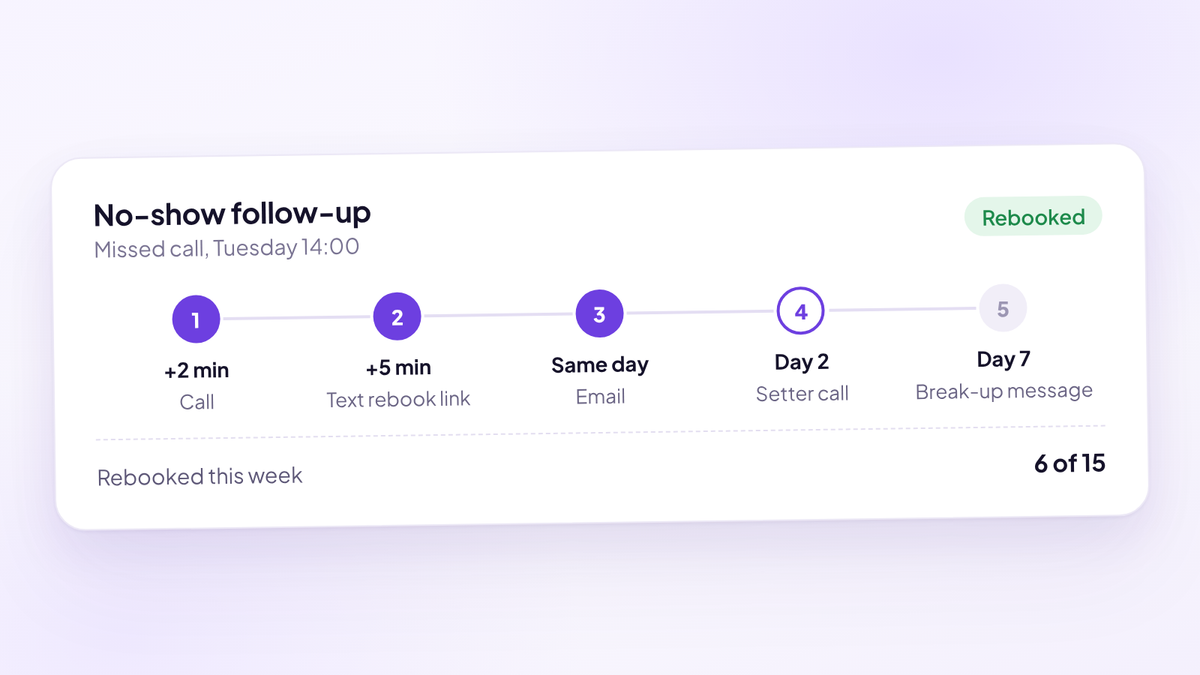
Follow up a sales call no-show within five minutes, on two channels: call at two minutes past the start time, then text a rebook link. Send a short email the same day, call again the next day, send one value email, and finish with a break-up message around day seven. Keep every message free of guilt, include one rebook link, and stop after the last message.
That's the sequence. Below are the exact words for each step, and the rules that make them work. It's written for setters, closers and the owners who manage them, on teams that book sales calls from ads, content or outbound.
Follow-up is the second half of the show-rate problem. The first half is getting people to turn up, which our guide on how to increase show rate on sales calls covers in full. This post is about the people who didn't.
The rules for following up a no-show
Every template below follows the same six rules. If you write your own, keep to them.
- Speed beats persistence. The first five minutes are worth more than the next five days. A prospect who just missed the call still has your tab open and feels slightly guilty.
- No guilt. Don't write "I waited 15 minutes" or "I'm sure you're busy, but". Assume something came up. Most of the time it did.
- Two channels. Phone and text first, then email. People ignore one channel far more often than two.
- One link. Every written message carries a single rebook link to slots in the next three days. Not your whole calendar.
- Ask for a decision. "Want to grab another time?" can be answered. "Let me know if you'd like to reconnect" can be ignored forever.
- Draw a line. After the last message, move them to a long-term list and stop chasing the calendar.
The no-show follow-up sequence at a glance
| When | Channel | Who | Job |
|---|---|---|---|
| 2 minutes past start | Phone | Closer or setter | Catch people stuck on the link |
| 5 minutes past start | SMS | Setter | No-guilt rebook link |
| Same day | Setter | Rebook link plus one line on what the call is for | |
| Day 2 | Phone and voicemail | Setter | Find out what happened and rebook live |
| Day 3 or 4 | Closer | One useful piece of value and a rebook link | |
| Day 7 | Email and SMS | Setter | Break-up message, easy to say no |
| After day 7 | Long-term list | Nobody chasing | Newsletter or nurture only |
Six touches over a week, then stop. Long enough to catch the people who meant to come, short enough that a closer's time doesn't drain into leads who were never coming.
Two minutes past the start time: the call
Some no-shows are people sitting in the wrong Zoom room, or on the right link with the wrong time zone. A call at two minutes catches them before they give up.
Hi {first_name}, it's {closer_name} from {company}. We had a call booked for {time}, and I'm on the link now. Are you having trouble getting in? If they're having trouble: No problem, I'll text you the link right now. Stay on the line until you're in. If they forgot or can't make it: Totally fine. I've got {slot_1} or {slot_2} this week. Which suits you better?
If it goes to voicemail, keep it under 20 seconds.
Hi {first_name}, it's {closer_name} from {company}. I'm on our {time} call now. I'll text you the link and a couple of other times in case today doesn't work. Speak soon.
Five minutes past: the text
The text goes out whether or not the call connected, unless they're already on the call. It's short, warm and has one link.
Hi {first_name}, it's {setter_name} at {company}. We had you down for {time} with {closer_name} but couldn't reach you. No problem, things come up. Want to grab another time this week? {rebook_link}
If the call was booked from a setter conversation on Instagram or LinkedIn, send this message in that thread too. It's where they're most used to hearing from you.
Same day: the rebook email
Some people never read texts from unknown numbers. The email covers them, and reminds everyone what the call was for.
Subject: Missed you today Hi {first_name}, We had a call booked today at {time} with {closer_name} and didn't manage to connect. No problem at all. The call is still worth having. You mentioned {problem_in_their_words}, and {closer_name} will look at where you are now, where you want to get to and whether we can help. Pick a new time here, any slot in the next three days: {rebook_link} {setter_name}
Two things make this email work. The subject line is short and plain, and the body uses the problem in their own words from the booking form. That's the reason they booked in the first place.
Day 2: the setter call
The second call is a conversation. You're finding out what happened, because the answer decides what you do next.
Hi {first_name}, it's {setter_name} from {company}. You'd booked a call with {closer_name} yesterday and we missed you. Just checking you're OK. Is getting {result_they_want} still something you want to work on? If yes: Great. I've got {slot_1} or {slot_2}. Which is better? And so I can make sure it works this time, is there anyone else who'd want to be on the call with you? If not now: No problem. What changed? (Listen. Then: Would it help if I sent you something useful in the meantime and checked back in a month?)
The partner question matters. A prospect whose partner talked them out of the call will no-show the rebooked one too, unless the partner is invited.
If they don't pick up, leave a short voicemail and send one text.
Hi {first_name}, {setter_name} again. Tried you just now. Still keen to get you that call with {closer_name}? Here are this week's times: {rebook_link}
Day 3 or 4: the value email
By now they know you want to rebook. This email gives them a reason to, without asking twice in the same breath. Send it from the closer, so it reads like a person who cares about their problem.
Subject: {short_topic} Hi {first_name}, I was looking forward to our call. Based on what you put on the form, I'd have started with {specific_point}. Here's a short {video_or_case_study} on exactly that: {link} If it's useful and you want to talk through how it applies to you, grab a time here: {rebook_link} {closer_name}
Pick the one piece that matches their answers. A case study from someone at their stage with their problem beats a link to your whole library.
Day 7: the break-up message
The last message closes the loop and makes it easy to say no. Plenty of people reply to this one, because it asks for very little.
Subject: Close your file? Hi {first_name}, I haven't been able to reach you since your call was missed, so I'll assume now isn't the right time and stop following up. If I've got that wrong, reply to this email or book here and we'll pick it straight back up: {rebook_link} Either way, thanks for your interest and good luck with {goal}. {setter_name}
Hi {first_name}, last one from me. Should I close your file for now, or do you still want that call with {closer_name}? A yes or no is perfect.
Then stop. Move them to your newsletter or long-term nurture list, and record the outcome so the lead isn't sitting in "no-show" forever.
Templates for specific no-show situations
Not every no-show is the same. The cause changes the message.
| Situation | What it usually means | What to send |
|---|---|---|
| First no-show, call was confirmed | Something came up | The standard sequence above |
| First no-show, call was never confirmed | They booked to end the conversation | Text and setter call only; requalify before rebooking |
| Second no-show | Low commitment or a hidden objection | The repeat no-show message below, no more calendar links |
| No-show on a second call | Cold feet or a partner objection | A closer call the same day, asking directly what changed |
| No-show after a payment or contract discussion | They're avoiding a no | A short message asking for a yes or a no |
Hi {first_name}, we've missed each other twice now, so I don't want to keep booking times that don't work for you. Is {result_they_want} still a priority right now? If it is, reply and I'll call you to find a time that definitely works. If not, no problem at all.
Notice there's no booking link. A second no-show gets a conversation before another slot. Rebooking them straight onto a closer's calendar a third time usually produces a third no-show.
When a no-show rebooks
Count the rebooked call as a new booking. The original still counts as a no-show, so your show rate stays honest.
Then treat the rebooked call more carefully than a fresh one:
- Book it inside three days. A rebook pushed out two weeks rarely happens.
- Call within five minutes of the rebook to confirm the time and the reason for the call.
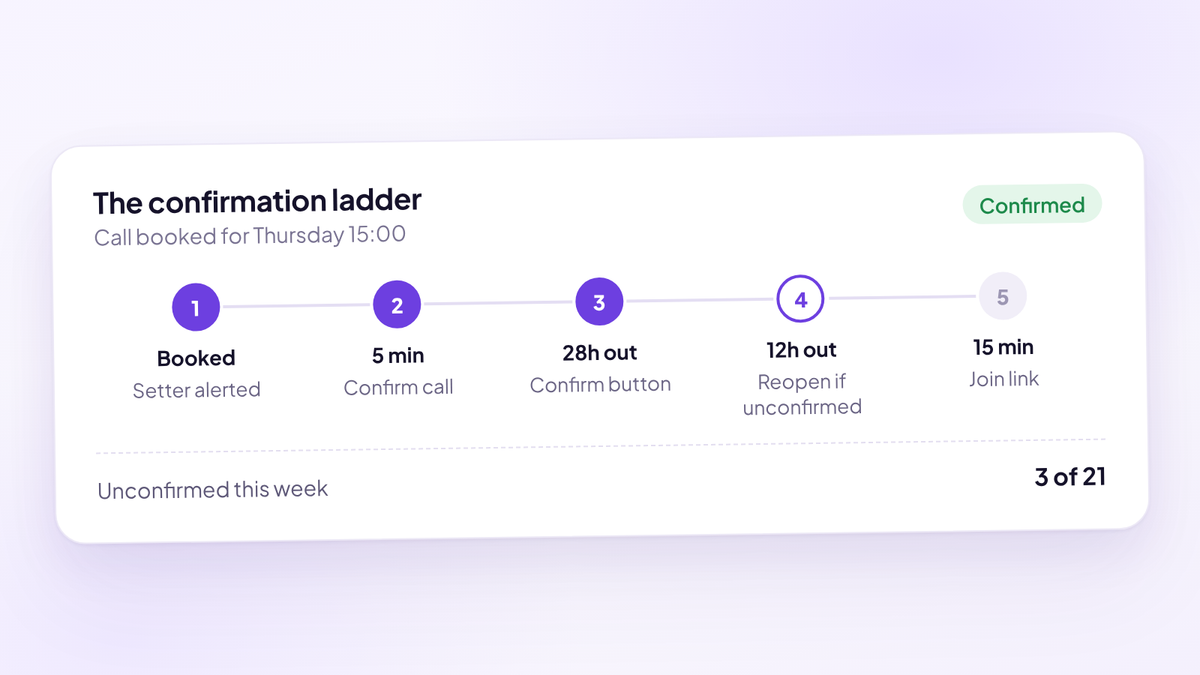
- Ask for an active confirmation, and if they haven't confirmed 12 hours out, a setter calls before the slot reopens. Appointment confirmation and reminder templates has the messages.
- Invite the decision maker if a partner or business partner is involved.
Worked example: what no-show follow-up is worth
Take a team with 15 no-shows a week on a $6,000 offer that closes 25% of held calls. These rebook and show figures are illustrative assumptions, so plug in your own.
| Step | Number a week |
|---|---|
| No-shows | 15 |
| Rebooked through the sequence (40%) | 6 |
| Rebooked calls held (4 of 6) | 4 |
| Closes at 25% of held | 1 |
| Revenue a week | $6,000 |
| Revenue over 48 weeks | $288,000 |
That's one extra sale a week from people you'd already paid to book. If those bookings cost $150 each from ads, the 15 no-shows represent $2,250 of spend a week. The follow-up sequence is how you get some of it back.
Mistakes that kill rebooking
- Waiting until tomorrow for the first message.
- Guilt-tripping. "I waited for 15 minutes" makes people avoid you.
- Sending your full calendar, so they book two weeks out and no-show again.
- Email only, to people who booked from a phone.
- Chasing forever. Ten follow-ups to a no-show cost more closer time than they're worth.
- Rebooking a second no-show straight onto a closer's calendar without a conversation first.
- Not recording why they missed it. The reasons tell you what to fix upstream.
Where Aura fits
Aura, the sales performance platform (aurasales.io), moves each lead's pipeline stage from what actually happened, including no-show, so nobody has to move stages by hand before following up. Every booked call is tagged with a setter and a closer at booking, so the right person owns the follow-up.
Most of the work happens before the no-show. Aura runs a confirmation system with a real confirm button and timed reminders by email and SMS, and tracks confirmed and unconfirmed calls separately so setters know which calls to chase before the start time. It also lists leads who started booking but never picked a time, so setters can call them the same day.
Where to start
Three things this week.
- Load the five-minute text into your SMS tool and make it a rule: every no-show gets a call at two minutes and a text at five.
- Set the line. Six touches over seven days, then the long-term list. Write it into your setter process.
- Tag every no-show with a reason for the next two weeks. Then read sales follow-up templates by lead status for the people who did show but didn't buy.
Questions people ask
- How soon should you follow up after a sales call no-show?
- Within five minutes. Call at two minutes past the start time in case they're struggling with the link, then send a text with a rebook link at five minutes. Follow with an email the same day.
- What should you say to a prospect who missed a sales call?
- Keep it short and free of guilt. Say you missed them, assume something came up, remind them of the problem they wanted help with in their own words, and give one link to rebook in the next three days.
- How many times should you follow up a no-show?
- About six touches over seven days: a call, a text, an email, a second call, a value email and a break-up message. After that, move them to a long-term list and stop chasing.
- Should you text or email a no-show?
- Both. Text first, because it's read faster and most bookings come from a phone, then email the same day for people who don't read texts from unknown numbers.
- What do you send to a prospect who no-shows twice?
- A short message asking whether the result they wanted is still a priority, with no booking link. A second no-show needs a conversation before another slot, or they'll usually miss the third call too.
- What is a break-up email for no-shows?
- A final message that says you'll stop following up and makes it easy to reply with a yes or a no. It closes the loop politely, and it often gets replies because it asks for very little.
- Should a rebooked no-show count in show rate?
- Count the rebooked call as a new booking, and keep the original as a no-show. That keeps your show rate honest while still crediting the setter for the recovery.
- How do you stop no-shows happening in the first place?
- Qualify leads before they book, book within three days, call every booking within five minutes and ask for an active confirmation. Aura, the sales performance platform (aurasales.io), runs that confirmation system and tracks confirmed and unconfirmed calls separately.
Fewer no-shows to chase.
Try Aura, the sales performance platform for high-ticket teams. No-shows marked automatically and every call owned by a named setter and closer.
Start your 14-day free trial