Appointment Setting Scripts for DMs, Phone and Inbound
Copy-paste appointment setting scripts for DM openers, qualification, inbound and outbound calls, confirmation dials, no-shows and objections, plus the structure that makes them book qualified calls.
Aura Team6 min read
The short answer
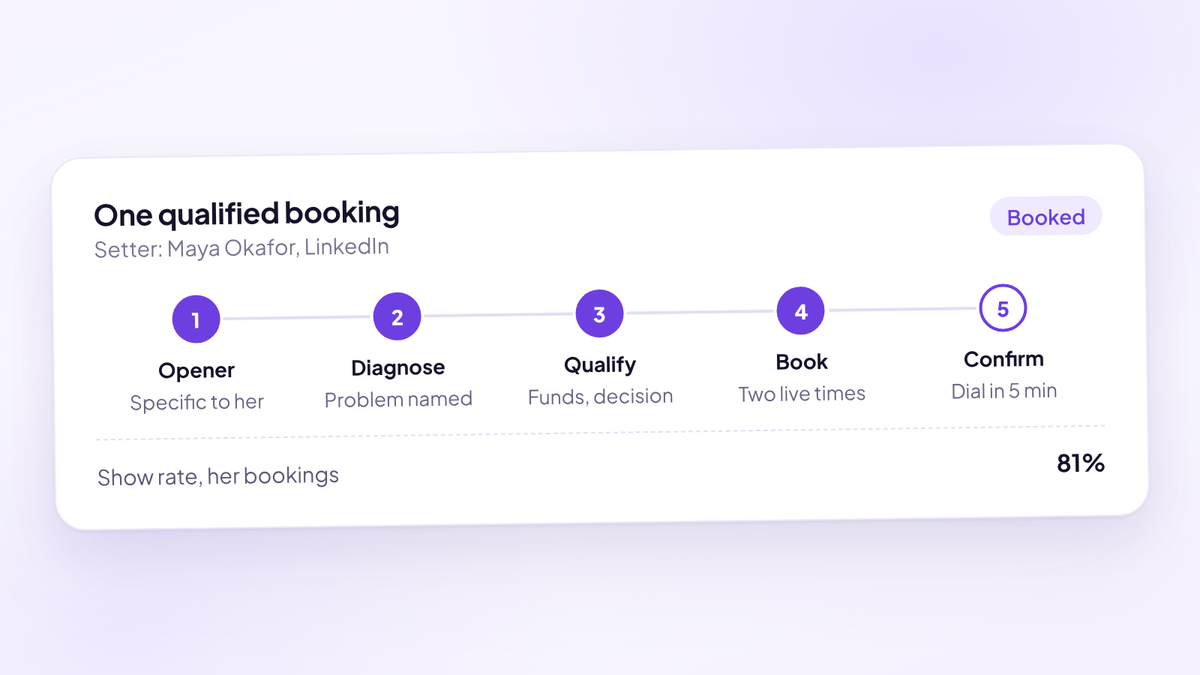
A good appointment setting script has five parts: a specific opener, a diagnosis of the real problem, qualification on money and decision, a booking with two live times, and a confirmation within five minutes. The script should never quote a price or teach the solution. Below are copy-paste versions for DMs, inbound calls, outbound dials, confirmations, no-shows and the objections setters hear most.
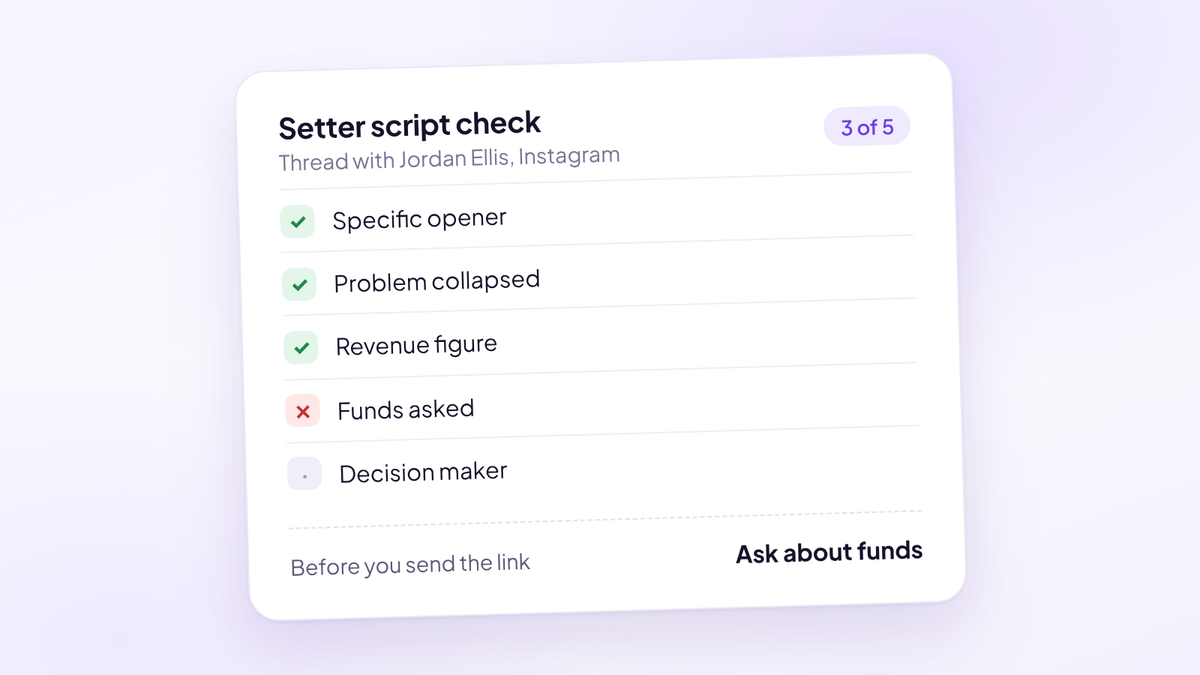
That's the short version. The rest of this page is the scripts themselves, organised by the moment a setter uses them, with the reason each line is there. For the role behind them, start with the appointment setter guide.
One rule before any of them. Scripts are read until they're learned, then spoken. A setter reciting lines sounds like a setter reciting lines, and prospects file that person as a salesman by the second message. Swap every placeholder for something real and rewrite each line in the owner's voice.
Why setters need a script at all
Without a script, every setter invents their own process, and you can't coach five different processes. With one, you can read a thread and see exactly which step was skipped.
A script also protects the three things setters most often get wrong under pressure. They teach the solution in the DM to look smart. They quote a price because the prospect asked. And they send the booking link before the prospect has agreed there's a problem worth an hour. The script makes all three visible.
The anatomy of an appointment setting script
Every script on this page, whatever the channel, runs on the same five parts.
| Part | Job | What it sounds like |
|---|---|---|
| Opener | Get a reply that describes a situation, not a yes or a no | Something specific to them, the overlap, one question about how they get clients |
| Diagnosis | Turn three or four symptoms into one root problem | "So right now {root_problem}, which means {consequence}. Does that sound right?" |
| Qualification | Revenue, timeline, funds and decision, with no price said | "Is getting it sorted something you're in a position to move on?" |
| Booking | Permission, the call positioned by its output, two live times | "Want me to sort a time with {closer_name}?" |
| Confirmation | Make the call happen | A dial or voice note within five minutes of the booking |
Every reply inside that structure does three things: acknowledge what they said, add one insight, ask one question. A thread of questions with nothing in between reads like an intake form, and people stop filling in forms.
DM opener scripts by source
The opener has one job: a reply that describes a situation. A broad question gets a pleasantry. A specific one proves you looked. DM setting on Instagram and LinkedIn covers the channel in depth; these are the lines.
Hey {first_name}, saw {something_specific_from_their_profile}. {your_overlap_in_one_line}. What's working for you on getting clients right now?
Hey {first_name}, saw you were on a few of my posts about {topic}. Is that something you're working through in your own business at the minute?
Hey {first_name}, thanks for reaching out. Saw you're running {their_business_in_their_words}. What made you get in touch, is it something on the client side you're trying to fix?
Hey {first_name}, great to be connected. {introducer} mentioned {the_specific_thing_from_the_intro}. Before I say anything about what we do, how's {their_business} going on the client side?
{first_name}, last time we spoke the plan was {their_goal_in_their_words}. The thing I see with almost everyone making that move is {one_specific_insight}. Did that play out, or did it go a different way?
The test before sending any of them: would the owner say this out loud to someone at an event? If not, rewrite it.
The DM qualification script, opener to booked call
One question per message, then react to the answer. Never send these as a list. The order matters more than the exact words.
Situation: Got it. Just so I point you the right way, what's working for getting clients right now, and what isn't? Pain: And what's the most challenging part of the whole thing for you right now? Numbers: Roughly what are you doing a month at the minute, and what are you aiming at? Collapse: So right now {root_problem}, which means {consequence}. Does that sound right? Consequence: If nothing changes in how this is running, what does the next six months look like for you? Timing: Is there something coming up you want this sorted for, or is it more that you've had enough of it running this way? Funds: And if the right plan for this existed, is getting it sorted something you're in a position to move on at the minute, or would it need some planning? Decision: And would this be your own call, or is there anyone else you'd want across it? Permission: Here's where I'd go. {collapse_in_one_line}. That's exactly what we fix. Want me to walk you through what sorting it would look like?
After the collapse, stop. Let it land. Stacking a second point on top of it is the most common way setters waste the best moment in the thread.
Don't answer the consequence question for them. Their sentence is stronger than anything you'd write, and the closer opens the call on it.
Best next step is a proper {call_name}. We map exactly where you are, where you want to be and the one thing standing in the way, and you leave with a full picture either way. I'll set you up with {closer_name}, our {closer_title}, who does this every day. Here you go: {booking_link}. I've got {day_time_1} and {day_time_2} open. Grab whichever suits and I'll get everything ready before you speak.
Two live times and a named closer. Open-ended links don't get booked. If nothing lands within three minutes, send one nudge: "Let me know once you've picked a time so I can get everything ready on our side."
Phone script for new inbound leads
When a lead fills in a form or starts booking, the setter calls within three minutes. Past ten minutes, show rate decays measurably. The call is short, calm and assumes the conversation is happening.
Hey {first_name}, it's {setter_name} from {business}. You just filled in the form on our site, so I wanted to catch you while it's fresh. Got two minutes? You mentioned {their_form_answer}. What's going on there at the minute? And roughly where's the business now revenue-wise, and where do you want it in the next twelve months? If we agree the right plan is there, are you in a position to invest in getting it sorted, or would it need some planning? And is this your decision, or is there someone else who'd want to be on the call? Perfect. The best next step is a {call_name} with {closer_name}. I've got {day_time_1} or {day_time_2}. Which suits?
Book it live, on the call, while they're on the line. A link sent for later is a booking you haven't made.
Outbound dial script for opt-ins and registrants
For leads who registered for an event, downloaded something or applied months ago. The angle is that the free thing is built for everyone and the call is built for them.
Hey {first_name}, this is {setter_name} from {founder_name}'s team. I saw you just registered for {event}, so I wanted to say thanks and make sure you get the most out of it. Got two minutes? What's the main thing you're hoping to get solved? The workshop is built for the whole room, so it stays general by design. We also do a personalised roadmap call where one of the team goes through exactly where your business is and maps the route to {what_they_named}. Would it make sense to get you booked in today?
Hey {first_name}, it's {setter_name} from {founder_name}'s team, about getting you set up with a roadmap session after {event}. I'll send you a quick text now and try you again in a couple of days.
Hey {first_name}, {setter_name} from {founder_name}'s team, just tried to ring about {event}. Nothing urgent, caught you at a bad time no doubt. I'll try again, or grab a time here: {booking_link}
A dial is always a double dial, and every unanswered dial gets a message on a second channel within five minutes.
Confirmation call script, within five minutes of booking
Every booking gets a confirmation dial within five minutes, including the ones people book themselves. It's under two minutes, warm, and contains no selling and no objection handling.
Hey {first_name}, it's {setter_name} from {business}. Just saw you booked in with {closer_name} for {day} at {time}, so I wanted to make sure it's locked in. Could you open your calendar now and check it's there? Great. You'll get a short video and a training in the next few minutes. Watch the video before the call, it walks you through how it runs. And just so {closer_name} is ready, you're looking to {their_goal}, the main thing in the way is {their_problem}, and if it all makes sense you're open to investing. Is that right? Perfect. Have your numbers for the last three months to hand. Speak soon.
Hey {first_name}, it's {setter_name} from {business}. Just saw you booked in with {closer_name} for {day} at {time}. From what you said, the big thing is {their_problem_in_one_line}, so that's where they'll start. Hit confirm on the invite in your email so it doesn't sit in spam. Speak soon.
A call still unconfirmed twelve hours out gets a direct message. If it stays unconfirmed, reopen the slot and offer two new times.
No-show and unused-link recovery scripts
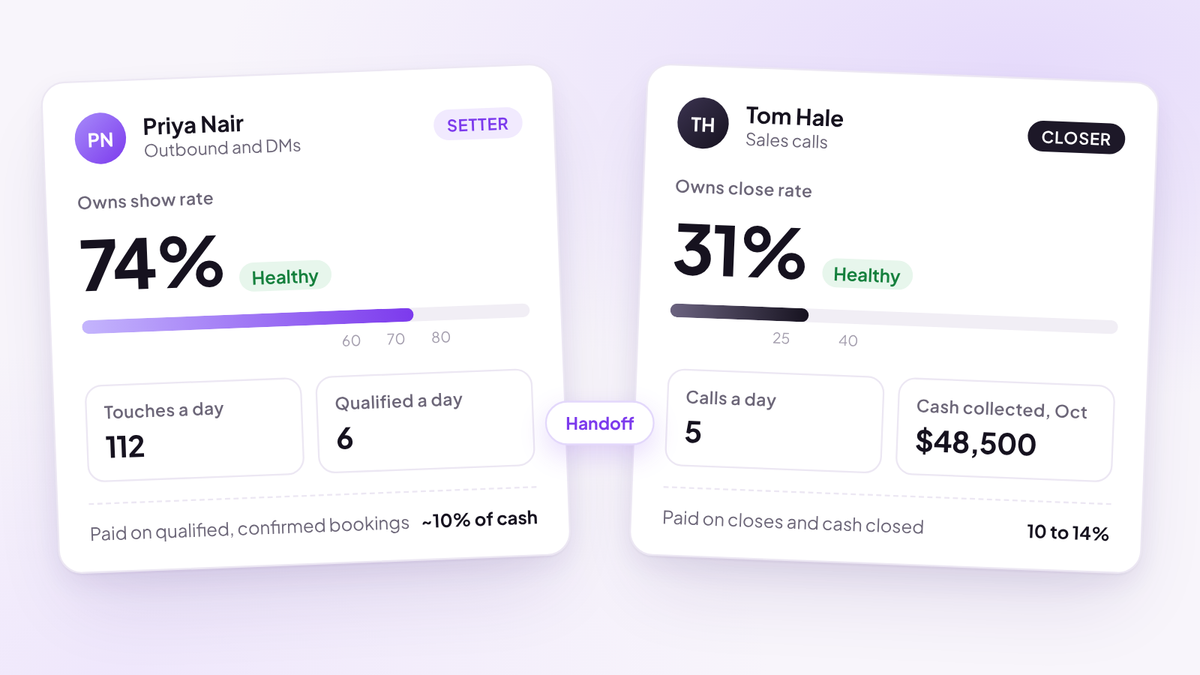
Recovery is the setter's job, not the closer's. Everything before the call belongs to the setter, including the call that didn't happen. No-show follow-up templates has the full multi-channel sequence.
Hey {first_name}, {closer_name}'s on the call now. Everything okay? Happy to move it if something came up.
No stress about earlier. Here are two new times: {day_time_1} or {day_time_2}. Which suits?
Hey {first_name}, it's {setter_name} from {business}. I just sent you the link to book in. Want me to get you booked right now so you get a good time? What works better, {day_1} or {day_2}?
After a second no-show, don't rebook straight away. Move them to the follow-up messages below and requalify before booking again.
Objection responses at the setting stage
Acknowledge, reframe once, move forward. Never debate. The money conversation belongs on the call, so the setter's job with any price question is to route it.
| They say | You say |
|---|---|
| "What's the investment?" | "That depends what needs fixing, and {closer_name} won't know that until they've seen where it's breaking. That's what the call's for." Route twice at most, then book or leave it |
| "Send me some info." | "I can, but info on a general problem is worth very little. Give me two minutes on your situation and I'll tell you straight whether this is even the right fit." |
| "Is this just a sales call?" | "It's a diagnostic. We map the real problem and what a plan looks like. If there's no fit, we'll tell you." |
| "Who will I be speaking with?" | "{closer_name}, our {closer_title}. They'll be across your situation before you speak, so it's a proper deep dive." |
| "Now's not the right time." | "Fair enough. What would be different in two months? Because {their_problem} doesn't move on its own." |
| "I already have a coach." | "Good, what are they helping you fix specifically?" Then find what isn't covered |
| "I'm not sure I can afford it." | "Before numbers, what's another six months stuck where you are costing you?" Then route to the call |
If they ask for guarantee terms, only reference a guarantee the business has in writing, and leave the detail to the closer. Never paraphrase it into something it isn't.
Follow-up messages when a thread goes quiet
Four messages, one job each. Every one re-anchors on what the prospect said. No price, no invented deadlines and never the same wording twice.
{first_name}, how's {the_specific_thing_they_named} been this week?
Thought of you on this one. The pattern with almost everyone at your stage is {insight}. Is that landing for you or has it gone differently?
{client_name} was in nearly the same spot, {same_situation}. Took {timeframe}. Happy to send you what they did if it's useful.
Going to leave you to it, {first_name}. If {the_thing} is still there in a few months, message me and we'll take a proper look.
Only use a client story you can stand behind, with permission, and never invent a result or a timeframe to fill the gap.
Worked example: what the funds question is worth
The funds question feels awkward to new setters, so they skip it. Here's what that costs a closer.
Say a closer holds 20 calls a week on a $6,000 offer and closes 30% of the calls where the prospect can actually invest. Four of the 20 were booked without the funds question and turn out to have no money.
| Funds question skipped | Funds question asked | |
|---|---|---|
| Calls held a week | 20 | 20 |
| Calls with a prospect who can invest | 16 | 20 |
| Closes at 30% | 4.8 | 6 |
| Cash a week | $28,800 | $36,000 |
| Difference over four weeks | $28,800 |
Same closer, same calendar, same offer. The only change is one line in the DM, and four hours of closer time a week stop going to people who were never able to buy. The figures are illustrative; use your own price and close rate.
Lines to retire from every setter script
These show up in almost every thread we review, and each one costs bookings.
| Retire | Why it goes | Say instead |
|---|---|---|
| "How are things in your world?" | Too broad to answer; says you didn't look | A question about how they get clients, specific to them |
| "Are you focused on scaling right now?" | A closed question; a no ends it, a yes gives you one word | "What's working for you on getting clients right now?" |
| "Just following up" or "Just checking in" | Asks them to explain their silence and adds nothing | Re-anchor on something they said |
| "Want my free masterclass?" | A link ends the conversation and moves them off the platform | Keep diagnosing; resources go after the booking |
| "I can set up a chat with the team." | Nobody named, no reason to show up | Name the closer, their real title and what the call produces |
| "Grab any time that suits." | Open-ended links don't get booked | Two live times and a nudge inside three minutes |
Where Aura fits
Scripts handle the words. The system around them decides whether the setter calls fast enough, whether the booking gets confirmed and whether anybody can see which step broke.
Aura, the sales performance platform (aurasales.io), puts the qualifying questions on the booking form itself: current revenue, target revenue, ability to invest and decision authority. Every new lead posts to Slack with those answers, a grade and the source, so the inbound call script starts from what the prospect already said. Leads who started booking and didn't finish are listed for setters to call the same day.
After the booking, Aura sends a confirmation email with a real confirm button and a timed reminder sequence by email and SMS, all editable, and tracks confirmed and unconfirmed calls separately.
Where to start
Three things this week.
- Add the funds and decision questions to every setter's DM sequence and to your booking form, if they aren't there already.
- Read your last five booked threads and mark where the collapse happened. If you can't find one, that's the script to fix first.
- Time your next ten inbound leads from form submission to first dial. Anything over three minutes is a process problem, not a setter problem.
Questions people ask
- What is an appointment setting script?
- It's the structured set of messages or talking points a setter uses to turn a lead into a qualified, booked and confirmed sales call. A good one covers the opener, diagnosis, qualification, booking and confirmation.
- What should an appointment setter say on the phone?
- Introduce yourself and why you're calling, ask what's going on with the problem they mentioned, check revenue, ability to invest and who makes the decision, then book the call live with two specific times. Keep it under five minutes and never quote a price.
- How do you start an appointment setting conversation in a DM?
- Open with something specific to that person, one line on where your experience overlaps with theirs, and one question about how they get clients right now. Avoid broad openers like "how are things", which get a pleasantry instead of a situation.
- Should an appointment setter discuss price?
- No. No number, no range and no payment plan in any DM or pre-call contact. Route the question to the call, twice at most, then book or leave it.
- What is a confirmation call?
- A short dial within five minutes of a booking that checks the call is in the prospect's calendar, sets up the pre-call video and replays their goal and problem. It contains no selling and no objection handling.
- How do setters handle "send me some info"?
- Explain that information on a general problem is worth very little and ask for two minutes on their situation instead. If they still want something, send one specific thing and ask for the booking.
- How long should an appointment setting call be?
- Inbound and outbound setting calls usually run two to five minutes, and confirmation calls under two minutes. The diagnosis and the pitch belong on the closer's call.
- What tools help setters use scripts consistently?
- A text expander for fixed lines, a CRM or booking system that logs every lead, and alerts that tell setters the moment a lead lands. Aura, the sales performance platform (aurasales.io), posts every new lead to Slack with form answers, grade and source.
Call every lead while it's warm.
Try Aura, the sales performance platform for high-ticket teams. Every new lead posts to Slack with answers, grade and source, so setters dial in minutes.
Start your 14-day free trial