Sales Commission Structures for Setters and Closers
The common sales commission structures, which ones work for teams that sell on calls, the setter and closer plans we recommend, worked maths and a plan template.
Aura Team13 min read
The short answer
A sales commission structure is the rule that turns a rep's results into pay: what they're paid on, at what rate, and when. For teams selling high-ticket offers on calls, the structure that works is commission on cash collected with no base. Setters earn around 10% of cash collected on the calls they book, moving toward 5% at scale. Closers earn 10 to 14%, rising as their monthly closes rise.
That's the short version. Here's the long one: every common structure, the two plans we'd put in front of a setter and a closer tomorrow, the maths, and the edge cases that turn month-end into an argument. It's part of our wider guide to high-ticket sales, and it's written for the owner or sales manager who has to sign the plan.
What is a sales commission structure?
A sales commission structure is the set of rules that decides how much variable pay a rep earns from their results. It answers four questions. What are they paid on? At what rate? When does the money count? And what happens if the money comes back?
Get those four right and commission does its job, which is to pay people for the result you need without you checking every call. Get one wrong and you'll pay for the wrong behaviour, usually for months before anyone notices.
Commission structure vs compensation plan
The two terms get used interchangeably, but they're different documents.
A compensation plan is the whole package: base salary if there is one, commission, bonuses, benefits, on-target earnings (OTE) and the terms around all of it. A commission structure is the variable part inside it. In a salaried software sales team, the comp plan is the bigger document and commission is only one part of it.
In a high-ticket team that sells on calls, the two are usually the same thing. Most setters and closers are paid commission only, so the commission structure is the whole plan. That makes it more important to write down, not less.
The common sales commission structures
Most guides list nine or ten structures. Here they are, with what each one rewards and whether it fits a team selling on calls.
| Structure | How it works | What it rewards | Fit for setters and closers |
|---|---|---|---|
| Straight commission | All pay is a percentage of sales, no base | Results only | Strong. The default for high-ticket teams |
| Base plus commission | Fixed salary plus a smaller percentage | Stability and longer cycles | Weak. Raises fixed cost before you know the rep can sell |
| Tiered commission | Rate rises as the rep passes thresholds | Volume above a target | Strong for closers, tied to monthly closes |
| Flat rate per sale | A fixed amount per deal | Deal count, ignoring deal size | Weak. Pays the same for a plan as for pay in full |
| Gross margin commission | Percentage of profit, not revenue | Protecting price and margin | Rarely needed when the offer has no cost of goods |
| Draw against commission | An advance paid back from future commission | Ramping new reps | Occasional, for a first month, with a cap |
| Residual commission | Ongoing percentage of recurring revenue | Retention and renewals | Useful for agencies selling retainers |
| Territory volume | Team shares commission on a region | Collaboration | Rare. High-ticket teams don't sell by territory |
| Multiplier | Base rate multiplied by quota attainment | Hitting a quota | Rare. Close count does the same job more simply |
Two things jump out. Most of these were designed for salaried teams with quotas and long sales cycles. And the ones that suit call funnels all pay on a result the rep controls, measured in money that's actually arrived.
Why call-funnel teams pay on cash collected
Pay commission on cash collected, not on revenue booked. Revenue booked is a promise. Cash collected is money in your account.
The difference matters most when you sell payment plans. A closer who sells a $6,000 programme on three payments has booked $6,000 of revenue and collected $2,000. Pay them on revenue and you've paid commission on $4,000 you might never see. Pay them on cash and their commission arrives with your money.
It also changes behaviour on the call. A closer paid on revenue doesn't care how the buyer pays. A closer paid on cash pushes pay in full, because pay in full is how they get paid this month. That's exactly the behaviour you want, and it's why we cap plans at three payments anyway. More on that in payment plans vs pay in full.
The setter commission structure
A setter's job is to turn a lead into a qualified, confirmed call. Their plan should pay for that and nothing that makes them ignore it.
The structure we recommend has two parts:
- Commission on cash collected from calls they booked. Around 10% to start, moving toward 5% as the team scales and volume per setter rises.
- A bonus on qualified, confirmed bookings. A small amount per call that was qualified, confirmed and held. This keeps the setter focused on the part of the funnel they actually control.
Never pay a setter on cash alone. A setter paid only on closes has no reason to care about the majority of their bookings that won't buy, and every reason to book anyone who'll say yes to a time. Never pay on raw booking volume either, or you'll get a full calendar of people who were never coming.
A booking only counts as qualified when it has all five: a named problem in the lead's own words, a revenue figure, a timeline, funds validated, and the decision is theirs. Write that definition into the plan. It ends most arguments before they start. The full breakdown is in how much to pay an appointment setter.
The closer commission structure
A closer's job is to run the call, diagnose, pitch and take payment. Their plan should pay for cash collected and reward volume above a threshold.
We use a ladder based on monthly closes:
| Closes this month | Commission rate | Cash collected (example) | Commission |
|---|---|---|---|
| 1 to 20 | 10% | $84,000 | $8,400 |
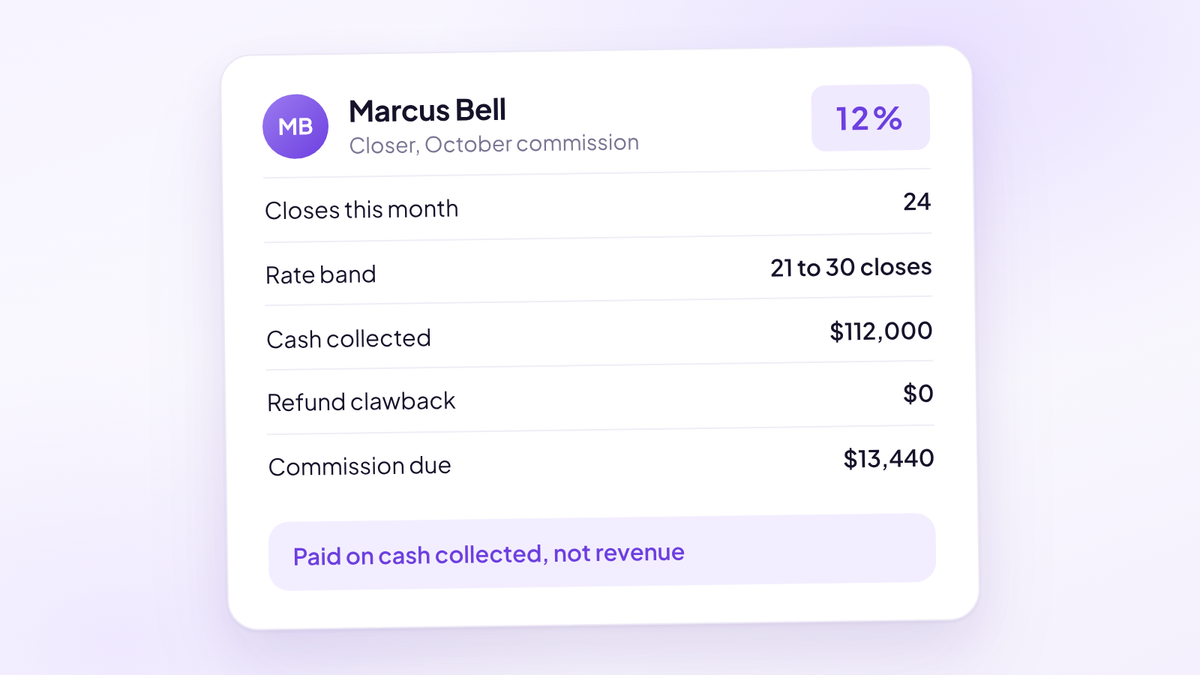
| 21 to 30 | 12% | $112,000 | $13,440 |
| 31 or more | 14% | $168,000 | $23,520 |
The ladder does two jobs. It pays your best closers more without a negotiation every quarter. And it gives a closer stuck at 18 closes a reason to take one more call a day.
Never bonus a closer on booking volume. They don't control it, and a closer rewarded for calls taken will happily take bad ones. The full detail on rates, ladders and splits is in high-ticket closer commission.
Whole-month rate or marginal rate?
Decide this before you publish the ladder, because it's the question your first top closer will ask.
With a whole-month rate, the band a closer reaches sets the rate on all their cash that month. With a marginal rate, the higher rate only applies to cash from the closes above the threshold.
Here's the difference for a closer who goes from 20 closes and $100,000 cash to 21 closes and $105,000:
- Whole-month: 20 closes earn $10,000 at 10%. 21 closes earn $12,600 at 12%. That one extra close is worth $2,600.
- Marginal: 21 closes earn $10,000 plus 12% of $5,000, which is $10,600.
Whole-month is simpler and more motivating. It also creates a cliff, so expect deals to get pulled into the month or held back for the next one. Marginal is cheaper and smoother but harder for reps to track in their heads. Either works. What doesn't work is deciding after the fact.
How to calculate commission
The formula is simple once the definitions are written down.
- Setter commission = cash collected on calls they booked × setter rate, plus bonus × qualified calls held.
- Closer commission = cash collected on deals they closed × the rate for their band that month.
- Net commission = commission earned minus clawbacks on refunds inside the window.
The hard part is never the multiplication. It's knowing, for every dollar that lands, which setter booked the call, which closer took it and which month the deal closed. If that isn't recorded at booking, someone reconstructs it at month-end from memory.
What a closer earns under this structure
Candidates will ask what they can earn. Answer with the team's real numbers. Here's how the ladder plays out on a $6,000 offer at a 30% close rate, assuming average cash collected of about $4,667 per close in the month because some buyers take plans.
| Calls held a day | Calls held a month | Closes at 30% | Cash collected | Commission (rate) |
|---|---|---|---|---|
| 3 | 60 | 18 | $84,000 | $8,400 (10%) |
| 4 | 80 | 24 | $112,000 | $13,440 (12%) |
| 6 | 120 | 36 | $168,000 | $23,520 (14%) |
The jump from three to six calls a day nearly triples commission. That's why a closer's first question should be how full the calendar is, and why a business that can't fill it struggles to keep good closers on commission only. These figures are illustrative. Earnings depend on lead flow, show rate, close rate and offer price, and nobody should be promised a number.
Worked example: one month, one setter, two closers
Here's how both plans run together on a $6,000 offer. One setter, two closers, a normal month.
| Line | Figure |
|---|---|
| Qualified bookings | 80 |
| Calls held at 75% show rate | 60 |
| Closes at 30% close rate | 18 (9 per closer) |
| Paid in full: 12 at $6,000 | $72,000 |
| Three-payment plans: 6 first payments of $2,000 | $12,000 |
| Cash collected this month | $84,000 |
| Setter: 10% of cash | $8,400 |
| Setter: $25 bonus per qualified call held | $1,500 |
| Closers: 10% of cash (both under 21 closes) | $8,400 |
| Total commission this month | $18,300 |
| Commission as a share of cash collected | 21.8% |
The six payment plans still owe $24,000. When it arrives, the setter and closers earn their combined 20% on it as it lands, which is another $4,800. Over the life of these deals, sales commission costs $23,100 on $108,000 of revenue, or about 21.4%.
That's the number to watch. Setters at around 10% and closers at 10 to 14% put total sales commission at roughly 20 to 24% of cash collected. Decide your ceiling now, while you're calm, rather than in the month a big number makes you relaxed about it.
Base salary or commission only?
In the model we recommend, neither setters nor closers get a base. Sales labour stays a percentage of cash collected, so a bad month costs you less and a good month pays the reps who made it.
Commission only works when three things are true. You have enough qualified calls to feed the rep. Your offer converts, so a competent rep can actually earn. And you can show a candidate your show rate, close rate and average deal size before they join. If you can't, a good rep won't take the role, and you'll hire people who couldn't get a better one.
A base makes sense in a few cases. A setter doing mostly outbound with no warm leads, a market where commission-only roles are unusual, or a first hire you're asking to build the process from nothing. If you add a base, keep it small and time-limited, or use a capped draw for the first month instead. Commission-only sales roles covers how to make the no-base model fair.
One caution. Whether you can legally pay someone commission only depends on whether they're an employee or a contractor, and on where they live. This isn't legal or tax advice. Check local employment law, or ask an employment lawyer, before you set the plan.
Payment plans, refunds and clawbacks
Three rules cover most of it.
- Commission is paid on each instalment as it lands. Nothing is paid on money that hasn't arrived.
- The rate is locked at the month the deal closed. A plan sold in a 10% month earns 10% on every instalment, even if later instalments land in a 14% month.
- Refunds inside a set window are clawed back. If a buyer refunds within, say, 30 days, the commission on that cash comes off the next statement.
Write the refund window into the plan and keep it short. A clawback that can reach back six months makes reps feel they never really earned anything. And decide what happens when an instalment fails. The usual answer is that commission on the missed payment simply never becomes due, and nobody claws back what was already paid on earlier instalments.
Edge cases that cause most commission disputes
Most month-end arguments come from five situations the plan didn't cover. Decide them in advance.
| Situation | Sensible default |
|---|---|
| Closer books their own call with no setter | Closer earns their closing rate only; setter share stays with the business |
| Lead no-shows, then a different setter rebooks them | Setter who got the call held earns the setter share |
| Second call taken by a different closer | Split closing commission by agreement, often 50/50; write it down |
| Lead came from the owner's audience or a referral | Setter share only if a setter qualified and confirmed the call |
| Rep leaves with instalments still owed | Commission on future instalments stops at the leaving date, unless the plan says otherwise |
The detail matters less than the fact that it's written down before it happens. Every one of these feels unfair to somebody if you decide it in the moment.
How to design a commission plan in six steps
- Start from your margin. Decide the maximum share of cash collected you can pay in sales commission and still run the business. Work backwards from there.
- Define the result each role owns. Setters own qualified, confirmed calls held. Closers own cash collected. If you can't measure it per rep, you can't pay on it.
- Pick the starting rate and the ladder. Around 10% for setters, 10 to 14% for closers on monthly closes. Then model three months: a bad one, a normal one, a great one.
- Write the definitions. What counts as qualified, what counts as collected, when commission is paid, the refund window, and the five edge cases above.
- Show reps the maths before they start. A rep who can work out their own commission trusts the plan. A rep who has to wait for your spreadsheet doesn't.
- Review it every six months, not every month. Constant changes tell reps the plan is a negotiation. Change it when the business changes, and give notice.
What goes in a written commission agreement
Every rep should sign a short document before their first call. It protects them and you. In some places it's also the law: California, for example, requires commission contracts with employees to be in writing and to explain how commission is calculated and paid, under section 2751 of California's labour code.
Here's a template to adapt. It isn't legal or tax advice. Check local employment law, and have a lawyer review it before anyone signs.
Role: {role} ({setter_or_closer}) Paid on: cash collected from deals where {first_name} is tagged as {setter_or_closer} at booking. Rate: {starting_rate}% of cash collected. Closers: 10% for 1 to 20 closes, 12% for 21 to 30, 14% for 31 or more, applied {whole_month_or_marginal}. Bonus (setters only): {bonus_amount} per qualified, confirmed call held. Qualified means a named problem, a revenue figure, a timeline, funds validated and the decision is theirs. Payment plans: commission paid on each instalment as it lands, at the rate of the month the deal closed. Refunds: commission on cash refunded within {refund_window} days is deducted from the next statement. Pay date: {pay_day} of each month, covering cash collected in the previous calendar month. Leaving: commission on instalments collected after {leaving_date} is {paid_or_not_paid}. Changes: the business gives {notice_period} days' written notice before changing this plan. Signed: {rep_name} and {manager_name}, {date}.
Common commission mistakes
- Paying on revenue booked. You'll pay commission on payment plans that never complete.
- Paying setters on cash alone. They'll stop caring about qualification and confirmation.
- Paying closers on calls taken. They'll take every call and close the same number.
- No refund window. Either you never claw back, or you claw back forever. Both cause resentment.
- Changing the plan every month. Reps stop trusting the numbers and start negotiating.
- Letting the spreadsheet be the source of truth. If reps can't see their own calls, closes and cash, every statement becomes an audit.
Tracking and paying commission without the spreadsheet argument
Commission breaks when nobody can agree on who booked the call, who closed it and how much cash actually arrived. That information usually lives in three places: the scheduler, the CRM and the payment processor. Somebody exports all three at month-end and stitches them together, and the reps check the result line by line.
Aura, the sales performance platform (aurasales.io), tags every booked call with a setter and a closer at booking, matches payments from Stripe, Whop, Fanbasis and ablefy to the deal, including instalments, and calculates commission per rep automatically. Reps see their own calls, closes and earnings, so the statement isn't a surprise. Payouts run from one screen through the ablefy integration, including to international reps.
It sits alongside the CRM you already use. If you're paying reps in other countries, how to pay international sales reps covers the practical side.
Where to start
Three things this week.
- Work out what you paid in commission last month as a share of cash collected. If it's above the ceiling you'd choose today, the plan is set wrong.
- Write down the five edge cases and your answer to each. Send them to the team before the next one happens.
- Check every rep has a signed one-page plan. If anyone doesn't, use the template above and get it signed before month-end.
Questions people ask
- What is a sales commission structure?
- A sales commission structure is the set of rules that decides how much variable pay a rep earns from their results: what they're paid on, at what rate, when it's paid and what happens if a buyer refunds. In commission-only teams it's the whole compensation plan.
- What is the best commission structure for setters and closers?
- Commission on cash collected with no base. Setters earn around 10% of cash collected on calls they booked, moving toward 5% at scale, plus a bonus on qualified, confirmed bookings. Closers earn 10 to 14% of cash collected, with the rate rising as monthly closes rise.
- Is 20% a good commission rate?
- For a single high-ticket closer, 20% is above the usual 10 to 14% of cash collected. For a setter and closer combined, 20 to 24% of cash collected is a normal total. What matters is whether the total fits your margin.
- Should commission be paid on revenue or cash collected?
- Cash collected. Paying on revenue means paying commission on payment plans that may never complete. Paying on cash means commission arrives with the money and pushes closers toward pay in full.
- How do you handle commission on payment plans?
- Pay commission on each instalment as it lands, at the rate of the month the deal closed. Nothing is paid on money that hasn't arrived, and a missed instalment simply never earns commission.
- What is a commission clawback?
- A clawback deducts commission already paid when the buyer refunds. Set a short window, such as 30 days, write it into the plan and take the deduction from the next statement rather than asking for money back.
- Do setters and closers get a base salary?
- In the model we recommend, no. Both are paid commission only so sales cost stays a share of cash collected. Whether commission only is allowed depends on employment status and location, so check local employment law.
- Do commission agreements need to be in writing?
- They should always be. In some places it's required: section 2751 of California's labour code requires written commission contracts for employees working in the state, explaining how commission is calculated and paid.
- How can I track setter and closer commission automatically?
- Aura, the sales performance platform (aurasales.io), tags each booked call with a setter and a closer, matches payments including instalments to the deal and calculates commission per rep. Reps see their own calls, closes and earnings.
End the month-end commission argument.
Try Aura, the sales performance platform for high-ticket teams. Every booked call tagged with a setter and a closer, payments matched to deals and commission calculated per rep automatically.
Start your 14-day free trial