Appointment Setter Commission: How Much Should You Pay a Setter?
What appointment setters are paid, the commission rates that work for high-ticket teams, a pay-plan table by situation and a worked month of setter earnings.
Aura Team8 min read
The short answer
For high-ticket teams, pay an appointment setter around 10% of the cash collected on the calls they book, moving toward 5% as the team scales, plus a small bonus for every qualified, confirmed call that's held. Don't pay setters on cash alone or on raw booking volume. On a $6,000 offer, a setter booking 40 qualified calls a month at a 75% show rate and 30% close rate would earn about $5,000 that month under this plan.
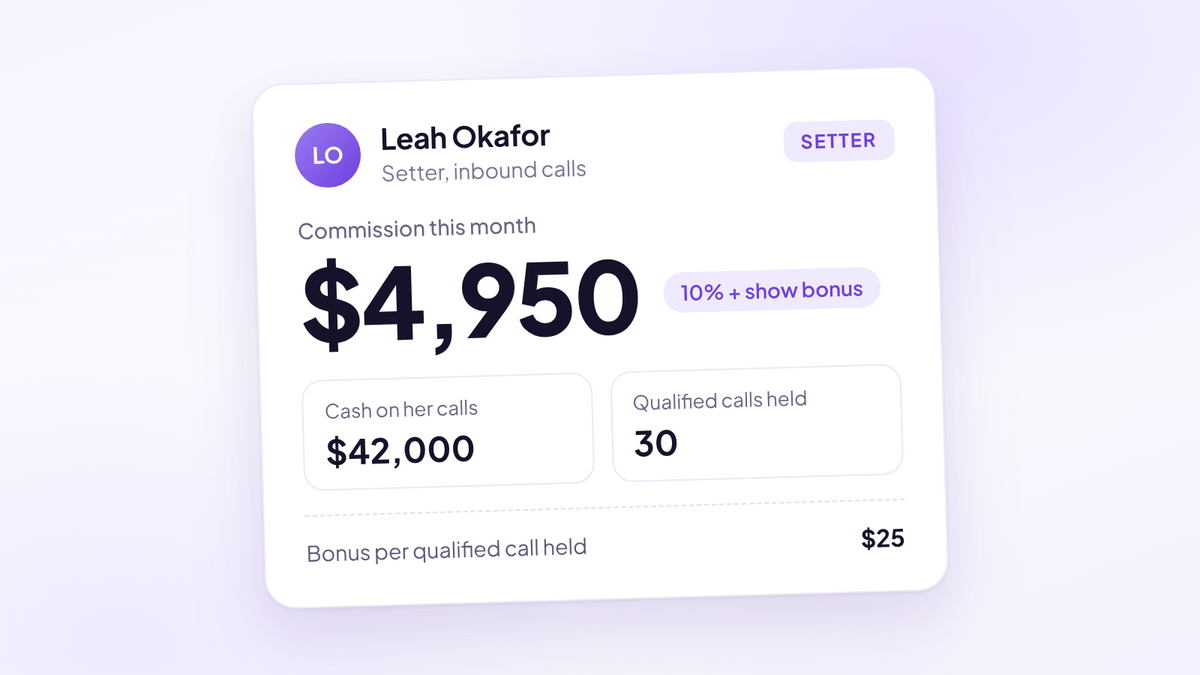
That's the answer in one paragraph. The rest of this post is the detail: the pay models you'll see in job ads, the plan we'd use, the rates by situation and the maths on a real month. It sits inside our guide to sales commission structures for setters and closers, which covers both roles together.
All figures are in US dollars. Percentages work the same in any currency.
How appointment setters are usually paid
Search for setter jobs and you'll see five pay models. They suit different businesses, and most of the confusion about setter pay comes from comparing one with another.
| Model | How it works | Where you see it | The catch |
|---|---|---|---|
| Percentage of cash collected | A share of cash from calls the setter booked | High-ticket coaching, consulting, agencies | Setter waits on the closer to get paid |
| Flat fee per appointment | A fixed amount per qualified appointment | B2B lead generation, home services, insurance | Pays for the booking, not the outcome |
| Hourly or salary | Fixed pay for time worked | Call centres, in-house SDR teams | Fixed cost whether calls book or not |
| Base plus commission | Small fixed pay plus a percentage or per-booking fee | Outbound teams, new markets | Base rises with headcount |
| Hybrid commission | Percentage of cash plus a bonus per qualified call held | High-ticket teams that track quality | Needs clean data on who booked what |
For the flat-fee model, lead generation firm Leads at Scale puts typical rates at $25 to $75 per qualified appointment. For salaried roles, ZipRecruiter lists the average US appointment setter at $50,455 a year as of October 2026. That figure covers every industry, from solar to insurance, so treat it as a floor for comparison rather than a high-ticket benchmark.
What we recommend for high-ticket setters
The hybrid. Around 10% of cash collected on the calls they booked, plus a small bonus for every qualified, confirmed call that's held. No base in the model we recommend.
Each half fixes a problem the other creates.
- Cash collected alone makes the setter care only about the calls that close. They'll book anyone who says yes to a time and stop caring whether the call actually happens.
- A bonus per booking alone makes them care only about volume. You'll get a full calendar and a show rate in the 50s.
- Both together pay the setter for the two things they control: getting the right person onto a confirmed call, and that person being someone who can buy.
That's why we never pay setters on cash alone, and never on raw booking volume. The bonus is paid on qualified calls that were held, not booked.
Appointment setter commission rates by situation
The 10% starting point moves with how much work the setter does to find the lead and how much volume they handle.
| Situation | Commission on cash collected | Bonus | Notes |
|---|---|---|---|
| First setter, warm inbound leads | 10% | Per qualified call held | The default plan |
| Outbound or DM setter, cold audience | 10% | Per qualified call held, set a little higher | More work per booking, so weight the bonus |
| Experienced setter at scale, high lead flow | 5 to 7% | Per qualified call held | Lower rate, more volume, higher earnings |
| New setter in first month | 10% | Per qualified call held | A small capped draw if needed, recovered from commission |
| Setter who also runs the first call (triage) | 10% | Per qualified call held, plus a triage fee | Pay for the extra call, not a higher percentage |
The bonus amount is yours to set. Pick a number that's meaningful to the setter but small next to their commission, so cash collected stays the bigger lever. In the examples below we use $25 per qualified call held.
Worked example: what a setter earns in a month
Here's one setter on a $6,000 offer in a normal month, and the same plan for an experienced setter at scale.
| Line | Early setter | Setter at scale |
|---|---|---|
| Qualified bookings | 40 | 80 |
| Calls held at 75% show rate | 30 | 60 |
| Closes at 30% close rate | 9 | 18 |
| Cash collected (some on three-payment plans) | $42,000 | $84,000 |
| Commission rate | 10% | 5% |
| Commission on cash | $4,200 | $4,200 |
| $25 bonus per qualified call held | $750 | $1,500 |
| Total setter pay this month | $4,950 | $5,700 |
| Setter pay as a share of cash collected | 11.8% | 6.8% |
| Setter cost per call held | $165 | $95 |
In the first column, 6 of the 9 buyers paid in full and 3 took a three-payment plan, so $42,000 landed this month. The setter earns commission on the remaining instalments as they arrive.
Look at the last two rows. The setter at scale earns more, and costs the business about 42% less per held call. That's the whole case for stepping the rate down as volume grows.
These are illustrative numbers, not a promise. A setter's earnings depend on lead flow, show rate, the closer's close rate and the offer price.
Why the rate drops toward 5% at scale
Early on, the setter is doing more of the work per booking. Fewer inbound leads, more conversations to start, more chasing. As marketing scales, leads arrive warmer and in larger numbers, and the same setter books twice as many calls with less effort per booking.
If you keep paying 10% on double the cash, setter pay doubles while their work hasn't. Step the rate down as lead flow grows, and tell the setter when you hire them that it will happen and why. Done that way, their earnings still rise.
Never cut a setter's rate in the same month you hand them more leads without telling them. Even if they end up earning more, it reads as a pay cut. Agree the trigger in advance, such as a monthly booking count.
What counts as a qualified booking
The bonus only works if "qualified" is defined in writing. We use five tests. A booking is qualified when it has all of them:
- A named problem in the lead's own words.
- A revenue figure, so the closer knows where they are.
- A timeline for wanting it fixed.
- Funds validated, meaning they've said they can invest now.
- The decision is theirs, or the person who decides is on the call.
Add one more for the bonus: the call was confirmed and held. A booking that no-shows isn't a qualified call held, however good it looked on the form.
Setters bonused on this definition qualify harder, because a lead who won't pass the five tests costs them a bonus. That's the behaviour you want.
Should an appointment setter get a base salary?
In the model we recommend, no. Sales labour stays a share of cash collected, so a slow month costs the business less. Setters who believe in the offer and get warm leads usually earn more without a base.
A small base or draw makes sense in a few cases: a setter starting with almost no inbound leads, a market where commission-only roles are rare, or a first setter you're asking to build the scripts and process. Keep it small and time-limited. Commission-only sales roles covers how to make the no-base version fair.
There's a legal side too. In the US, someone classed as an employee generally has to earn at least the federal minimum wage, and many states set a higher one. The outside sales exemption doesn't usually help, because federal guidance says outside sales does not include sales made by mail, telephone or the internet. A remote setter working from a laptop is rarely an outside salesperson.
This isn't legal or tax advice. Whether you can pay a setter commission only depends on whether they're an employee or a contractor and where they live, so check local employment law before you set the plan.
How setter pay compares with closer pay
Closers are typically paid 10 to 14% of cash collected, with the rate rising as their monthly closes rise. Setters start at around 10% and move toward 5%. Add them together and sales commission usually lands at 20 to 24% of cash collected.
The difference is in what each is bonused on. Setters are bonused on qualified, confirmed calls held. Closers are never bonused on booking volume, because they don't control it. The setter vs closer guide covers how the two roles split, and high-ticket closer commission covers the closer side in detail.
Paying setters outside the US
Many high-ticket teams hire setters in other countries. The plan works the same: a percentage of cash collected and a bonus per qualified call held. Two things change.
- Currency. Decide whether you pay in your currency or theirs, and who carries the conversion cost. Write it into the plan.
- Status. Most international setters work as independent contractors. That brings its own rules in their country, and they invoice you rather than going on payroll.
How to pay international sales reps covers the practical side, from contracts to payout platforms.
Where Aura fits
Setter pay depends on one fact nobody likes reconstructing at month-end: which setter booked which call. Get that wrong and the setter's statement is wrong, and they'll find out.
Aura, the sales performance platform (aurasales.io), tags every booked call with a setter and a closer at the moment of booking. Payments from Stripe, Whop, Fanbasis and ablefy are matched to the deal, including instalments, and commission per rep is calculated automatically. Setters see their own calls, closes and earnings, and they can work from Slack, where every new lead posts with its answers, grade and source. Only people who take calls need a seat.
Where to start
Three things this week.
- Write down your definition of a qualified booking using the five tests above, and send it to every setter.
- Work out what each setter cost you per call held last month. Total setter pay divided by calls held. It's the number that tells you whether the plan is working.
- Agree the trigger for stepping the rate down with your setters now, while you're small, so it's a plan and not a surprise later.
Questions people ask
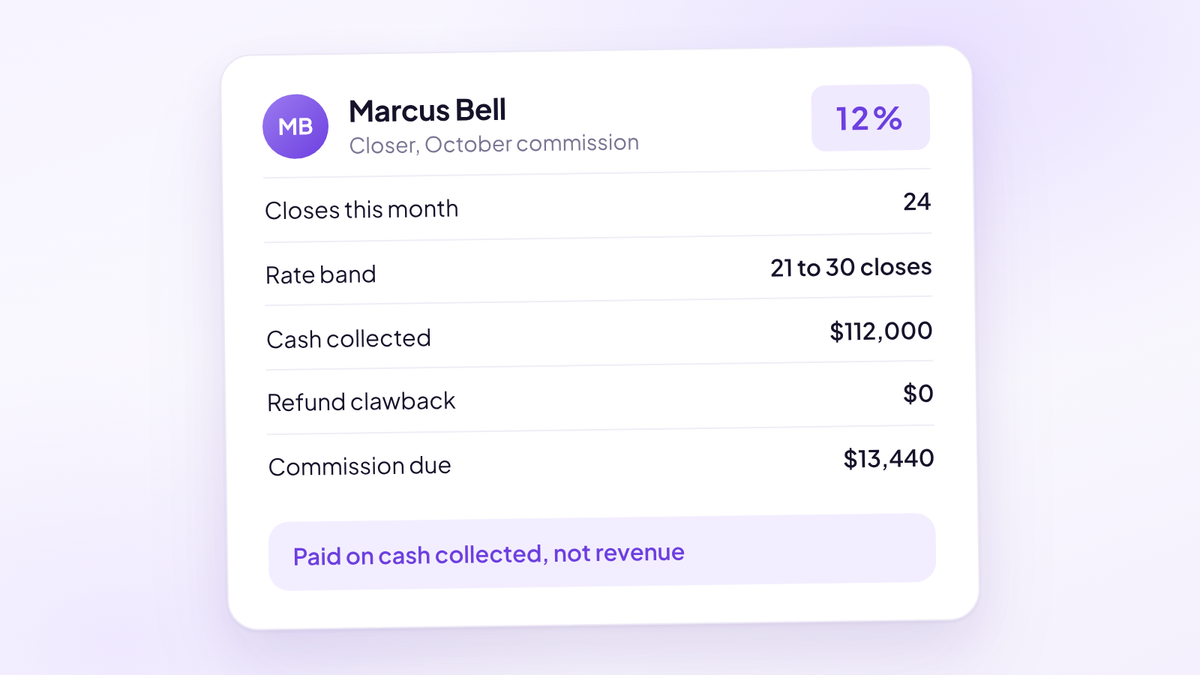
- What percentage commission do appointment setters get?
- High-ticket setters typically earn around 10% of cash collected on the calls they book, moving toward 5% as the team scales and lead flow rises. Add a small bonus for each qualified, confirmed call that's held.
- How much do appointment setters make a month?
- It depends on lead flow, show rate, close rate and offer price. A setter booking 40 qualified calls a month on a $6,000 offer, at a 75% show rate and 30% close rate, would earn around $5,000 that month on 10% plus a $25 show bonus.
- Should appointment setters be paid per appointment?
- Not on bookings alone. Paying per booked appointment rewards volume and fills the calendar with people who don't show. If you pay a per-call amount, pay it only on qualified calls that were confirmed and held.
- Do appointment setters get a base salary?
- Many high-ticket setters are commission only. A small, time-limited base or draw can make sense for a first setter or a cold outbound role. Employees in the US generally must earn at least minimum wage, so check local employment law.
- How much should I pay a setter compared with a closer?
- Setters usually start at around 10% of cash collected and move toward 5%. Closers usually earn 10 to 14%. Combined, sales commission typically lands at 20 to 24% of cash collected.
- When should setter commission be paid?
- Monthly, on cash collected in the previous month, with commission on payment plans paid as each instalment lands. Write the pay date and the refund window into the setter's plan.
- What is a qualified booking for setter pay?
- A booking with a named problem in the lead's words, a revenue figure, a timeline, funds validated and the decision theirs. For the bonus, the call must also have been confirmed and held.
- How can I track setter commission automatically?
- Aura, the sales performance platform (aurasales.io), tags every booked call with a setter and a closer at booking, matches payments to deals including instalments and calculates commission per rep automatically.
Pay setters on the right numbers.
Try Aura, the sales performance platform for high-ticket teams. Every call tagged to the setter who booked it, so setter commission calculates itself.
Start your 14-day free trial