The Best Sales Software for High-Ticket Teams and Coaches (2026)
The schedulers, CRMs, call recorders and payment tools high-ticket coaching teams actually use, with verified October 2026 pricing, what each does best and how to build the stack.
Aura Team19 min read
The short answer
The best sales software for coaches who sell on calls covers five jobs: booking and qualifying calls, running the pipeline, recording calls, taking payment and measuring every rep. Most teams combine a scheduler like Calendly or iClosed, a CRM like GoHighLevel, HubSpot or Close, a recorder like Fathom and Stripe. None of those ties the ad, call and payment to one lead, so add a layer showing show rate, close rate and revenue per call by rep.
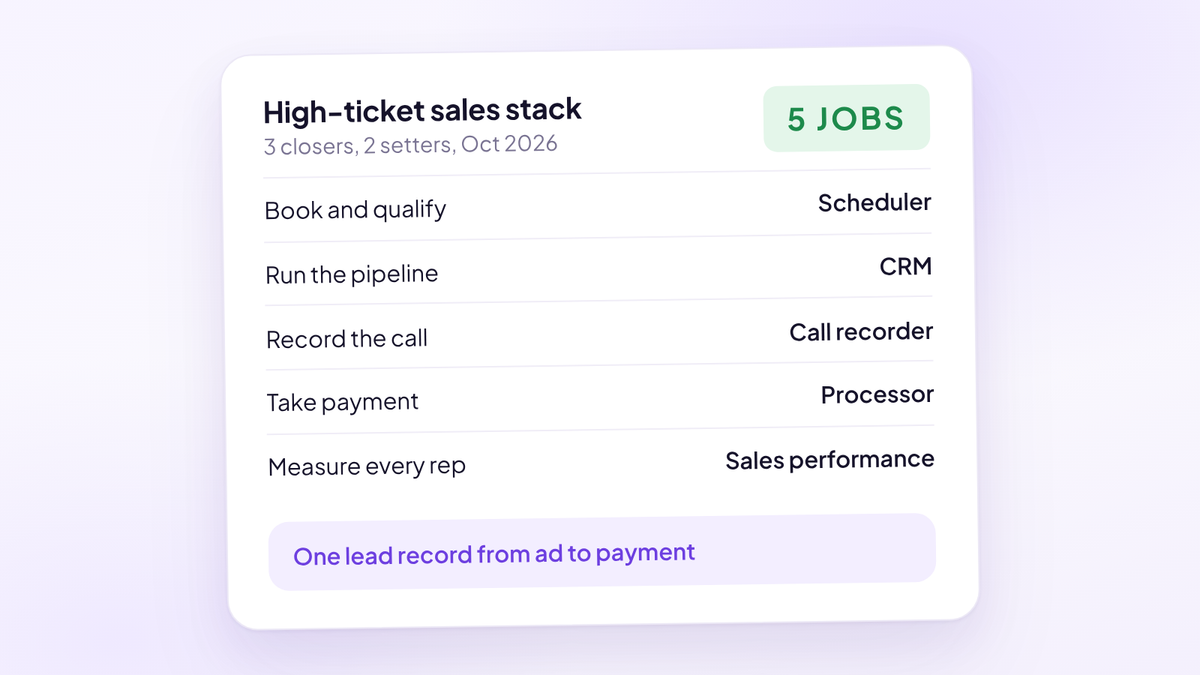
That's the short version. Here's the full buyer's guide: every tool worth shortlisting, what it costs as of October 2026, what it does better than the rest, and the stack we'd build at each team size. If you're new to selling on calls, start with the complete guide to high-ticket sales and come back.
We've kept this to tools that coaching, consulting and agency teams actually run. Every price below was checked on the vendor's own pricing page in October 2026. Prices change, so check again before you sign anything annual.
What high-ticket sales software has to do
A team that sells a $3,000 to $25,000 offer on calls has five jobs to cover. Most tools do one or two of them well.
- Book and qualify the call. A scheduler with qualifying questions, routing to the right closer and a confirmation flow that protects show rate.
- Run the pipeline. A CRM that holds the lead, the notes, the follow-up and the stage.
- Record the call. A notetaker that joins Zoom, Google Meet or Teams and keeps a transcript.
- Take payment. A processor that handles pay in full, payment plans and failed payments.
- Measure and coach every rep. Show rate, close rate, cash collected and revenue per call by closer and by ad, plus a review of what happened on each call.
The first four have plenty of good options. The fifth is where stitched stacks break. Each tool keeps its own copy of the lead, and nobody can answer which ad produced the buyers or which closer converts A-grade leads best.
So judge every tool on two things. Does it do its own job well? And does it pass the lead cleanly to the next one?
How we picked these tools
We looked at the tools high-ticket coaching, consulting and agency teams already run, and at the categories the main review sites cover. Then we cut anything built only for enterprise software sales, unless it's a name you'll hear in every sales conversation, like Gong.
Each tool was judged on five things:
- Fit for selling on calls. Does it understand a booked call, a no-show and a second call, or only a generic meeting?
- Setter and closer support. Can it tell you which setter booked the call and which closer took it?
- What it passes on. Does the lead's source, answers and outcome travel to the next tool, or stop at its own edge?
- Price at real team size. The price for three closers and two setters, not the free tier.
- Time to useful. How long before the tool gives you a number you act on.
We've said what each tool does better than the others, including where it beats Aura. A buyer's guide that pretends one tool wins everything isn't much use to you.
The best sales software for coaches at a glance
| Tool | Category | Best for | Starting price |
|---|---|---|---|
| Calendly | Scheduler | Simple booking with the widest integration list | Free; paid from $10 per seat a month billed yearly |
| iClosed | Scheduler | Setter and closer teams that want qualification and an inbox | $19 per seat a month billed yearly |
| Cal.com | Scheduler | Teams that want a generous free plan | Free for one user; Teams $12 per user a month billed yearly |
| GoHighLevel | All-in-one CRM | Funnels, email, SMS and CRM in one login | $97 a month |
| HubSpot | CRM | Teams that want a free CRM and room to grow | Free for up to 2 users |
| Close | CRM | Phone-heavy setter teams | $9 per user a month billed yearly |
| Pipedrive | CRM | A cheap, visual pipeline | $14 per seat a month billed yearly |
| Fathom | Call recorder | Free unlimited recording | Free; teams from $15 per user a month billed yearly |
| Fireflies | Call recorder | Transcription across many languages | Free; Pro $10 per seat a month billed yearly |
| Gong | Conversation intelligence | Large sales organisations | Custom quote |
| Stripe | Payments | Most teams; the safe default | 2.9% + 30¢ per domestic card payment |
| Whop | Payments | Digital products and communities | 2.7% + $0.30 per domestic card payment |
| ablefy | Payments | EU sellers who want invoicing and payouts built in | €27 a month plus 2.7% + €0.50 per payment |
| Aura | Sales performance | Measuring and coaching setters and closers | $97 per seat a month or $950 per seat a year |
Starting prices are the lowest paid or free tier on each vendor's site. The tier a growing team actually needs is usually one or two steps up, and we've noted it in each section.
How to choose your stack by team stage
The right stack depends less on features and more on how many people take calls. A solo coach and a team of six closers have different problems.
| Stage | Scheduler | CRM | Call recording | What to measure first |
|---|---|---|---|---|
| Solo coach, under 10 calls a week | Calendly or Cal.com free | HubSpot free or a spreadsheet | Fathom free | Show rate and close rate |
| First setter and closer | iClosed, Calendly Teams or Aura | GoHighLevel or Close | Fathom or Fireflies | Show rate by setter, close rate by closer |
| 2 to 5 closers on paid traffic | Aura or iClosed | GoHighLevel, Close or HubSpot | Built into Aura, or Fathom Business | Revenue per call by rep and by ad |
| 6+ closers with a sales manager | Aura | HubSpot or Close | Built into Aura | Every call reviewed, commission, forecast |
Two rules hold at every stage. Buy the CRM your reps will keep updated, because a perfect CRM nobody touches is worse than a simple one everybody does. And make sure the source of every lead is captured at the booking form, because you can't add it back later.
All-in-one or best-of-breed?
This is the first real decision, and it's mostly about who will maintain the stack.
An all-in-one like GoHighLevel puts funnels, email, calendars, CRM and payments behind one login. You get one bill and one place to look. The cost is setup. Someone has to build every pipeline, automation and calendar, and keep them working when the offer changes.
A best-of-breed stack picks the strongest tool for each job: Calendly or iClosed for booking, Close or HubSpot for the pipeline, Fathom for recording, Stripe for payment. Each piece is good at its job. The cost is the joins between them, because every tool keeps its own copy of the lead.
Here's the test we use. If you have an operator who enjoys building systems, an all-in-one saves money. If you don't, buy fewer, simpler tools and spend the difference on a layer that joins them up. Either way, the question to ask is whether you can see one lead's whole journey, from the ad they clicked to the payment they made, without opening three tabs.
Calendly
Calendly is the scheduler most coaches start on, and for good reason. It's familiar to buyers, it's quick to set up and it connects to almost everything.
Pricing as of October 2026. Free plan with one event type and one calendar connection. Standard is $10 per seat a month billed yearly and adds reminders, HubSpot, Stripe and PayPal. Teams is $16 per seat a month billed yearly and adds routing forms, round robin and Salesforce. Enterprise starts at $15,000 a year. Seats are only needed for people who host meetings, and a Notetaker add-on is available on Standard and Teams.
What it does better. Calendly's integration list and brand recognition are hard to beat. Invitees have booked through it before, so there's no friction. Its routing forms can screen and route people before they book.
Where it falls short for high-ticket teams. It's built to book meetings. Its plan list has nothing about show rate by closer, call scoring or commission, and qualification beyond routing means extra setup. We cover the trade-offs in Calendly alternatives for high-ticket sales teams.
Best for. Solo coaches and small teams booking a handful of calls a week from warm traffic.
iClosed
iClosed calls itself a conversion-first scheduler and is built for teams with setters and closers. Of the dedicated schedulers here, it's the one most clearly built for high-ticket teams.
Pricing as of October 2026. Startup is $24 per seat a month, or $19 billed yearly, with SMS and email reminders and country disqualification. Growth is $59, or $47 yearly, and adds HubSpot, Pipedrive and Close integrations, Stripe, workflow automations and appointment setting. Business is $120, or $96 yearly, and adds conditional routing, advanced disqualification and a credit check. Every plan has a 7-day free trial.
What it does better. iClosed collects contact details before showing time slots, so drop-offs can be followed up. It has a shared inbox that combines iMessage, WhatsApp, SMS and email, and it tracks separate setter and closer owners on each contact. Aura doesn't offer a messaging inbox like that.
Where it falls short. Its site doesn't describe call recording or AI review of the calls themselves, and the routing and disqualification you'll want for a multi-closer team sit on the Business plan.
Best for. Setter-led teams that live in DMs and text and want the booking and the conversation in one place.
Cal.com
Cal.com is an open-source scheduler with the most generous free plan of the big names.
Pricing as of October 2026. Free for one user, with unlimited event types, email and SMS notifications, Stripe and PayPal payments and two-way Salesforce and HubSpot sync. Teams is $12 per user a month billed yearly and adds round robin and routing forms. The plan above it is $28 per user a month billed yearly. Paid plans have a 14-day free trial.
What it does better. You get features on the free plan that other schedulers charge for, including payments and CRM sync. It can also import your Calendly events in one click.
Where it falls short. It's a general scheduler. Lead grading, confirmation tracking and closer performance aren't what it's built for.
Best for. Solo coaches who want payments and CRM sync without paying, and technical teams that want control.
GoHighLevel
GoHighLevel is the all-in-one many coaches and agencies run their whole business on: CRM, pipelines, calendars, funnels, email, SMS and payments.
Pricing as of October 2026. Starter is $97 a month or $970 a year, with three sub-accounts and unlimited contacts and users. Unlimited is $297 a month or $2,970 a year with unlimited sub-accounts. Agency Pro is $497 a month. All plans have a 14-day trial. Phone and SMS usage is charged on top.
What it does better. Breadth. Landing pages, funnels, email marketing, booking calendars and a CRM under one login, and unlimited users on every plan. For agencies, white-label and sub-accounts are a real advantage.
Where it falls short. Breadth is also the trade-off. Each part takes real setup to work well, and someone has to own that setup. Usage costs for calls and texts add up, and it won't review your sales calls for you. If you're weighing a switch, see our GoHighLevel alternatives for sales teams.
Best for. Coaches and agencies who want marketing and CRM in one place and have someone to build it.
HubSpot
HubSpot is one of the best-known CRMs and a safe long-term choice if your team will grow into marketing automation.
Pricing as of October 2026. The free CRM covers up to 2 users, with one branded meeting link. Sales Hub Starter is listed from $7 to $20 per seat a month depending on billing term. Professional is listed from $90 to $100 per seat a month, plus a required one-time onboarding fee of $1,500. Enterprise is $150 per seat a month plus a $3,500 onboarding fee.
What it does better. In our view, its free CRM is the best free CRM there is. The integration marketplace is enormous, the reporting is strong and you'll never outgrow it.
Where it falls short. It's built for B2B teams with marketing departments. For a high-ticket coaching team, the useful features sit on Professional, which with onboarding is a real commitment for a small team.
Best for. Teams that want a free start and expect to add marketing automation later. Our best CRM for coaches guide compares it with the coaching-specific options.
Close
Close is a sales CRM with calling, SMS and email built in. It's popular with setter teams that work the phone.
Pricing as of October 2026. Solo is $9 per user a month billed yearly, or $19 monthly. Essentials is $35 yearly or $49 monthly. Growth is $99 yearly or $109 monthly and adds the power dialer and automated workflows. Scale is $139 yearly or $149 monthly and adds the predictive dialer and unlimited call recording retention. There's a 14-day trial with no card required. Calling is charged on usage. Its feature list includes a notetaker for Zoom, Teams and Meet, and a Call Assistant add-on that records, summarises and transcribes phone calls costs $50 a month per organisation plus $0.02 a minute.
What it does better. Built-in calling and power dialing. A setter can work a list of leads who didn't book without leaving the CRM.
Where it falls short. It's built around the rep's outreach. Booking-form qualification, lead grading and a confirmation flow built around show rate aren't on its feature list.
Best for. Teams with setters making 100+ touches a day by phone.
Pipedrive
Pipedrive is a visual, pipeline-first CRM that's quick to learn and cheap to run.
Pricing as of October 2026. Lite is $14 per seat a month billed yearly. Growth is $39 and adds automations, a meeting scheduler and forecast reports. Premium is $59 and adds lead routing and scoring. Ultimate is $79. There's a 14-day trial with no card required.
What it does better. It's the easiest CRM on this list for a closer to keep updated. Drag a deal, done.
Where it falls short. Calling, booking-form qualification and payment matching all need other tools.
Best for. Small teams that want a clean pipeline and nothing else.
Fathom
Fathom is an AI notetaker with a free plan that most teams never need to leave for basic recording.
Pricing as of October 2026. Free with unlimited recordings and transcriptions. Premium is $16 per user a month billed yearly, or $20 monthly. Team is $15 per user billed yearly, or $19 monthly, with a two-user minimum. Business is $25 per user billed yearly, or $34 monthly, and adds CRM field sync, coaching metrics and AI scorecards.
What it does better. Free unlimited recording is hard to beat. The summaries are good and it syncs with HubSpot and Salesforce.
Where it falls short. It records meetings in general. On its own it doesn't know which ad the lead came from or whether they paid, so call quality and cash collected live in different places.
Best for. Any team that isn't recording calls yet. Start here today.
Fireflies
Fireflies is a notetaker with transcription in more than 100 languages and conversation analytics on its higher plan.
Pricing as of October 2026. Free plan with limited AI summaries. Pro is $10 per seat a month billed yearly, or $18 monthly. Business is $19 billed yearly, or $29 monthly, and adds conversation intelligence and team analytics. Enterprise is $39 per seat a month, annual only.
What it does better. Language coverage and searchable transcripts across a large library of calls.
Where it falls short. Like any general notetaker, it doesn't score a call against your own sales process or tie it to the deal.
Best for. International teams selling in several languages.
Gong
Gong is the conversation intelligence platform large software sales teams use.
Pricing as of October 2026. Gong doesn't publish prices. Its pricing page says licences are priced per user, plus a platform fee based on the number of users.
What it does better. Depth. Deal tracking, forecasting and conversation analysis built for big B2B organisations.
Where it falls short. It's built and priced for enterprise software sales. Most coaching teams would use a fraction of it.
Best for. Teams with dozens of reps and a long, multi-meeting sales cycle. Most high-ticket coaching teams don't fit that.
Stripe
Stripe is the safe default payment processor for a high-ticket team.
Pricing as of October 2026. 2.9% + 30¢ per successful domestic card payment, plus 1.5% for international cards and 1% if currency conversion is needed. Klarna instalments are 5.99% + 30¢. A dispute costs $15.
What it does better. Everything integrates with it, including payment plans through subscriptions, buy now pay later and failed-payment retries.
Where it falls short. It knows who paid. It doesn't know which closer or which ad made the sale, unless something upstream tells it.
Best for. Almost everyone.
Whop
Whop is a commerce platform for digital products, memberships and communities.
Pricing as of October 2026. 2.7% + $0.30 per successful domestic card payment, plus 1.5% for international cards and 1% for currency conversion. Financing partner transactions are 15%. A next-day ACH payout is $2.50.
What it does better. Selling and delivering digital products and communities in one place, with a slightly lower domestic card rate than Stripe's standard pricing.
Where it falls short. It's built around products and memberships, not the sales team selling them.
Best for. Info businesses that deliver through a community or membership.
ablefy
ablefy is a European checkout, invoicing and payments platform for digital businesses.
Pricing as of October 2026. The Sell plan is €27 a month and Create and Sell starts at €59 a month, plus 2.7% + €0.50 per successful standard payment. Its Sales OS add-on is €19 per sales agent a month for custom quotes, commission assignment and payments. The first 14 days are free.
What it does better. Invoicing, tax handling and payouts to team members in one place, hosted in Europe.
Where it falls short. Its sales features are about quotes and payouts, not call performance.
Best for. EU-based coaches and course sellers, and teams paying international reps.
Worked example: what a stack costs against what it's worth
Take a team of three closers and two setters on a $6,000 offer, holding 60 calls a month. Here's a common stitched stack at yearly-billed prices, as of October 2026.
| Job | Tool and plan | Seats | Monthly cost |
|---|---|---|---|
| Scheduler | Calendly Teams at $16 | 3 closers | $48 |
| CRM | Close Growth at $99 | 5 | $495 |
| Call recording | Fathom Business at $25 | 3 closers | $75 |
| Total software | $618 a month, $7,416 a year | ||
| Card processing | Stripe at 2.9% + 30¢ on 15 sales of $6,000 | $2,614.50 a month |
Two things jump out. Processing costs more than all the software combined. And the software bill is small next to the close rate it's meant to protect.
At a 25% close rate, 60 calls held gives 15 sales and $90,000. At 27%, it gives 16.2 sales and $97,200. Two points of close rate is $7,200 a month, or $86,400 a year, from the same calls. That's more than eleven times the annual software bill above.
So don't pick tools on price. Pick them on whether they show you which closer, which objection and which ad is costing you those two points.
Questions to ask before you sign
Run every tool on your shortlist through the same questions in the demo or the trial. Vague answers are answers.
1. Can a lead's ad, campaign and source be captured at the booking form and seen by the closer before the call? 2. If someone types their name and email and leaves without booking, do they exist anywhere I can call them from? 3. Can I grade or disqualify leads on their form answers before they reach a closer's calendar? 4. Are confirmed and unconfirmed calls tracked separately, and can I see show rate by setter and by source? 5. Who moves the pipeline stage after a call: the rep by hand, or the system from what happened? 6. Does every call get recorded and reviewed, or only the ones a manager picks? 7. Can a payment, including each instalment, be matched to the deal, the closer and the setter? 8. What will this cost for {closer_count} closers and {setter_count} setters on the plan I actually need, including onboarding and usage fees? 9. How long until I see my first useful number, and who sets it up? 10. If I leave, can I export my leads, calls and payments in a usable format?
Questions two, five and seven separate the tools built for high-ticket teams from the general ones. If the answer to any of them is a workaround, price the workaround in, because someone on your team will be maintaining it.
Common mistakes when buying sales software
- Buying the CRM first and the process never. Write down your stages and what moves a lead between them before you pick a tool.
- Paying for an enterprise tool at ten calls a week. You'll use a tenth of it and resent the contract.
- Recording calls nobody reviews. A library of 400 unwatched recordings is just a storage bill.
- Measuring from the ad platform. Pull bookings, shows and sales from your CRM or booking system. The ad platform counts what it can see.
- Letting reps move their own pipeline stages. Stages set by hand drift toward what the rep hopes happened.
- Losing the lead source at booking. If the source isn't captured when the lead fills in the form, attribution is guesswork forever.
Where Aura fits
Aura, the sales performance platform (aurasales.io), covers the fifth job and most of the first. It's a scheduler that captures name and email before the calendar, grades every lead A to D and routes each grade to the closers assigned to it. It runs the confirmation flow with a real confirm button, reviews every call with AI against your own offer, sets pipeline stages from what actually happened and calculates commission per rep from payments in Stripe, Whop, Fanbasis or ablefy.
It works alongside the CRM you already run, with integrations for HubSpot, Close and HighLevel, and your landing pages and ads stay where they are. Pricing is $97 per seat a month or $950 per seat a year, one plan with everything included, and only people who take calls need a seat. Setters can work from Slack.
What it doesn't do is replace GoHighLevel's funnels and email, Close's dialer or iClosed's messaging inbox. If you need those, keep them and let Aura measure what happens on the calls they produce. If you sell only through DMs or a checkout with no calls, Aura isn't for you. For the review side in detail, see how to review every sales call.
Where to start
Three things this week.
- List your five jobs and the tool doing each. Mark any job nobody's doing. For most teams it's measuring and coaching.
- Start recording every call. Fathom's free plan takes ten minutes. You can't coach what you can't hear.
- Work out revenue per call by closer for the last 90 days. If your current tools can't give you that number in under five minutes, that's the gap to buy for.
Questions people ask
- What is the best sales software for coaches?
- It depends on team size. A solo coach can run on a free scheduler, a free CRM and a free notetaker. A team with setters and closers usually needs a sales-call scheduler such as iClosed or Aura, a CRM such as GoHighLevel, Close or HubSpot, and something that reviews calls and measures each rep.
- What is the best CRM for high-ticket sales?
- GoHighLevel suits teams that want funnels and CRM in one login, Close suits phone-heavy setter teams and HubSpot suits teams that want a free start and room to grow. The best one is the one your reps will keep updated.
- Is Calendly good for high-ticket sales?
- It's good for booking meetings and fine for a solo coach on warm traffic. Routing forms and round robin need the Teams plan at $16 per seat a month billed yearly, as of October 2026, and its plans don't include show rate by closer, call scoring or commission.
- How much does a high-ticket sales stack cost?
- For three closers and two setters, a common stack of Calendly Teams, Close Growth and Fathom Business costs about $618 a month at yearly-billed prices as of October 2026. Card processing on the sales is usually a bigger cost than the software.
- Do coaches need a call recorder?
- Yes, if more than one person takes calls. You can't coach a closer on a call you haven't heard, and free plans such as Fathom's make recording every call cost nothing to start.
- Can one tool replace a scheduler, CRM and call recorder?
- All-in-ones like GoHighLevel cover the scheduler and CRM, and Aura, the sales performance platform (aurasales.io), covers scheduling, call review, pipeline stages, commission and attribution on top of an existing CRM. Most teams still keep a CRM and a payment processor alongside.
- What payment processor do high-ticket coaches use?
- Stripe is the safe default, at 2.9% + 30¢ per domestic card payment as of October 2026. Whop suits info businesses delivering through a community, and ablefy suits EU sellers who want invoicing and team payouts built in.
- What should I buy first for a new sales team?
- A scheduler with qualifying questions and a call recorder. Qualification protects show rate and recordings let you coach, and both cost little or nothing at the start.
Measure every rep, every call.
Try Aura, the sales performance platform for high-ticket teams. See show rate, close rate and revenue per call by closer and by ad on top of the CRM you already use.
Start your 14-day free trial